
Solar Control Window Film in Vancouver: The Complete Guide for Homes & Businesses (2026)
Solar control window film is a multi-layer polyester film bonded to the interior glass surface that blocks 40, 80% of solar heat entering through windows while maintaining natural light and outward views. In Metro Vancouver’s climate, where summer sun loads can push west-facing office and residential floors 8, 12°C above ambient temperature, solar control film is the most cost-effective retrofit available before HVAC upgrades.
If you’ve spent a July afternoon in a glass-heavy condo in Olympic Village or a Burrard Corridor office tower, you already understand the problem. The sun pours through floor-to-ceiling glazing, your air conditioning struggles to keep pace, and the afternoon hours become genuinely uncomfortable, sometimes unbearable. Solar control window film changes that equation without blocking your view or requiring a building permit.
This guide covers everything you need to know about solar control window film for Metro Vancouver homes and businesses: how it works, which film grades make sense for BC’s specific climate, realistic installed costs in 2026, and what to expect from the installation process. We also cover the rules that matter in BC, strata bylaws, the BC Energy Step Code, and IGU thermal stress requirements that affect which films can go on double and triple-pane windows.
What Is Solar Control Window Film?
Solar control window film is a thin, optically clear or lightly tinted polyester film applied to the interior surface of existing glass. The film uses one or more of three mechanisms to reduce solar heat gain: metallic or ceramic particles that reflect solar radiation before it enters the glass, dyes that absorb solar energy within the film itself, and nano-ceramic or multi-layer sputtered coatings that selectively block near-infrared wavelengths while allowing visible light through.
The key concept is spectral selectivity. The solar spectrum includes ultraviolet light (UV, roughly 5% of solar energy), visible light (about 44%), and near-infrared radiation (NIR, about 51%). The heat you feel through a window is almost entirely NIR. Spectrally selective solar films are engineered to block NIR while transmitting visible light, which is why a high-quality ceramic solar film can reject 70, 80% of solar heat while still looking nearly clear from inside and outside.
This is the critical difference between solar control film and standard window tinting. Standard tint reduces visible light across the board, it makes your window darker, which reduces glare and some heat, but it does so bluntly. Solar control film targets the infrared portion of the spectrum specifically, so you get heat rejection without the same degree of darkening. For office environments where screen visibility matters, or for residential spaces where occupants want to preserve natural light and views, this distinction is significant.
The key performance metrics for solar control film are:
- Solar Heat Gain Coefficient (SHGC): The fraction of solar heat that passes through the glazing system. Lower is better for heat rejection. An uncoated double-pane window typically has an SHGC of 0.55, 0.70. A high-performance solar film can bring that down to 0.20, 0.30.
- Visible Light Transmission (VLT): The percentage of visible light that passes through. Higher means a clearer, brighter view. Premium ceramic solar films achieve VLT of 50, 60% while still rejecting 70, 80% of solar heat.
- UV Rejection: Nearly all quality solar control films block 99% of UV radiation, protecting furnishings, flooring, and artwork from fading.
- Total Solar Energy Rejected (TSER): A combined metric that captures visible, IR, and UV rejection. Premium solar films achieve TSER of 60, 80%.
Ecovision installs LLumar and Vista solar film lines across Metro Vancouver. LLumar’s AIR series represents the current benchmark in spectrally selective ceramic solar film, it achieves high heat rejection at relatively high VLT, making it the right choice for residential spaces and commercial offices where occupants want maximum comfort without a dramatic change in how windows look. Vista’s V-Series and S-Series provide strong performance at competitive price points, with excellent warranties backed by Eastman Chemical.
Vancouver’s Climate and Why Solar Film Matters Here
Metro Vancouver is often mischaracterized as a mild, grey, rainy climate where overheating isn’t a real concern. That framing hasn’t been accurate for years, and it’s becoming less accurate every summer. Environment Canada’s data shows Metro Vancouver now averages 28 or more days above 25°C between May and September, with west-facing and south-facing exposures regularly experiencing radiant heat loads that make interior temperatures feel 8, 12°C higher than ambient air temperature, even when the air conditioner is running.
The problem is concentrated in specific building types. Glass-heavy residential towers along the Burrard Corridor, the string of high-rises from False Creek to Coal Harbour, and in newer developments in Olympic Village, East Fraser Lands, and the Broadway Plan corridor face intense solar exposure on their south and west facades. A 25th-floor suite with floor-to-ceiling glazing facing southwest can receive direct sun from roughly 1:00 PM until sunset from June through August. Standard double-pane windows do almost nothing to stop that heat load.
The same dynamic applies in Surrey City Centre, Burnaby’s Metrotown and Brentwood corridors, and the newer high-density developments in Coquitlam and Port Moody. These are buildings designed to maximize views and natural light, design goals that are entirely compatible with solar control film, which addresses the thermal problem without sacrificing transparency.
The BC Energy Step Code adds a regulatory layer to the conversation. For new construction and major renovations, the Step Code sets performance targets that include solar heat gain requirements for glazing. Solar control film isn’t typically used in new construction (the glazing is specified to meet code at the factory), but it plays a meaningful role in retrofitting older buildings, pre-2016 construction that predates the Step Code, or buildings where the original glazing specification was made before the current understanding of Vancouver’s summer heat loads.
There’s also a winter comfort angle that’s often overlooked. Some grades of solar control film have low-emissivity properties, they reduce the amount of radiant heat that escapes through glass on cold nights. In Vancouver’s maritime climate, where winter temperatures hover between 0, 8°C rather than the deep cold of Alberta or the interior, this radiant heat retention effect is genuinely meaningful. A well-chosen solar film can function as a four-season comfort upgrade, not just a summer solution.
Types of Solar Control Window Film Available in BC
Solar control films come in several categories, each with different performance trade-offs. Here’s a practical comparison of the main types available through Ecovision in BC, with installed price ranges for 2026:
| Film Type | SHGC | VLT | UV Block | Best For | Installed Cost (BC, CAD) |
|---|---|---|---|---|---|
| Reflective Solar | 0.22, 0.30 | 20, 35% | 99% | Max heat rejection, south/west exposures | $9, $12/sq ft |
| Ceramic Solar | 0.20, 0.28 | 40, 60% | 99% | Clear view + heat rejection, high-end residential/commercial | $12, $18/sq ft |
| Neutral/Subtle Tint | 0.28, 0.40 | 55, 70% | 99% | Low visibility change, heritage buildings, strata bylaws | $10, $15/sq ft |
| Dual-Reflective | 0.22, 0.30 | 30, 45% | 99% | Daytime privacy + heat rejection | $11, $16/sq ft |
Reflective solar film is the traditional workhorse of commercial solar control. It uses a metallic sputtered coating to reflect solar radiation before it enters the glass. The trade-off is appearance: reflective film gives windows a mirrored look from the outside, which some strata bylaws restrict and which not all building managers or homeowners prefer. On the positive side, reflective film delivers the maximum heat rejection at the lowest cost.
Ceramic solar film is the premium category and the one that’s grown significantly in market share over the past decade. Ceramic films use nano-ceramic particles rather than metal to block infrared radiation. The result is a film that looks nearly clear from inside and outside, achieves excellent SHGC performance (0.20, 0.28), and maintains 40, 60% visible light transmission. For residential condos in Metro Vancouver where strata bylaws may restrict exterior appearance changes, and for commercial offices where views are a premium asset, ceramic solar film is typically the right answer. LLumar’s AIR series and Vista’s ceramic-grade films sit in this category.
Neutral and subtle tint films offer a middle path, some heat rejection combined with minimal change to exterior appearance. These are well-suited to heritage buildings, strata complexes with strict exterior uniformity rules, or residential applications where the homeowner simply doesn’t want any perceptible change to how the windows look. The heat rejection performance is lower than reflective or ceramic film, but significant UV and some IR blocking still occurs.
Dual-reflective film is engineered to appear less reflective from the inside than from the outside, you see a relatively clear view outward, while the exterior presents a reflective surface to the sun. This category combines meaningful daytime privacy with strong solar heat rejection, making it popular for west-facing offices in Vancouver where afternoon sun and occupant visibility from adjacent buildings are both concerns.
Benefits of Solar Control Window Film in Metro Vancouver
The case for solar control window film in Metro Vancouver homes and offices rests on several well-documented benefits:
Heat reduction. Depending on the film grade and the window’s existing performance, solar control film blocks 40, 80% of the solar heat that would otherwise enter through the glass. In practical terms, this means a west-facing floor that was reaching 30°C on a July afternoon may stabilize at 24, 26°C with film installed, a meaningful comfort difference without any change to the HVAC system.
UV protection. All quality solar control films block 99% of UV-A and UV-B radiation. UV exposure is the primary driver of fading and degradation in wood flooring, upholstery, artwork, and retail merchandise. In a sun-drenched south-facing condo or a gallery-style retail space, this UV protection extends the life of interior finishes significantly.
Glare reduction. For screen-based work environments, which describes almost every office in Vancouver, glare from west-facing windows during afternoon hours is a productivity and comfort issue as significant as temperature. Solar control film reduces visible light transmission to the level where glare is manageable without requiring blinds or shutters that block views entirely. A film reducing VLT from a typical 70, 80% (standard double pane) to 40, 50% typically reduces glare to acceptable levels for monitor work.
Energy savings. Glass-heavy commercial floors in Metro Vancouver can achieve 10, 30% cooling load reduction after solar film installation, depending on glazing ratio, orientation, and film grade. For BC Hydro commercial customers paying time-of-use rates, peak-hour demand reduction translates directly to lower electricity bills. In residential condos, the savings are more modest but consistent: reduced demand on portable air conditioners or mini-splits during summer months.
No building permit required. Interior-applied window film does not require a building permit in BC. This is a significant practical advantage over other energy retrofit measures, no permit process, no engineering sign-offs for the installation itself, and no notification required to the municipality. Strata approval may be required if the film changes the building’s exterior appearance, but that’s a strata governance matter, not a regulatory one.
How Much Does Solar Control Window Film Cost in BC?
Installed costs for solar control window film in Metro Vancouver in 2026 range from $9 to $22 per square foot CAD, depending on the film grade, building access, and glass configuration. Here’s a practical breakdown:
Residential projects typically run $9, $18 per square foot installed for LLumar or Vista certified film. For a three-bedroom home or condo with approximately 200 square feet of south and west-facing glazing, expect a total installed cost of $1,800, $3,600. The lower end of that range represents reflective or neutral tint film; the upper end represents premium ceramic solar film like LLumar AIR series.
Commercial projects run $9, $22 per square foot installed. A single office floor with 500 square feet of glazing would cost $4,500, $9,000 for solar film installation. Multi-floor commercial projects often benefit from volume pricing, and high-rise access (scissor lifts, swing stages) adds cost that should be factored into the budget. Projects in buildings with difficult interior access, furniture-dense offices, occupied healthcare facilities, also carry higher installation costs.
Payback period. For commercial properties, the payback period on solar film investment typically falls in the 3, 7 year range when BC Hydro electricity savings are calculated against the installed cost. The payback calculation depends heavily on how much cooling the building does, the current SHGC of the existing glazing, and the building’s operating hours. Ecovision provides energy savings estimates as part of our commercial project proposals.
Free on-site estimates are available across the Lower Mainland, contact Ecovision at (236) 862-0052 or through our contact page.
The Installation Process for Solar Film in Vancouver
The solar film installation process has four distinct stages, and understanding them helps set accurate expectations for timeline and outcome.
Assessment. Before any film is ordered or installed, Ecovision conducts an on-site assessment that includes measuring all glass, identifying the window unit type (single pane, IGU double-pane, IGU triple-pane), checking for existing low-e coatings, and, for IGU projects, completing a thermal stress calculation. Thermal stress is the key variable in IGU installations: the film absorbs heat in the glass unit, and the absorbed heat must be within the thermal tolerance of the IGU to avoid stress fractures. Not all films are compatible with all IGU configurations, and an experienced installer will calculate this before committing to a film specification.
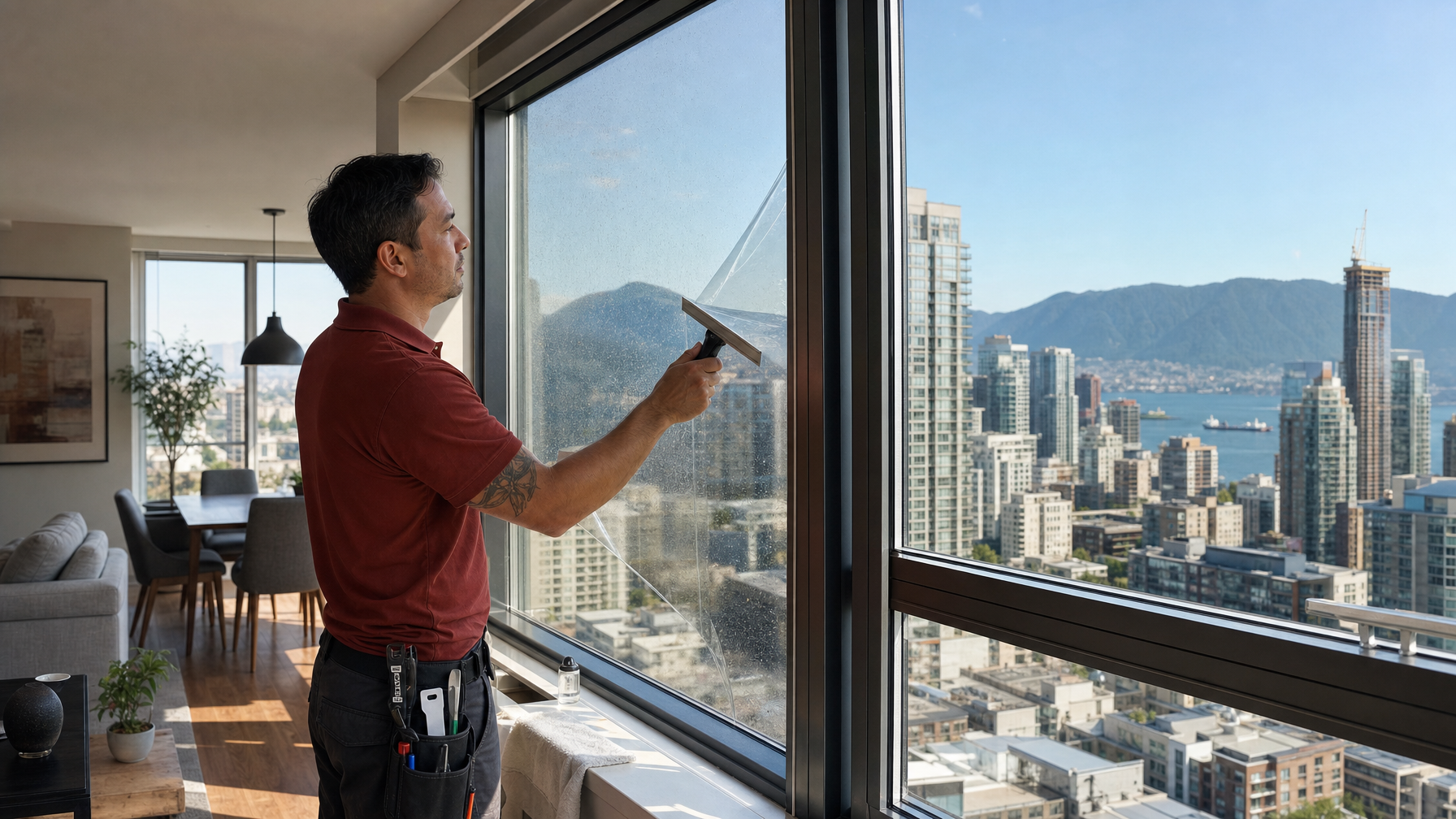
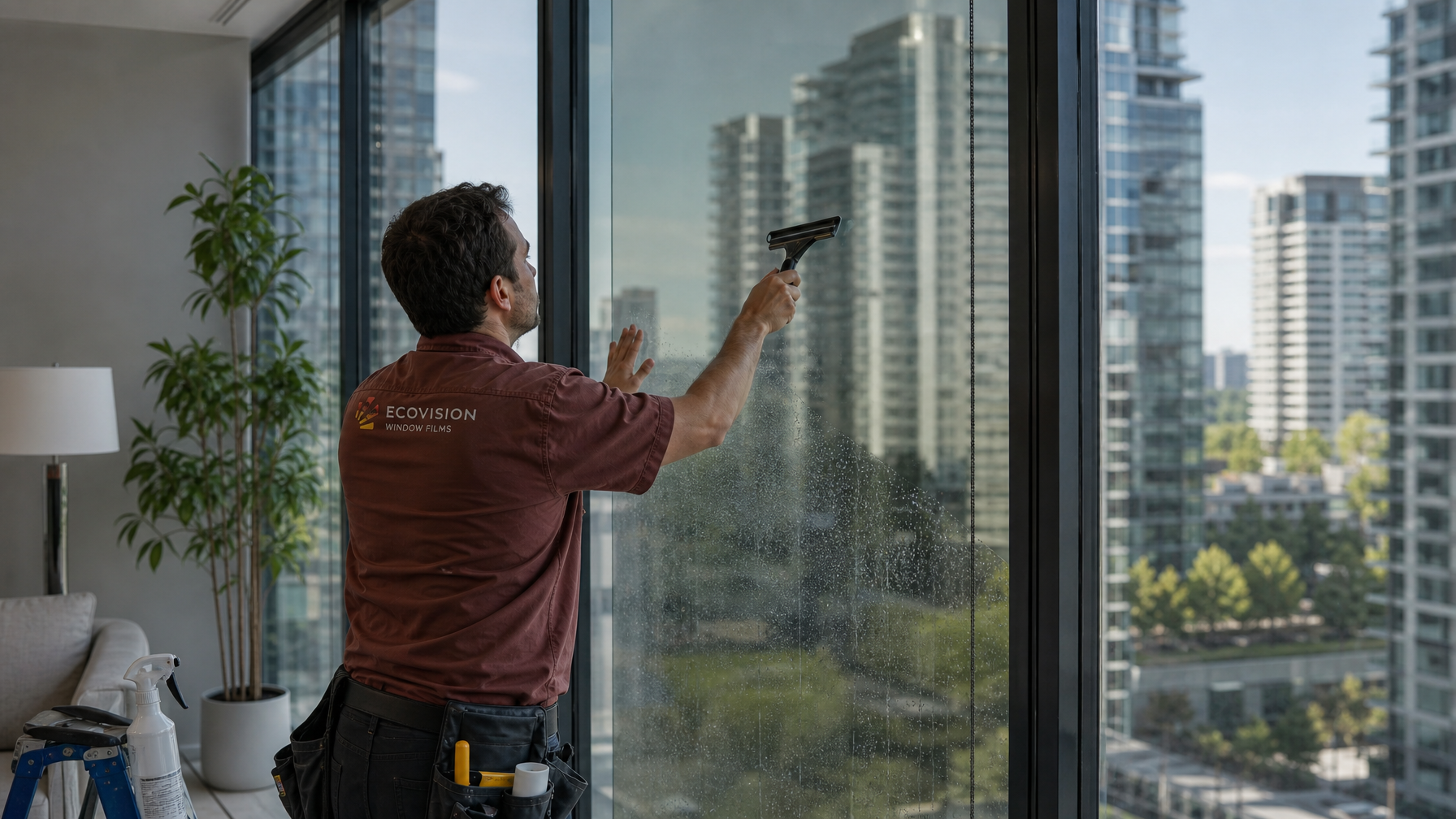
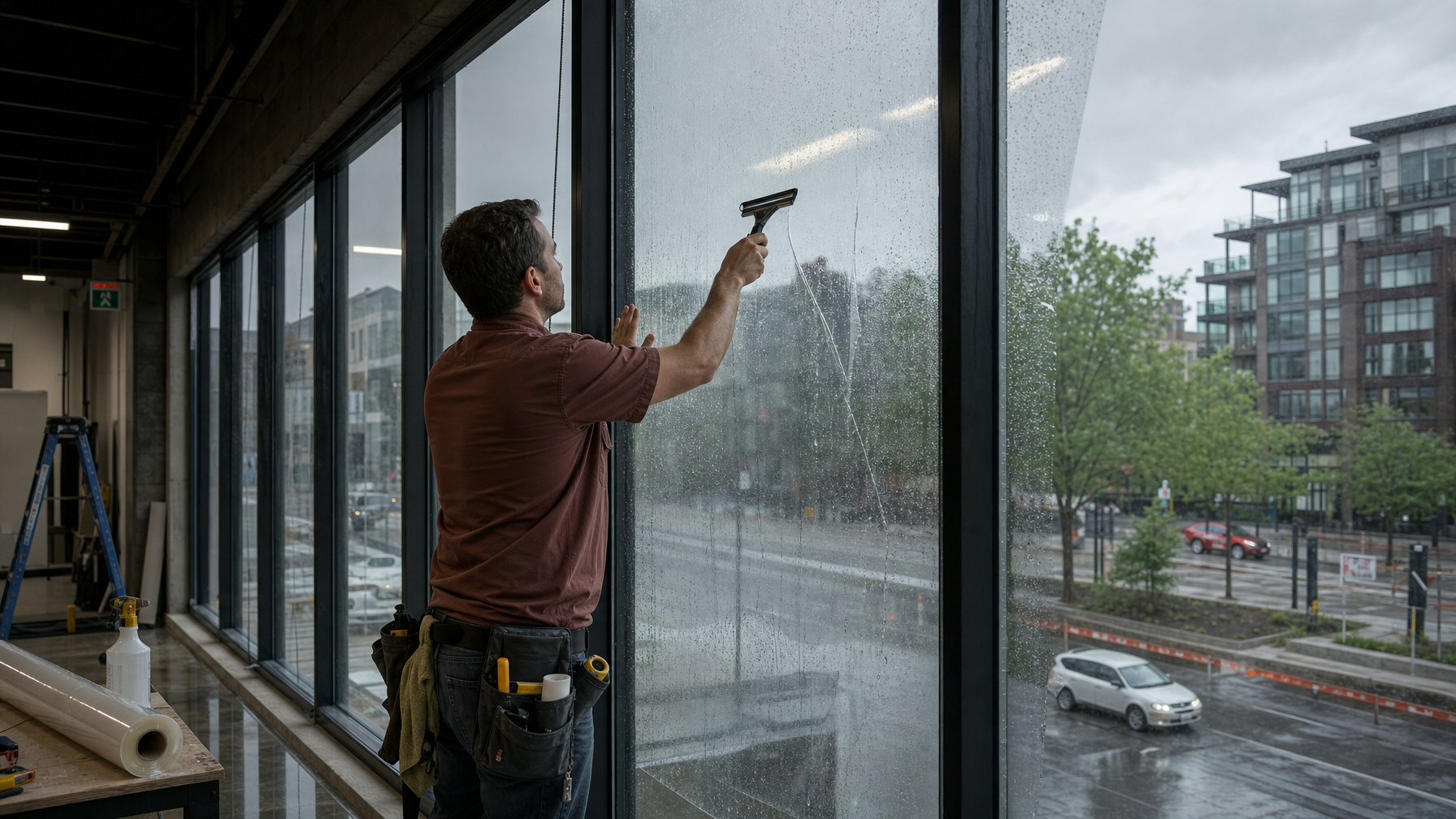
Installation timeline. Most residential projects, a condo suite or single-family home, are completed in one day. Multi-floor commercial projects typically take 2, 5 days depending on total glass area and site logistics. The installation itself is clean and relatively low-disruption: installers use a spray solution to apply the film, squeegee out air and excess moisture, and trim edges precisely. Furniture near windows may need to be moved temporarily.
Curing period. Solar film requires approximately 30 days to fully cure after installation. During the curing period, it is completely normal to see minor haze, small water droplets visible through the glass, or slight dimpling. These are not defects, they are the adhesive and retained moisture working their way out of the film. They disappear on their own as the film cures. Attempting to push out water bubbles or wipe the film aggressively during the curing period can damage the adhesive.
Ongoing care. After the 30-day curing period, solar film can be cleaned normally, with the specific exception that ammonia-based cleaners (many common glass cleaners) should be avoided, as ammonia degrades film adhesive over time. A simple solution of water and mild dish soap, or a dedicated film-safe glass cleaner, is all that’s needed.
Solar Film for Homes vs Commercial Buildings in BC
The solar film decision looks somewhat different for residential and commercial clients, and it’s worth addressing both audiences directly.
For residential clients in Metro Vancouver, the most common scenario is a strata condo on a south or west-facing exposure in Surrey, Burnaby, New Westminster, or Vancouver. The priority is typically comfort on hot summer afternoons, with secondary concerns about UV protection for furnishings and flooring. Ceramic solar film, which changes the exterior appearance minimally, is typically the appropriate choice for strata buildings where the bylaws require exterior uniformity. Before any film installation that changes the exterior appearance of a strata unit, written strata approval is required. Ecovision’s proposal process includes documentation support for strata approval applications.
For detached homes in Vancouver, North Vancouver, West Vancouver, Burnaby, Richmond, and across the Lower Mainland, strata rules don’t apply, and film selection can focus purely on performance and aesthetics. South-facing and west-facing exposures are the highest priority; north-facing glass rarely needs solar control film in BC’s climate.
For commercial clients, solar control film intersects with several BC-specific regulatory and incentive frameworks. The BC Energy Step Code sets energy performance targets for commercial buildings that include glazing performance requirements, solar film retrofits can help existing buildings meet or approach Step Code performance levels without replacing windows. BC Hydro’s commercial energy efficiency programs have historically included window treatments as eligible measures for rebates. WorkSafeBC thermal comfort guidelines provide employers with a rationale to address chronic overheating in glazed offices as a workplace health matter.
For healthcare facilities, government buildings, and educational institutions pursuing LEED or BREEAM certification, solar film installations can contribute to the energy and atmosphere credit categories. Ecovision can provide project documentation suitable for LEED submission on request.
Which Buildings Benefit Most from Solar Control Film in Metro Vancouver?
While solar control window film can improve comfort in almost any glazed building, the highest-impact applications in Metro Vancouver share a few characteristics: large glass area, south or west orientation, limited shading from adjacent structures, and buildings that pre-date the BC Energy Step Code’s more demanding glazing requirements.
The buildings that see the most dramatic before-and-after results include:
- Strata condos on south/west exposures in Surrey City Centre, Brentwood, Metrotown, Olympic Village, and the Broadway Plan corridor, especially towers built between 1990 and 2016 with large-format double-pane glazing
- Commercial offices in the Burrard Corridor, the office towers between Burrard Street and the waterfront that receive intense west sun from mid-afternoon through to sunset
- Broadway Plan commercial and mixed-use buildings, the new generation of office and retail along the Broadway corridor, where glazing ratios are high by design
- Healthcare facilities, patient rooms and waiting areas with west-facing glass, where thermal comfort directly affects patient experience and staff productivity
- Schools and community centres, gymnasiums and classrooms with large south or west glazing that become uncomfortable in spring and fall when the building’s heating system is still running
- Government buildings and municipal facilities, older civic buildings that predate energy-efficient glazing specifications and are pursuing sustainability retrofits
Frequently Asked Questions
Does solar control window film work in Vancouver’s winter?
Yes. Low-emissivity coated films reduce radiant heat loss through glass in winter, making them a four-season comfort solution, not just a summer fix. In Metro Vancouver’s mild but damp winter climate, where temperatures hover between 0, 8°C from November through February, reducing radiant heat loss through large glass surfaces contributes to overall building comfort and reduces heating load. The effect is more pronounced on single-pane glass than on modern IGUs, but it’s measurable on both.
Will solar film void my window warranty in BC?
Interior-applied film from a certified LLumar or Vista installer typically does not void the glass warranty, provided the film’s heat load complies with the IGU’s thermal stress specification. The key requirement is that the installer conduct a thermal stress calculation, a standard part of Ecovision’s pre-installation process, to confirm the selected film grade is compatible with the window unit. Ecovision provides thermal stress documentation for all IGU projects on request.
Can solar film be applied to double-pane or triple-pane windows?
Yes, but film selection must account for the glass unit’s thermal stress tolerance. Double and triple-pane insulated glass units (IGUs) can be damaged by excessive heat buildup in the glass layers if an incompatible film is applied. Ecovision calculates thermal stress for every IGU project before installation and selects film grades that stay within the manufacturer’s tolerance. This is one of the reasons to choose a certified installer over DIY film, the thermal stress calculation requires detailed knowledge of both the film and the glazing system.
Do I need strata approval for solar window film?
For any building where exterior appearance is governed by a strata bylaw, written strata approval is required before installing film that changes the exterior look of the unit’s windows. This applies to most Metro Vancouver strata condominiums. Ceramic solar film, which changes the exterior appearance minimally, often navigates this requirement more easily than reflective film. Ecovision’s proposal process includes a pre-installation documentation checklist and can provide supporting materials for strata approval applications.
How much heat does solar window film actually block?
Depending on the film grade, solar control film blocks 40, 80% of solar heat. Standard reflective film at the lower cost range blocks approximately 55, 70% of solar heat gain. Ceramic solar films, including LLumar AIR series and Vista ceramic grades, achieve up to 80% solar heat rejection while maintaining 50, 60% visible light transmission. The specific number for any project depends on the film selected, the existing window’s baseline SHGC, and the orientation of the glass.
How long does solar control window film last in Vancouver?
LLumar and Vista solar control films installed by Ecovision typically last 10, 15 years in Vancouver’s coastal climate. The manufacturer warranty covers adhesive failure, delamination, bubbling, and colour shift from the installation date. Vancouver’s relatively mild climate, no extreme temperature cycling, moderate UV index compared to interior BC, is actually favourable for film longevity. The limiting factor is typically cleaning habits: ammonia-based cleaners degrade film adhesive over time, shortening the effective life of the installation.
Is there a BC Hydro rebate for solar window film?
BC Hydro’s PowerSmart program for commercial buildings has historically included window treatments and solar control measures as eligible energy efficiency upgrades. Eligibility and rebate amounts change from year to year as BC Hydro updates its program parameters. Current commercial customers should check current eligibility at bchydro.com, Ecovision can provide project documentation, energy savings calculations, and technical specifications required for rebate applications.
How soon will I notice a difference after solar film installation?
You’ll notice reduced glare and a more comfortable temperature immediately on the first sunny afternoon after installation. The full curing period is 30 days, during curing, minor haze or small water bubbles visible in the glass are completely normal and will disappear on their own as the adhesive cures. There is nothing to do during the curing period except keep the windows clean (after day 3, gentle cleaning only) and avoid pressing on any water pockets.
Get a Free On-Site Estimate for Solar Control Window Film
Ecovision Window Films installs LLumar and Vista certified solar control film across Metro Vancouver and the Lower Mainland, Vancouver, Burnaby, Richmond, Surrey, North Vancouver, West Vancouver, Coquitlam, Port Moody, New Westminster, Delta, Langley, Abbotsford, and Maple Ridge. We provide free on-site estimates with film sample demonstrations, thermal stress calculations for IGU projects, and full project documentation for strata and commercial clients.
Call us at (236) 862-0052, email info@ecovisioncanada.com, or visit our contact page to book your estimate. You can also learn more about our solar and energy-saving window film services on our Energy Saving Window Film page.
Related Articles
Supporting articles in this solar control film series, links will be updated as posts are published:
- Does Window Film Block Heat in BC? What to Expect in Vancouver’s Climate
- Solar Film for Windows: How to Choose the Right Film for Your BC Home
- Window Film to Block Sun: Reducing Glare and Heat in Metro Vancouver Offices
- How Much Does Solar Window Film Cost in BC? (2026 Pricing Guide)
- Heat Rejection Window Film for BC Homes: How It Works and What It Costs