
How Much Does Solar Window Film Cost in BC? (2026 Pricing Guide)
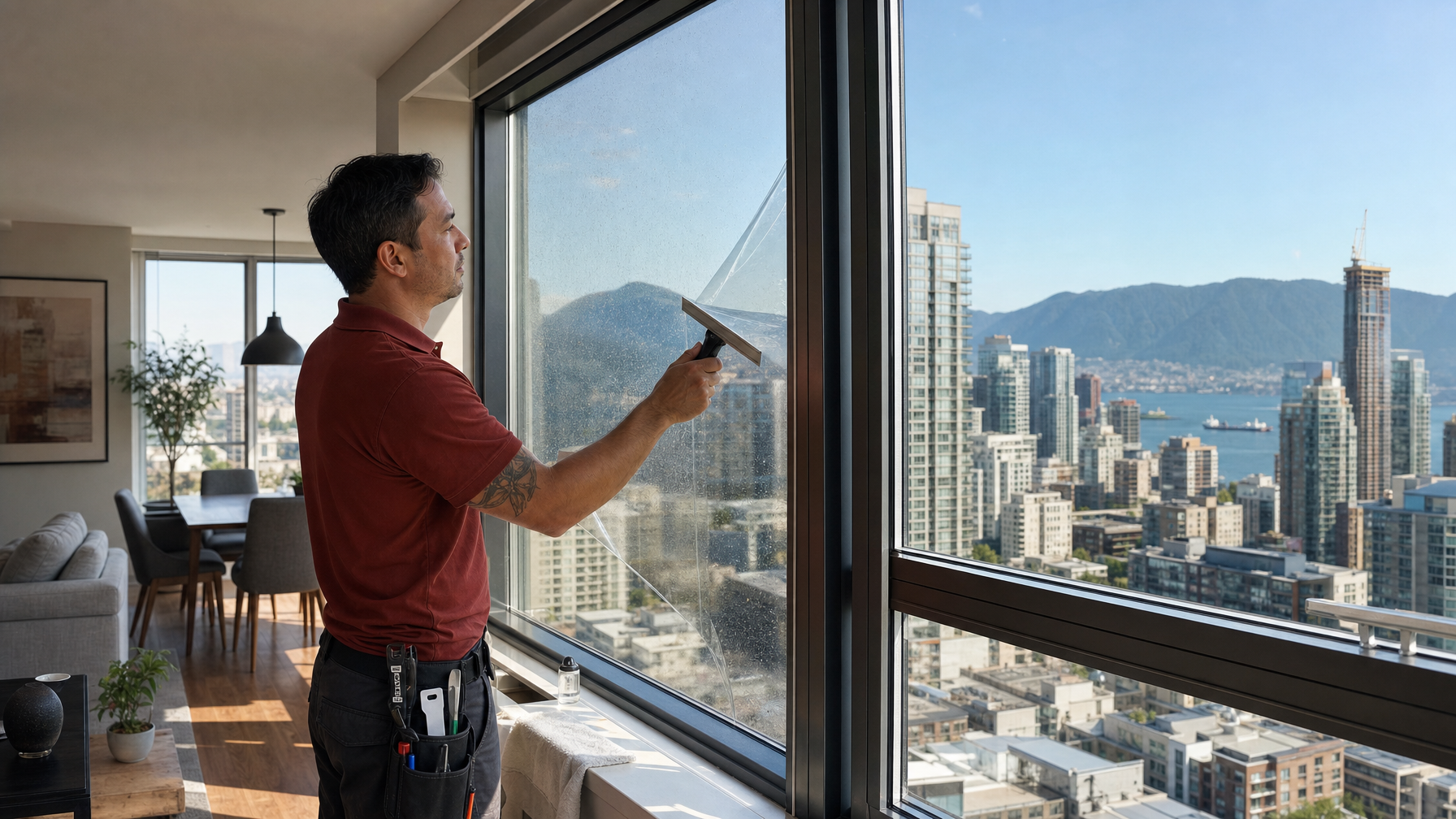
Solar window film installation in BC costs $9, $22 per square foot CAD installed in 2026, depending on film grade, building access, and window type. For a typical Metro Vancouver residential project (200 sq ft of south/west-facing glass), expect $1,800, $3,600 total. For a commercial office floor (500 sq ft of glazing), expect $4,500, $9,000. These are all-in prices for LLumar or Vista certified film installed by a professional installer, not DIY film or unbranded tint.
Cost is the first question most Metro Vancouver homeowners and building managers ask when they’re considering solar window film, and it’s the right place to start. Understanding what’s actually included in a professional window film installation, and what drives the price up or down, helps you evaluate quotes accurately and avoid the common mistake of choosing a cheap option that fails within a few years.
For a comprehensive overview of solar film types and how they perform in Vancouver’s climate, see our Complete Guide to Solar Control Window Film in Vancouver. For help choosing the right film type for your home, see our BC solar film selection guide.
Full Pricing Breakdown: Film Type, Building Type, and Access
| Film Type | Residential (CAD/sq ft) | Commercial Ground-Floor (CAD/sq ft) | Commercial High-Rise (CAD/sq ft) |
|---|---|---|---|
| Reflective Solar | $9, $12 | $9, $13 | $13, $18 |
| Ceramic Solar (LLumar AIR / Vista ceramic) | $12, $18 | $13, $19 | $17, $22 |
| Neutral / Subtle Tint | $10, $15 | $11, $16 | $15, $20 |
| Dual-Reflective | $11, $16 | $11, $17 | $16, $21 |
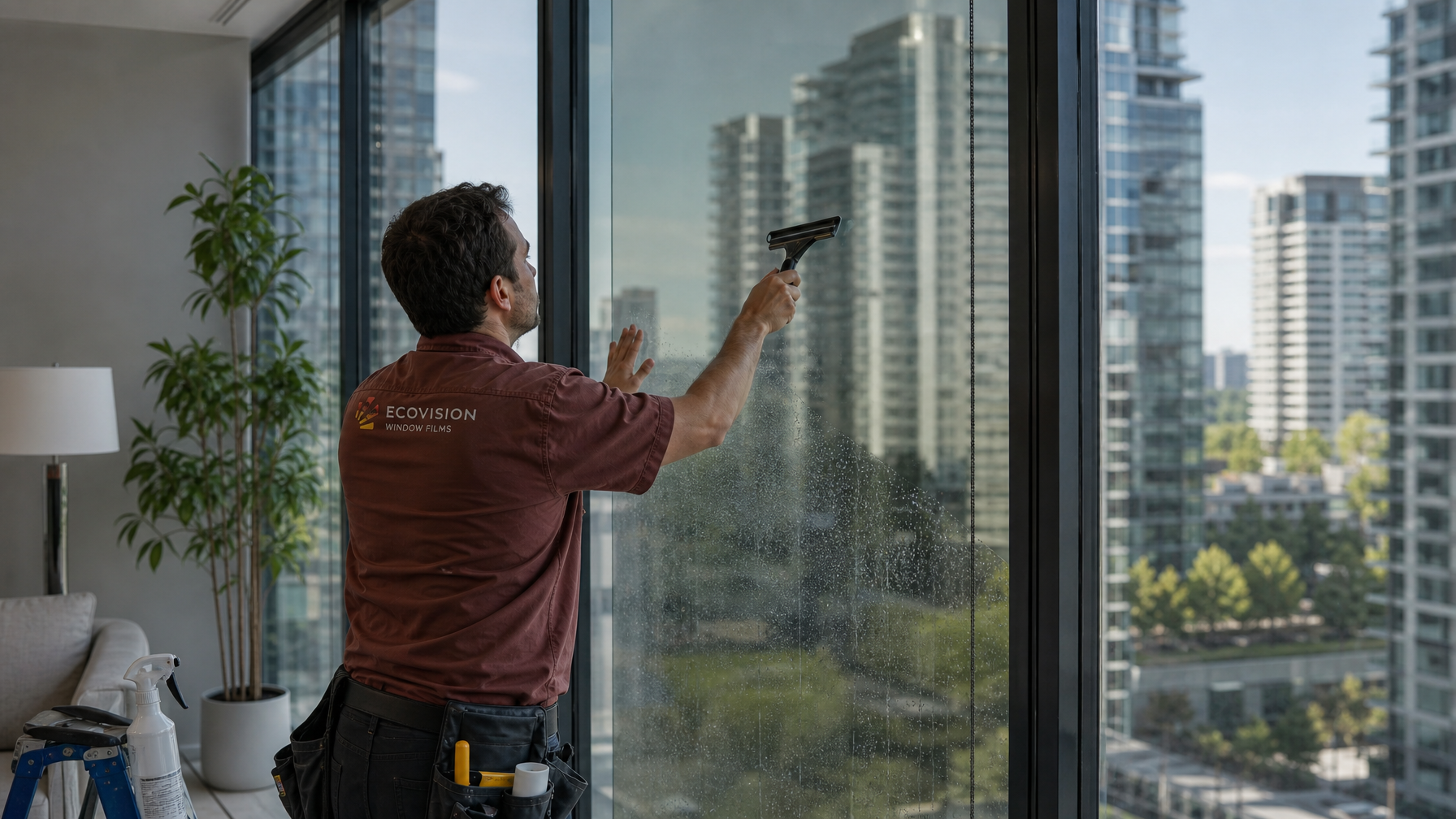
All prices are in Canadian dollars and include supply and installation of LLumar or Vista certified film by Ecovision’s technicians. Prices include site assessment, thermal stress calculation for IGU windows, professional installation, and post-installation documentation. They do not include travel for projects outside Metro Vancouver and the immediate Lower Mainland, for which a travel supplement may apply.
What Drives Cost Up in BC Solar Film Projects
Understanding cost drivers helps you budget accurately and ask the right questions when getting quotes.
High-Rise Access
The single biggest cost variable in commercial solar film projects is access. Ground-floor and low-rise installations (up to roughly 4 storeys) can be reached from inside with standard ladders and extension poles. High-rise installations, the office towers and residential towers that dominate Metro Vancouver’s skyline, often require scissor lifts, aerial work platforms, or exterior swing stages for glass that cannot be safely reached from inside. This equipment costs $3, $6 per square foot on top of the base installation price and can be the dominant cost component for upper-floor installations.
For most residential condos, interior access is sufficient, the film is applied from inside the building, and no exterior access is needed. This is why residential pricing is generally lower than commercial high-rise pricing even for equivalent film grades.
IGU vs Single-Pane Glass
The vast majority of windows in Metro Vancouver’s post-1990 building stock are insulated glass units (IGUs), double or triple-pane sealed units. Installing solar film on IGUs requires a thermal stress calculation to confirm the film grade is compatible with the specific glass unit’s heat tolerance. This calculation is part of Ecovision’s standard process and is included in our pricing. However, IGU projects also require more careful film specification, not every film grade can go on every IGU, which can sometimes push the project toward a higher-cost film grade.
Single-pane windows, common in older homes and in some commercial warehouses, are simpler to film and rarely require thermal stress calculations. If your project involves single-pane glass, you may see pricing at the lower end of the residential range.
Film Grade
Premium ceramic solar film (LLumar AIR series, Vista ceramic) costs $3, $6/sq ft more than standard reflective film for the same project. The premium reflects the film manufacturing cost, nano-ceramic technology is more complex to produce than standard metallic sputtering, and the product’s superior performance and warranty terms. For most Metro Vancouver homeowners where strata approval or view quality is important, the premium is worth paying. For industrial or secondary commercial applications where appearance doesn’t matter, reflective film delivers excellent performance at a lower price.
Project Size
Solar film installation has a base cost component regardless of project size, the technician’s travel time, site setup, thermal calculations, and documentation. Very small projects (under 50 sq ft) are priced at the higher end of the per-square-foot range because the base cost is distributed over a small area. Large projects (over 1,000 sq ft) typically qualify for volume pricing that brings the per-square-foot cost down toward the lower end of the range.
Occupied Commercial Spaces
Installing film in an occupied office, healthcare facility, or retail space during business hours requires more planning, furniture must be temporarily cleared from window areas, sensitive equipment may need to be protected, and the installation schedule may need to work around occupant movements. After-hours or weekend installation in occupied commercial spaces carries a premium of approximately $1, $3/sq ft above the standard rate.
What Drives Cost Down
Several factors can bring the per-square-foot cost to the lower end of the range:
- Large project area: Projects over 500 sq ft allow better technician efficiency and typically qualify for volume pricing
- Simple access: Ground-floor or interior-accessible windows with clear workspace around the glass
- Standard film grade: Choosing reflective or neutral tint rather than premium ceramic where appearance constraints allow
- Single-pane windows: Simpler specification and no thermal stress complexity
- Flexible scheduling: Weekday business hours installation avoids after-hours premiums
Residential Project Examples
Here are representative project scenarios for Metro Vancouver residential clients, with realistic cost ranges for 2026:
Strata condo, west-facing, 150 sq ft of glazing, ceramic solar film: $1,800, $2,700. This is the most common residential project type, a one or two-bedroom condo in a Metro Vancouver tower with afternoon heat and glare issues. Ceramic film is specified because of strata exterior appearance requirements. Interior access. One-day installation.
Detached home, south/west exposures, 250 sq ft of glazing, reflective solar film: $2,250, $3,000. A two-storey home in the Lower Mainland with significant south and west glass area. Reflective film is acceptable because there’s no strata bylaw, and the cost savings versus ceramic are meaningful at this scale. One to one-and-a-half day installation.
Three-bedroom home, mixed exposures, 200 sq ft of glazing, ceramic solar film: $2,400, $3,600. Ceramic film selected for view preservation and UV protection on valuable wood floors and furniture. Standard interior access. One-day installation.
Commercial Project Examples
Commercial projects have more variability in cost due to access, occupancy, and scale:
Single office floor, low-rise building, 500 sq ft of glazing, dual-reflective film: $5,500, $8,500. A typical commercial office tenant installation in a 3, 6 storey building. Interior access throughout. One-day installation. Most common commercial project type in Metro Vancouver.
Single floor, Class A tower, 600 sq ft of glazing, dual-reflective film, interior access: $6,600, $9,600. Class A office buildings with occupied floors, requiring coordination with building management and careful protection of workstations. Standard interior access. One-day to one-and-a-half day installation.
Multi-floor commercial installation, 2,000 sq ft total, dual-reflective film: $22,000, $34,000. Volume pricing applied at this scale. Three to five day installation. Ecovision coordinates with building management on scheduling to minimize occupant disruption.
High-rise residential tower, exterior-accessible upper floors, ceramic film, swing stage required: Add $3, $6/sq ft to base pricing for access equipment. Contact Ecovision for a specific high-rise access quotation, these projects require building management coordination and advance scheduling for swing stage access.
Payback Period and Energy Savings
The payback period for solar film investment depends heavily on the building type, current SHGC performance, cooling system costs, and operating hours. Here’s a realistic calculation framework for Metro Vancouver commercial properties:
Scenario: A commercial office floor in Metro Vancouver, 500 sq ft of west-facing glazing, existing SHGC of 0.60, upgraded to SHGC 0.25 with dual-reflective solar film. BC Hydro commercial rate approximately $0.12/kWh (blended rate). Cooling season May, September (approximately 1,400 cooling hours).
The film reduces solar heat gain through that glazing area by approximately 330 kWh per cooling season (based on ASHRAE solar radiation data for Vancouver’s climate zone). At $0.12/kWh, that’s approximately $40/year in direct electricity savings from the 500 sq ft area. However, the more significant saving is peak demand reduction, the glazing’s contribution to peak HVAC demand is reduced, which reduces BC Hydro peak demand charges that can represent 30, 50% of commercial electricity bills. A realistic annual saving for this scenario, including peak demand reduction and reduced HVAC maintenance: $500, $1,500/year.
At $6,600, $9,600 installed cost and $500, $1,500/year in energy and maintenance savings, the payback period falls in the 5, 10 year range for this scenario. The payback is faster for buildings with higher cooling loads, older HVAC systems that were already struggling with the heat load, and buildings where comfort improvements reduce occupant turnover or complaints (a real but harder-to-quantify benefit).
For residential applications, energy savings are more modest (mini-splits and window air conditioners rather than large commercial HVAC systems), and the payback is primarily measured in comfort improvement and reduced cooling equipment usage rather than dramatic electricity savings.
Why Cheap DIY Film Is a False Economy
Cheap DIY window film from online retailers or hardware stores typically costs $1, $3/sq ft for the material, seemingly a fraction of professional installation costs. The problems become apparent within months to years:
- DIY films lack thermal stress ratings for IGU windows, applying an incompatible film to a double-pane IGU can cause thermal stress fractures that void the window warranty and require window replacement
- Low-quality adhesive delaminates, bubbles, and discolours within 2, 5 years, requiring removal and reapplication
- DIY installation typically produces visible streaks, air bubbles, and misaligned edges that professional installation avoids
- No manufacturer warranty means no recourse when the film fails
- Removal of failed DIY film is itself a skilled job, adhesive residue is difficult to remove from glass without damaging coatings
Professional LLumar and Vista film, properly installed by Ecovision’s certified technicians, carries manufacturer warranties of 10 years to lifetime. The total cost of ownership, initial installation plus the value of the warranty, makes professional film substantially better value than DIY tint over any meaningful time horizon.
For more detail on the heat-blocking performance you can expect from a professional installation, see our post on what window film heat blocking looks like in Vancouver’s climate. For information on commercial office sun-blocking specifically, see our guide to window film for Metro Vancouver offices.
Get a Free On-Site Quote
Ecovision provides free on-site estimates for all solar film projects across Metro Vancouver and the Lower Mainland. Every estimate includes a full site assessment, film sample demonstration, and, for IGU windows, a thermal stress calculation to confirm the appropriate film grade. Learn more about our energy-saving window film services.
Call (236) 862-0052, email info@ecovisioncanada.com, or visit our contact page to schedule your free estimate. We serve Vancouver, Burnaby, Richmond, Surrey, North Vancouver, West Vancouver, Coquitlam, Port Moody, New Westminster, Delta, Langley, Abbotsford, and Maple Ridge.