
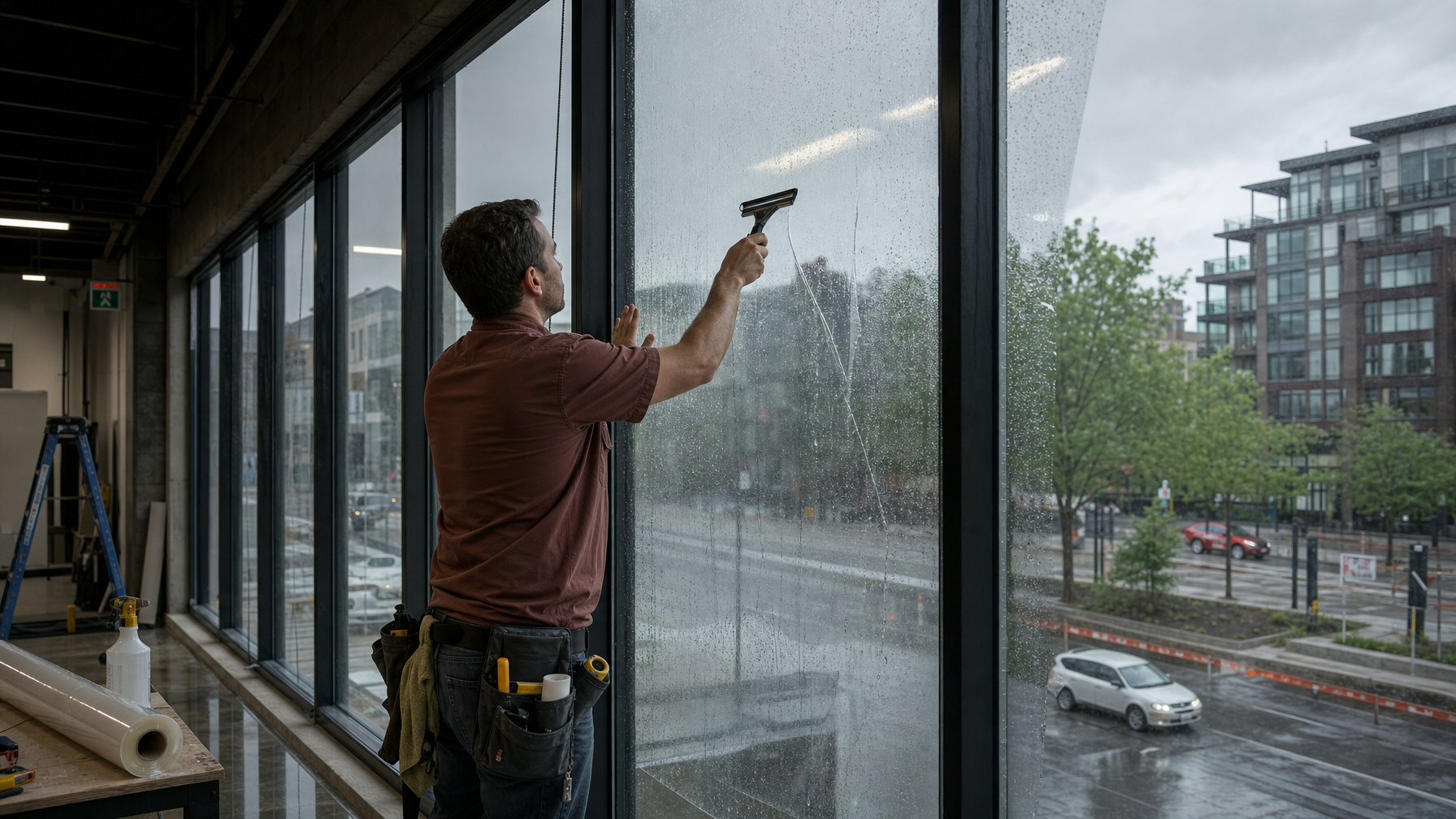
Heat Rejection Window Film for BC Homes: How It Works and What It Costs
Heat rejection window film works by blocking near-infrared radiation (NIR), the invisible portion of sunlight that accounts for roughly 51% of solar energy and nearly all of the heat you feel through a window. In Metro Vancouver’s climate, high-performance heat rejection film reduces solar heat gain by 40, 80%, making south and west-facing rooms significantly more comfortable without darkening windows or replacing glass. Installed cost in BC: $9, $18/sq ft for residential, $9, $22/sq ft for commercial.
The phrase “heat rejection” is more precise than the general term “solar control”, it points to the specific mechanism that matters most for comfort. You can block some solar heat by darkening glass (reducing all light transmission), but the most effective heat rejection films do something different: they selectively block the infrared spectrum while allowing visible light through. Understanding this distinction helps you choose the right film and set realistic expectations for your BC home.
For a comprehensive overview of solar control film including types, costs, and installation details, see our Complete Guide to Solar Control Window Film in Vancouver. This post dives specifically into the heat rejection mechanism and what it means for BC residential applications.
How Heat Rejection Works: The Near-Infrared Spectrum
Sunlight is a broad-spectrum form of electromagnetic radiation. Of the solar energy that reaches a Vancouver window on a clear summer afternoon, roughly 5% is ultraviolet (UV), about 44% is visible light, and approximately 51% is near-infrared radiation (NIR). That 51% NIR portion is the heat you feel when you stand near a sunny window, it’s what makes the glass warm to the touch and what raises the temperature of the room behind it.
Visible light, despite representing nearly half of solar energy, contributes very little to the heat load you experience in a room. The photons of visible light that pass through glass are mostly absorbed by objects in the room and converted to heat slowly, but the immediate, intense warmth of solar radiation is almost entirely due to NIR. If you could block NIR while letting visible light through, you’d have a window that looks clear and bright but doesn’t heat up the room. That’s exactly what high-performance heat rejection film achieves.
The technical measure of how effectively a glazing system resists solar heat gain is the Solar Heat Gain Coefficient (SHGC). A standard uncoated double-pane window typical of Metro Vancouver’s pre-2016 building stock has an SHGC of 0.55, 0.70, it lets 55, 70% of solar energy through as heat. A premium heat rejection film applied to that same glass can bring the effective SHGC down to 0.20, 0.25, a reduction of 60, 75% in solar heat gain. The room behind that glass becomes fundamentally different to occupy on a hot summer afternoon.
The Visible vs Infrared Spectrum: How Ceramic Film Separates Them
Standard metallic reflective film achieves heat rejection by reflecting all solar radiation, UV, visible, and NIR, back off the glass surface. This works well but comes with a significant trade-off: it also reflects much of the visible light, making the window dark and giving it a mirrored exterior appearance. For many Metro Vancouver strata condos and commercial offices where views matter, this is unacceptable.
Ceramic solar film takes a fundamentally different approach. The nano-ceramic particles in these films are specifically engineered to absorb and dissipate NIR wavelengths, the 700, 2500 nanometre range that accounts for most solar heat, without significantly attenuating visible light in the 400, 700 nanometre range. The result is a film that rejects 70, 80% of solar heat while maintaining 40, 60% visible light transmission. From inside and outside, the window looks nearly clear or lightly tinted. The view is preserved. The heat is not.
This spectral selectivity is the key technical advancement in modern window film, and it’s why ceramic film commands a premium price over reflective film. The manufacturing process for nano-ceramic films is significantly more complex and precise than standard metallic sputtering. The performance benefit, heat rejection without darkness, is worth the premium for most Metro Vancouver residential applications.
A useful metric for comparing films across this dimension is the Total Solar Energy Rejected (TSER) value, sometimes called Total Solar Rejection (TSR). TSER captures the complete solar energy rejection across all wavelengths, not just the visible spectrum. Premium ceramic films from LLumar and Vista achieve TSER values of 65, 80%, while their Visible Light Transmission remains at 40, 60%. The gap between TSER and VLT is the measure of how well the film separates heat from light, and for high-quality ceramic film, this gap is the largest available in commercially installed window film.
Why Heat Rejection Matters in BC’s Coastal Climate
Metro Vancouver’s climate has a characteristic that makes heat rejection particularly relevant: the combination of coastal humidity and summer heat creates a radiant heat effect that many residents underestimate. On a 28°C day in August, a west-facing room with unprotected glass doesn’t just feel warm because the air is warm, it feels substantially warmer because the glass is radiating heat into the space from absorbed solar energy. The radiant component of discomfort near a hot glass surface can make a 28°C room feel like 35°C to someone sitting near the window.
This is also why air conditioning alone doesn’t fully solve the problem in glass-heavy buildings. Air conditioning treats the air temperature, it can bring the air to 22°C. But a large hot glass surface continues to radiate NIR and heat into the room even when the air is cool, creating a radiant asymmetry that makes occupants near the windows uncomfortable even with effective HVAC running. Heat rejection film addresses the source, the glass surface, rather than compensating for it downstream.
Vancouver’s increasing frequency of summer heat events makes this more relevant every year. The heat dome of June 2021 was an extreme case, but the general trend toward more summer days above 28°C in Metro Vancouver is well-documented by Environment Canada. Buildings that were designed for Vancouver’s historically mild climate are increasingly inadequate for the summers the city now experiences, and heat rejection film is among the lowest-cost, fastest-payback retrofits available.
LLumar and Vista Ceramic Film Lines for Maximum Heat Rejection
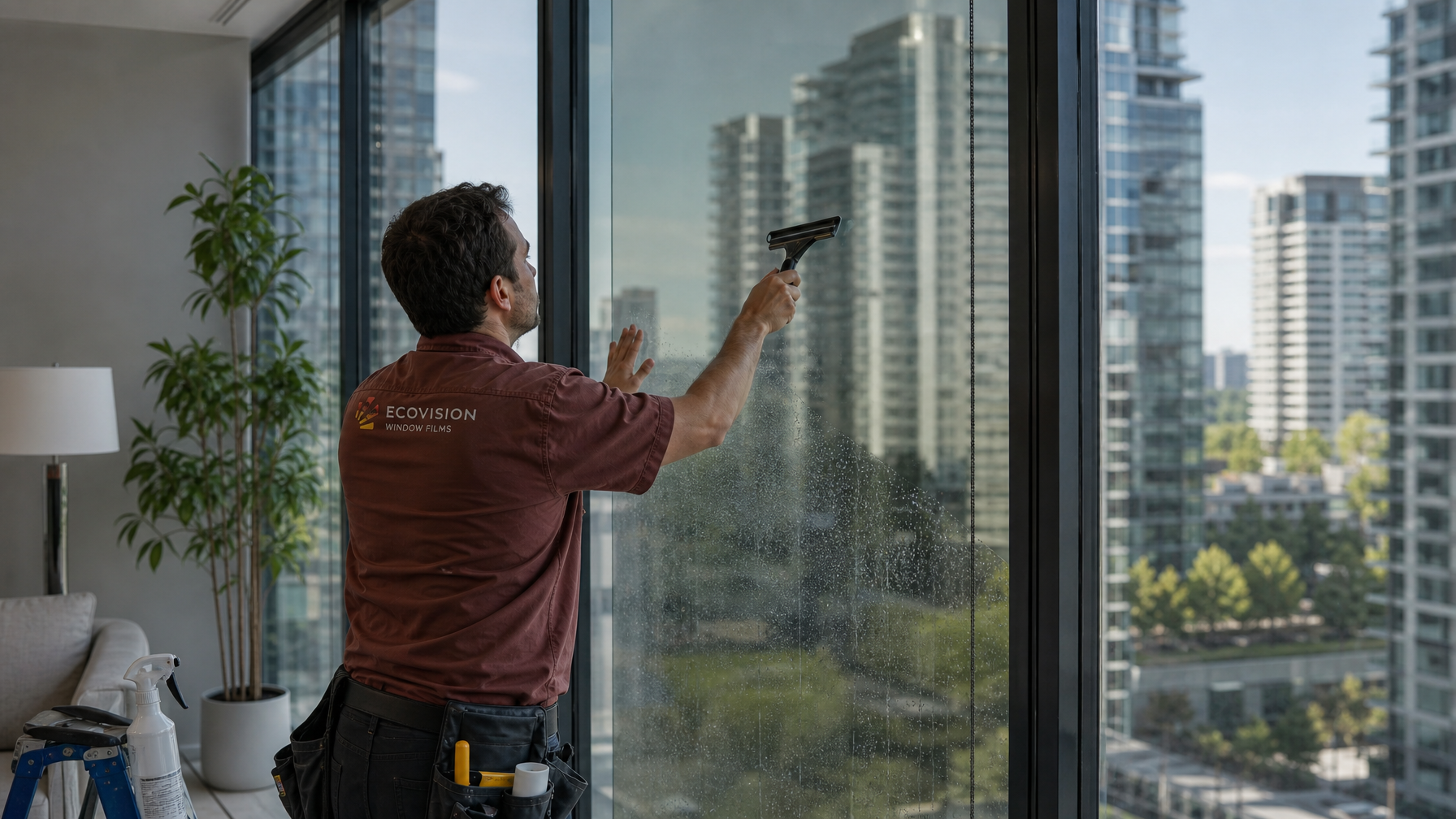
Ecovision installs LLumar and Vista window films exclusively for residential and commercial projects across Metro Vancouver. Here’s how their heat rejection product lines compare:
LLumar AIR Series, the benchmark for residential heat rejection in BC: LLumar’s AIR series represents the current state of the art in spectrally selective ceramic solar film. AIR grades achieve SHGC of 0.20, 0.22 with VLT of 50, 60%, a combination that was technically impossible with film technology available a decade ago. The film rejects up to 80% of solar heat while maintaining a near-clear appearance. On double-pane IGU windows in Metro Vancouver strata condos, AIR series film is the appropriate specification when maximum heat rejection with minimum visual change is the priority. Covered by LLumar’s lifetime warranty against adhesive failure, delamination, and colour shift.
Vista V-Series ceramic, strong heat rejection at a practical price: Vista’s V-Series ceramic films deliver excellent heat rejection performance (SHGC 0.23, 0.28, TSER 65, 75%) with VLT in the 40, 55% range. For BC homes where maximum heat rejection is the priority but the premium of LLumar AIR isn’t required, detached homes, townhouses, suites without specific strata appearance requirements, Vista V-Series provides an excellent combination of performance and value. Vista films carry a 10-year manufacturer warranty.
LLumar and Vista reflective films, highest heat rejection, reflective appearance: For applications where the reflective exterior appearance is acceptable, detached homes, commercial buildings without strata or design restrictions, industrial applications, metallic reflective film achieves comparable SHGC (0.22, 0.30) at a lower cost per square foot. The heat rejection performance of quality reflective film is excellent; the trade-off is purely aesthetic.
Choosing Between Reflective and Ceramic for Heat Rejection in BC
The heat rejection performance of ceramic and reflective film is similar, both achieve SHGC in the 0.20, 0.30 range with professional-grade film. The choice between them comes down to three practical factors specific to BC applications:
Strata approval requirements: As discussed in our guide to solar film selection for BC homes, Metro Vancouver strata condos frequently require exterior appearance approval for window film. Ceramic film’s near-clear exterior appearance typically navigates strata approval requirements easily. Reflective film’s mirrored exterior often triggers strata scrutiny or outright restrictions. For strata properties, ceramic is usually the only practical choice.
View quality and light levels: Ceramic film at 50, 60% VLT maintains a brighter interior and better view quality than reflective film at 20, 35% VLT. For BC homes where the view, ocean, mountains, neighbourhood trees, is part of what makes the property valuable, ceramic film preserves that asset. Reflective film delivers excellent heat rejection but at the cost of a noticeably darker interior and reduced view quality.
Budget and application type: Ceramic film costs $12, $18/sq ft installed versus $9, $12/sq ft for reflective film. For a 200 sq ft residential project, this is a difference of $600, $1,200. For detached homes where strata restrictions don’t apply, the choice between ceramic and reflective often comes down to this budget question and how much the homeowner values view quality versus cost savings. For commercial buildings without design restrictions, reflective film at the lower cost often makes the most sense for the heat rejection performance delivered.
For a detailed breakdown of all cost factors, see our 2026 BC solar window film pricing guide. For the specific commercial application, blocking afternoon sun in Metro Vancouver offices, see our guide to window film to block sun in Vancouver offices.
What to Expect from Heat Rejection Film in Your BC Home
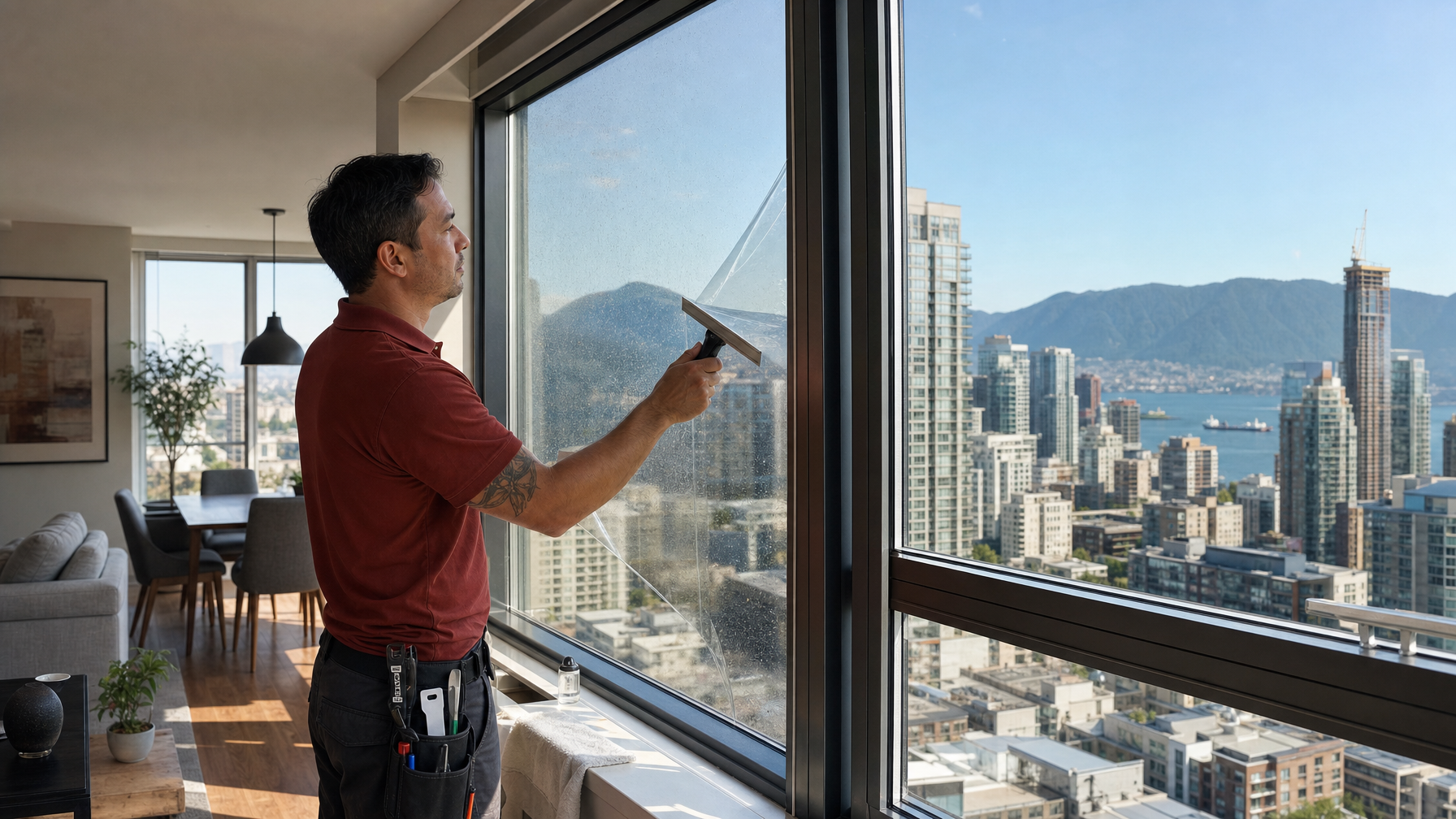
To close with practical expectations: after a professional heat rejection film installation by Ecovision, here is what Metro Vancouver homeowners typically experience.
On the first sunny afternoon after installation, the change in the treated rooms is immediately noticeable, not as a measurement, but as a felt experience. The radiant heat component near the glass is dramatically reduced. The room achieves the HVAC set temperature and maintains it rather than fighting a continuous battle against solar heat gain. Glare on screens and surfaces is reduced. The space becomes usable in the afternoon hours it was previously uncomfortable or unusable.
Over the following 30-day curing period, minor haze or water pocket effects in the film are normal and will disappear on their own. After curing, the film requires no maintenance beyond standard glass cleaning with ammonia-free cleaners. LLumar and Vista ceramic films installed by Ecovision carry warranties of 10 years to lifetime, with proper care, you should never need to replace them during the time you own the property.
Learn more about Ecovision’s energy-saving window film services, then call (236) 862-0052 or visit our contact page for a free on-site estimate across Metro Vancouver and the Lower Mainland.