
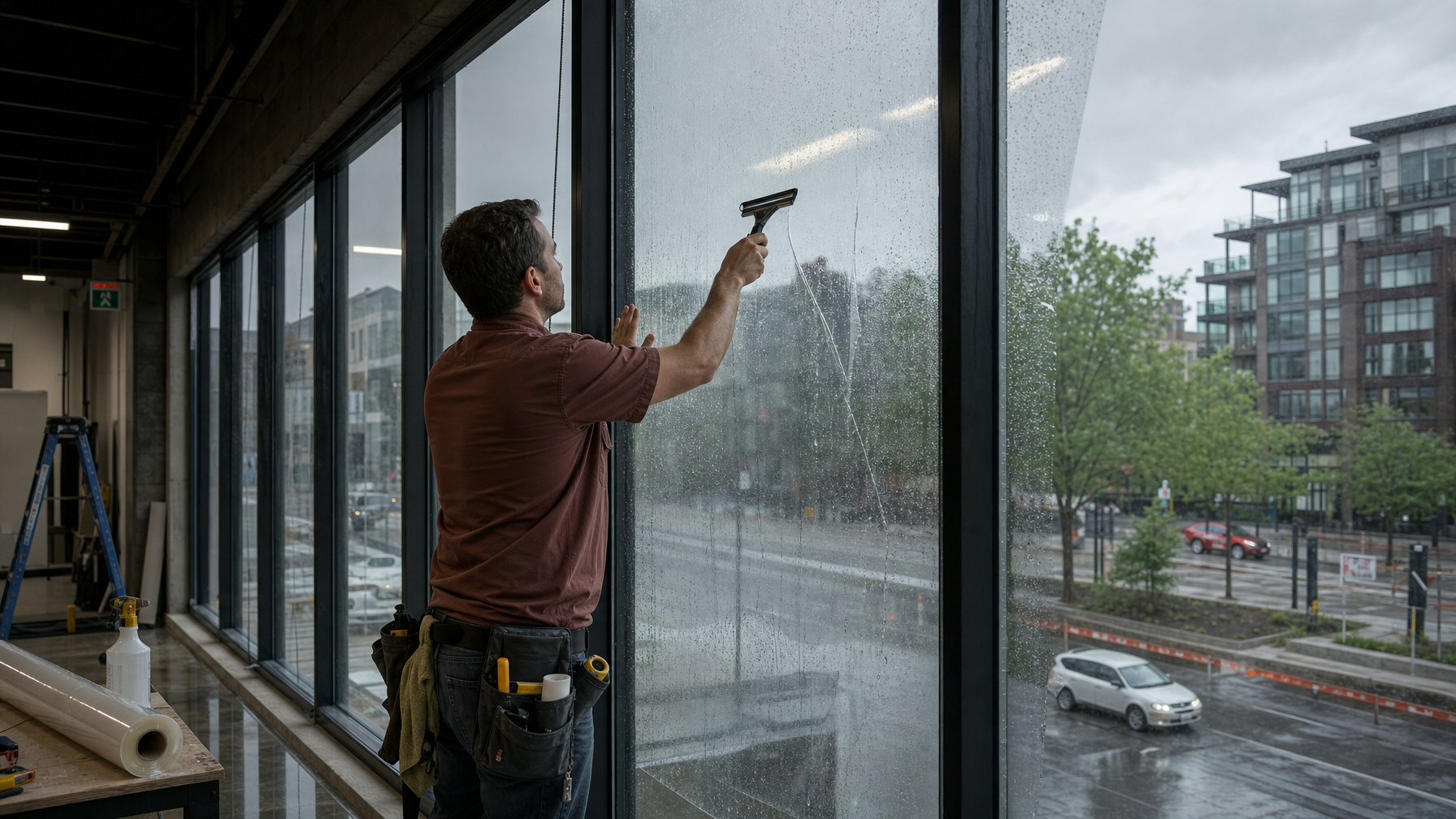
Window Film to Block Sun: Reducing Glare and Heat in Metro Vancouver Offices
Window film blocks 60, 80% of the sun’s solar heat and reduces visible glare by 50, 80% in commercial office environments. For west-facing and south-facing offices in Metro Vancouver, where afternoon sun loads are the most persistent productivity and comfort problem in glass-heavy commercial buildings, solar control film is the most targeted and cost-effective sun-blocking solution available, at $9, $22/sq ft installed.
The scenario is familiar to anyone who has worked in a Vancouver office tower: it’s 3:00 PM in July, the sun has moved to the west elevation, and half the open floor plan is unusable. Monitors face-on to the west window are completely washed out. The employees near the glass are uncomfortably warm despite the air conditioning running continuously. Blinds are drawn across the entire west facade, eliminating the view and the natural light that made the space attractive in the first place.
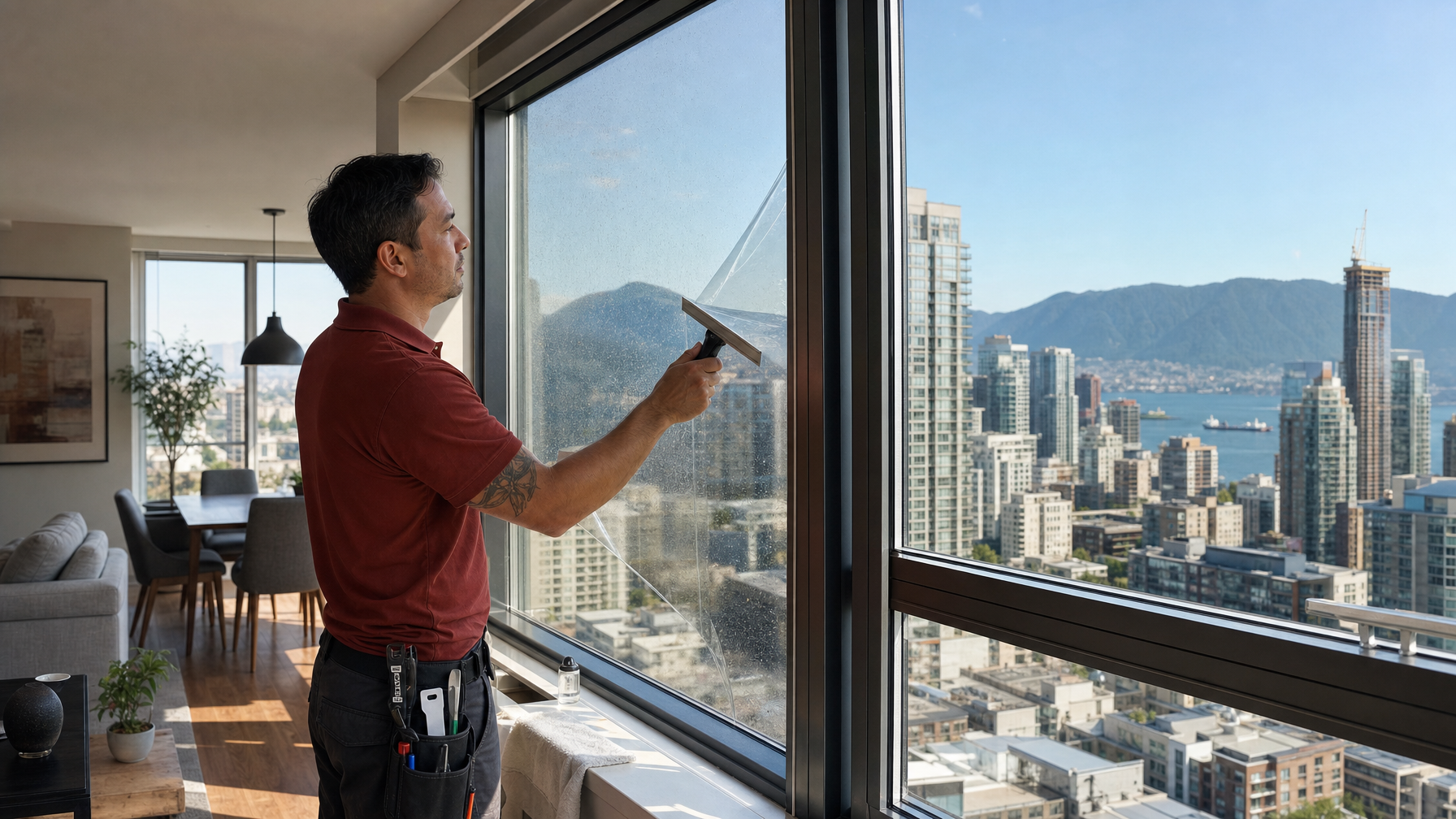
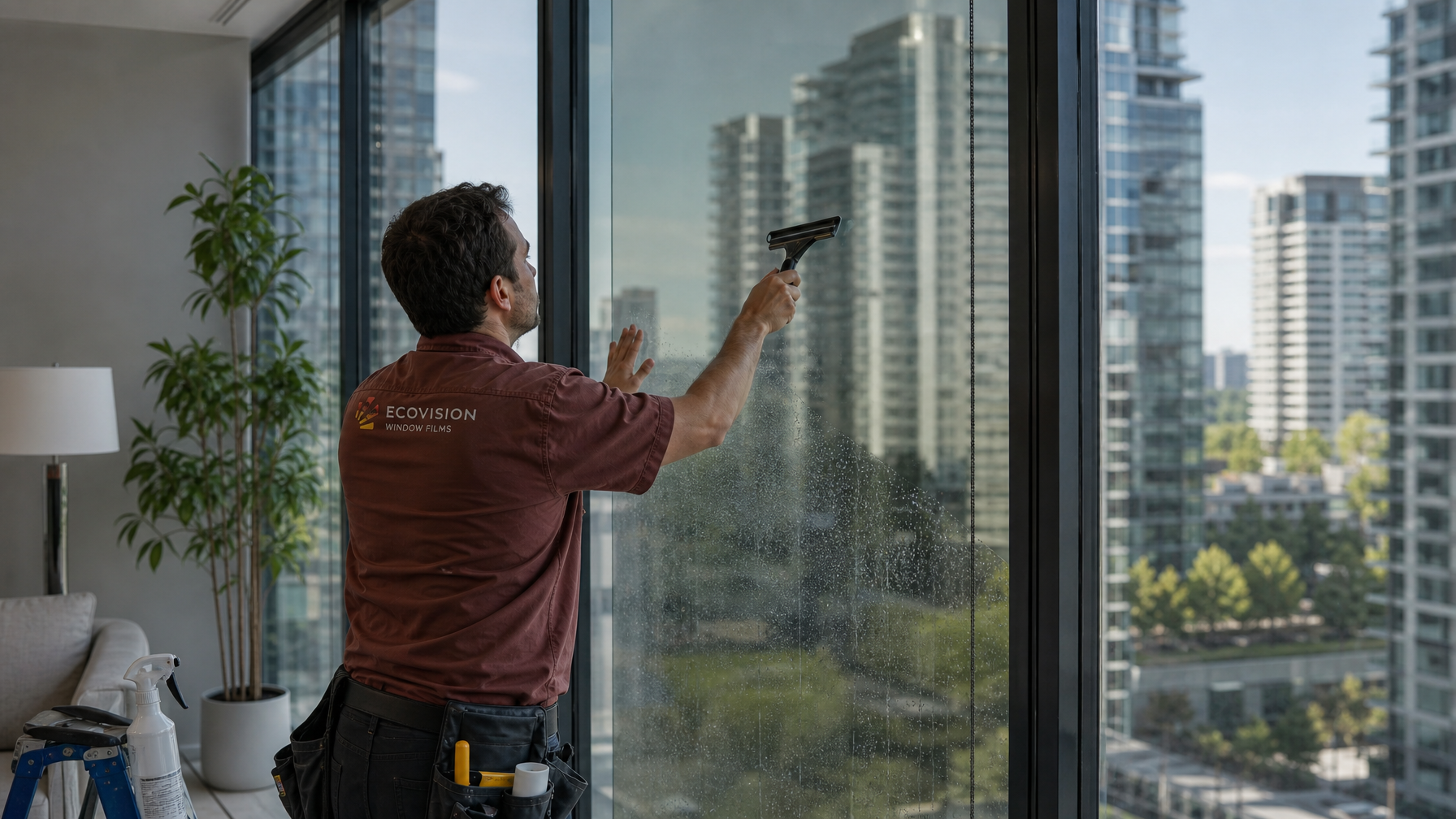
Window film addresses this problem directly without requiring blinds. It blocks the solar heat and reduces glare to a manageable level while preserving views and natural light at other times of day. For a full technical overview of solar film performance, see our Complete Guide to Solar Control Window Film in Vancouver. This post focuses specifically on the commercial office application.
The Specific Problem: West-Facing Offices, Screen Glare, and Afternoon Heat
Metro Vancouver’s commercial office market is concentrated in corridors where west-facing exposure is the norm, not the exception. The Burrard Corridor, the string of Class A office buildings running from Burrard Street toward the waterfront, is oriented precisely to receive intense western sun from mid-afternoon through evening during the May, September period. The Broadway Plan corridor, now seeing a rapid increase in commercial office inventory, has similarly high glazing ratios on its west and south faces.
The solar problem in these offices has two distinct dimensions:
Heat. Without solar control, a west-facing commercial floor with a high glazing ratio can experience interior temperatures running 8, 12°C above ambient on hot afternoons, even with HVAC running. The HVAC system is fighting a constant battle against the solar heat load entering through the glass. Peak demand occurs during exactly the hours when the building is most occupied, 1:00, 5:00 PM on summer weekdays, which drives both comfort problems and peak BC Hydro electricity costs.
Glare. Glare in screen-based work environments is not just uncomfortable, it’s a measurable productivity and health problem. WorkSafeBC defines acceptable glare levels for screen-based workstations, and direct afternoon sun through west-facing glass routinely exceeds these thresholds. Luminance ratios between a sun-lit window surface and an adjacent monitor screen can reach 100:1 or more, far above the 10:1 threshold that human vision can comfortably adapt to. The result is eye strain, headaches, and employees pulling blinds that then create flat, unpleasant artificial lighting conditions for the rest of the afternoon.
Commercial Film Options for Sun Blocking
Dual-Reflective Film: The Commercial Standard
Dual-reflective solar film is the most commonly specified product for west-facing commercial offices in Metro Vancouver, and for good reason. It achieves SHGC of 0.22, 0.30 (blocking 65, 75% of solar heat) while simultaneously reducing visible light transmission to 30, 45%. From inside the office, the view out remains clear and the appearance of the window is lightly tinted rather than mirrored. From outside, from the street or from adjacent buildings, the window presents a reflective exterior that provides meaningful daytime privacy for the building’s occupants.
For screen-based work environments, the reduction in VLT to 30, 45% is critical. This brings the luminance ratio between the window surface and adjacent monitor screens down from the 100:1 problem range to roughly 10, 20:1, within the zone where human vision can adapt without eye strain. In practical terms, this means employees can work at west-facing desks without requiring blinds during afternoon sun hours.
Ceramic Solar Film: Premium Clarity for High-End Commercial Spaces
For commercial spaces where the exterior appearance of the glazing is a premium concern, a headquarters building, a hospitality property, or a commercial podium where the building design calls for a specific glass appearance, ceramic solar film is the appropriate choice. LLumar AIR and Vista ceramic grades achieve SHGC of 0.20, 0.25 (up to 80% heat rejection) while maintaining 40, 60% VLT with a near-clear exterior look.
The glare reduction from ceramic film at 50% VLT is real but less aggressive than dual-reflective. For offices with direct western exposure and significant monitor work, ceramic film at 50% VLT may not fully solve the glare problem during peak sun hours, it reduces the problem substantially but may still require supplementary blinds in the worst afternoon conditions. For offices where the heat problem dominates and glare is secondary, ceramic film is an excellent choice.
High-Performance Reflective Film: Industrial and Secondary Commercial
For commercial buildings where appearance is secondary to performance, warehouse offices, manufacturing facilities, secondary commercial space, high-performance metallic reflective film delivers the highest heat rejection at the lowest cost. SHGC of 0.22, 0.28, VLT of 20, 30%, installed at $9, $12/sq ft. The exterior mirror appearance is significant and may not be appropriate for all commercial building types, but where it’s acceptable it’s the most cost-effective commercial solar control solution.
Glare Reduction in Screen-Based Work Environments
Let’s be specific about glare numbers, because the difference between a 70% and a 40% VLT film has real consequences for office usability.
A typical uncoated double-pane window on a west-facing facade at 3:00 PM in June transmits luminance values well above 10,000 cd/m² from the window surface itself. A modern office monitor set at a comfortable brightness for indoor work displays at roughly 150, 350 cd/m². The contrast ratio between these two values is 30:1 to 70:1, causing the visual system to continuously adapt between looking at the screen and the window, leading to fatigue.
A dual-reflective film at 35% VLT reduces the transmitted window luminance by approximately 65%, bringing the contrast ratio with an adjacent monitor down to roughly 10, 25:1, the threshold zone for acceptable screen work. The same film also reduces the direct solar beam intensity that causes the “laser in the eye” glare that employees near west windows experience on sunny afternoons.
In practical terms, offices that install dual-reflective or high-performance solar film on west-facing glazing typically find that blinds remain open throughout the afternoon hours on summer days, a change that improves the occupant experience significantly and is immediately noticed by the people who work there.
BC Energy Step Code and Commercial Solar Film
The BC Energy Step Code establishes progressive performance targets for new commercial construction, with glazing performance requirements that include SHGC limits for different climate zones and building orientations. Metro Vancouver falls in Climate Zone 4 under the BC Building Code, which applies specific solar heat gain requirements to glazing on south and west exposures.
For new commercial construction, the glazing is specified at the factory to meet Step Code requirements. The relevance for solar film is in the existing building stock: commercial buildings constructed before 2016 (when the Energy Step Code was introduced) and many buildings constructed under earlier editions of the BC Building Code have glazing that performs well below current Step Code thresholds. Solar film retrofits allow these buildings to approach current performance standards without window replacement.
This is relevant for building owners pursuing LEED or BREEAM certification for retrofit projects, for organizations reporting on sustainability metrics under GHG Protocol standards, and for commercial tenants who have made energy reduction commitments under corporate sustainability frameworks. Ecovision can provide energy performance calculations and project documentation for commercial clients reporting on building energy improvements.
Commercial Film in Practice: The Class A Office Building
To make this concrete, consider a typical scenario: a commercial tenant occupying a west-facing floor in a Class A office building in Vancouver’s downtown core, a building type well-represented in the Burrard Corridor and increasingly common in the Broadway Plan corridor. The floor has approximately 600 square feet of west-facing double-pane glazing with no existing solar coating. The existing glazing’s SHGC is 0.60.
A dual-reflective solar film installation reduces the glazing’s SHGC from 0.60 to approximately 0.25, blocking an additional 58% of solar heat gain through that glass. This reduces peak cooling demand on the floor significantly enough that the HVAC system achieves the set temperature during afternoon hours instead of running continuously and still missing targets. Employees at west-facing desks no longer need blinds for afternoon screen work. BC Hydro peak demand charges decrease. The floor becomes a measurably more comfortable and productive working environment.
Installed cost for 600 square feet of commercial-grade dual-reflective film in a typical Vancouver commercial building: $6,600, $9,600 CAD. Payback period from energy savings and reduced HVAC maintenance: typically 4, 6 years. For Ecovision’s full commercial window film services, including multi-floor installations and high-rise access projects, contact us for a commercial proposal.
Commercial Pricing: What to Budget in 2026
Commercial solar film installation in Metro Vancouver runs $9, $22 per square foot CAD installed, with the range driven by three factors: film grade, building access complexity, and total project area. Here’s a practical breakdown:
| Scenario | Glass Area | Film Type | Estimated Installed Cost (CAD) |
|---|---|---|---|
| Single commercial floor, standard access | 500 sq ft | Dual-reflective | $5,500, $8,000 |
| Single commercial floor, standard access | 500 sq ft | Ceramic solar | $6,000, $9,000 |
| Multi-floor commercial, standard access | 2,000 sq ft | Dual-reflective | $18,000, $28,000 |
| High-rise, scissor lift or swing stage required | 500 sq ft | Any grade | Add $3, $6/sq ft for access |
All prices in Canadian dollars. Commercial projects with 1,000+ sq ft of glass typically qualify for volume pricing, contact Ecovision for a commercial project quote. For a complete breakdown of what drives cost in BC, see our 2026 BC solar window film pricing guide.
For the residential equivalent, choosing the right film for a BC home, see our guide to solar film selection for BC homes. And for a technical explanation of how heat blocking specifically works, see our post on what window film heat blocking looks like in Vancouver’s climate.
Get a Commercial Film Assessment for Your Vancouver Office
Ecovision provides commercial window film assessments for office buildings, retail spaces, healthcare facilities, and institutional buildings across Metro Vancouver and the Lower Mainland. We bring film samples and lighting demonstration tools to commercial site visits, so decision-makers can see exactly how different film grades will affect the space before committing.
Learn more about our energy-saving window film services, then call (236) 862-0052 or visit our contact page to schedule a commercial assessment. We serve all of Metro Vancouver, Vancouver, Burnaby, Richmond, Surrey, North Vancouver, West Vancouver, Coquitlam, New Westminster, and beyond.