
Solar Film for Windows: How to Choose the Right Film for Your BC Home
The right solar window film for a BC home depends on three factors: how severe your heat and glare problem is, how much visibility change you’re willing to accept, and whether your building is governed by a strata bylaw. For most Metro Vancouver condos and homes on south or west exposures, ceramic solar film is the best all-round answer, it delivers top-tier heat rejection while keeping windows looking nearly clear from inside and outside.
There are dozens of solar film products on the market, and the specifications can feel overwhelming when you’re trying to make a practical decision for your home. This guide cuts through the complexity with a BC-specific lens. We’re not covering every product that exists, we’re covering the selection decision that Metro Vancouver homeowners actually face, using the LLumar and Vista film lines that Ecovision installs.
For the full technical breakdown of how solar film works and all the performance metrics, see our Complete Guide to Solar Control Window Film in Vancouver. This post focuses on the selection decision for BC homes specifically.
The Three Main Factors for Choosing Solar Film
Factor 1: How Severe Is Your Heat and Glare Problem?
Start by honestly assessing the problem you’re solving. Is your suite genuinely uncomfortable, rooms that reach 28, 30°C on hot afternoons despite air conditioning or a mini-split? Or is the issue more moderate, warmth near the windows, some glare on screens, but generally manageable? The answer determines how aggressively you need to approach film selection.
For severe heat problems, typically west-facing suites in high-rise towers from Burnaby to Vancouver with large-format floor-to-ceiling glazing, you want the highest solar heat rejection available. That means ceramic solar film (SHGC 0.20, 0.25) or high-performance reflective film. The premium cost of ceramic is justified because the performance gap between a mid-grade and premium film is the difference between a room that’s tolerable and one that’s genuinely comfortable.
For moderate heat problems, south-facing windows in a townhouse, or a condo where the HVAC manages but struggles, a neutral tint or mid-range ceramic film will deliver meaningful improvement at a lower cost per square foot.
Factor 2: How Much Visibility Change Will You Accept?
All solar films reduce visible light transmission (VLT) to some degree. Reflective film at the high-performance end can drop VLT to 20, 35%, a noticeable darkening from both inside and outside. Ceramic film maintains 40, 60% VLT, which most people describe as “barely noticeable” in normal light conditions. Neutral tint films sit at 55, 70% VLT, almost no perceptible change.
For homes with valuable views, a North Shore mountain view, a False Creek marina outlook, or a leafy neighbourhood streetscape, protecting the view quality while still controlling heat is a real priority. Ceramic film is typically the answer here. The heat rejection is excellent, the view through the glass is preserved, and on most window types the film is nearly invisible to the occupant.
For homes where light levels are already adequate and views are secondary to performance, reflective film at a lower cost per square foot may be the most practical choice.
Factor 3: What Type of Building Do You Live In?
In Metro Vancouver, a significant proportion of homeowners live in strata-governed buildings, condominiums, townhouse complexes, and co-operative housing arrangements. Strata bylaws frequently restrict exterior appearance changes, including window film that is visible from outside the building. This factor can significantly narrow your film options.
If your strata has a standard appearance bylaw, reflective film, which gives windows a metallic mirror look from outside, will likely require a variance approval and may simply not be permitted. Ceramic film, which appears nearly clear or lightly tinted from outside, often satisfies strata requirements without a variance. Neutral tint film is the safest option for strata buildings with strict uniformity requirements.
For detached homes, townhouses with no strata, and commercial buildings with full owner discretion, the building type factor drops away and the decision reduces to heat problem severity versus appearance preference.
Film Type Guide for BC Homes
Ceramic Solar Film: Best for Most Metro Vancouver Homes
Ceramic solar film is the premium category and, for most BC residential applications, the right choice. Using nano-ceramic technology rather than metal coatings, ceramic film achieves the highest heat rejection in a nearly clear format. LLumar’s AIR series and Vista’s ceramic-grade films achieve SHGC of 0.20, 0.25, blocking up to 80% of solar heat, while maintaining 40, 60% visible light transmission.
The practical advantages for Metro Vancouver homeowners are significant. Ceramic film does not affect the exterior appearance of the building in any way that a strata bylaw would typically restrict. It maintains view quality through the glass. It provides 99% UV protection, protecting floors, upholstery, and window treatments from fading. And it comes with the strongest manufacturer warranties, LLumar and Vista ceramic films carry 10-year to lifetime warranties against adhesive failure, delamination, and colour shift.
The trade-off is cost: ceramic film runs $12, $18/sq ft installed in BC. For a condo suite with 150 square feet of south and west-facing glass, that’s $1,800, $2,700, a real investment, though one with a payback period measured in years of improved comfort and reduced cooling costs.
Reflective Solar Film: Best for Maximum Performance at Lower Cost
Reflective solar film delivers comparable heat rejection performance to ceramic film at a lower installed cost of $9, $12/sq ft. The metallic sputtered coating reflects solar radiation before it enters the glass, achieving SHGC of 0.22, 0.30. If the performance numbers are similar to ceramic, why is it cheaper? Because the manufacturing process is less complex and because the exterior appearance, a reflective, mirror-like look, limits the market.
For BC homes where the strata permits reflective film, or for detached homes where the homeowner is comfortable with the exterior look, reflective film is the most cost-effective high-performance solar control option. It’s also appropriate for secondary spaces, a garage apartment with a west-facing window, a sunroom, or a home office in a detached building, where appearance is secondary to function.
Neutral and Subtle Tint Film: Best for Strata with Strict Bylaws
Neutral tint film offers the most conservative appearance change, from outside, windows look almost identical to uncoated glass. The heat rejection performance is real (SHGC improvement to 0.28, 0.40, with 99% UV blocking) but more modest than ceramic or reflective grades.
This category is appropriate for heritage buildings, older strata developments with very strict uniformity bylaws, or homeowners who want the UV protection and modest heat reduction without any visible change to their windows. Installed cost: $10, $15/sq ft.
Dual-Reflective Film: Best for Daytime Privacy Plus Heat Control
Dual-reflective film is engineered to appear darker from outside than inside, you see out clearly, but people walking by or looking from adjacent buildings cannot easily see in during daylight hours. For ground-floor homes on busy streets, or for main-floor rooms that face a neighbouring property, dual-reflective film combines solar control with a meaningful privacy upgrade. SHGC of 0.22, 0.30, installed at $11, $16/sq ft.
Strata Considerations in Metro Vancouver
Strata window film approval is one of the most common practical questions Ecovision receives from Metro Vancouver homeowners. Here’s the straightforward answer: if your strata bylaw governs exterior appearance (most do), you need written strata council approval before installing any film that changes how your windows look from outside.
The process is typically straightforward. You request approval in writing, describing the film product, its exterior appearance (including VLT and whether it has a reflective or tinted exterior look), and the windows to be covered. Most strata councils approve ceramic or neutral tint film without difficulty. Highly reflective metallic film is more likely to face scrutiny, particularly in buildings where the strata has invested in a consistent building appearance.
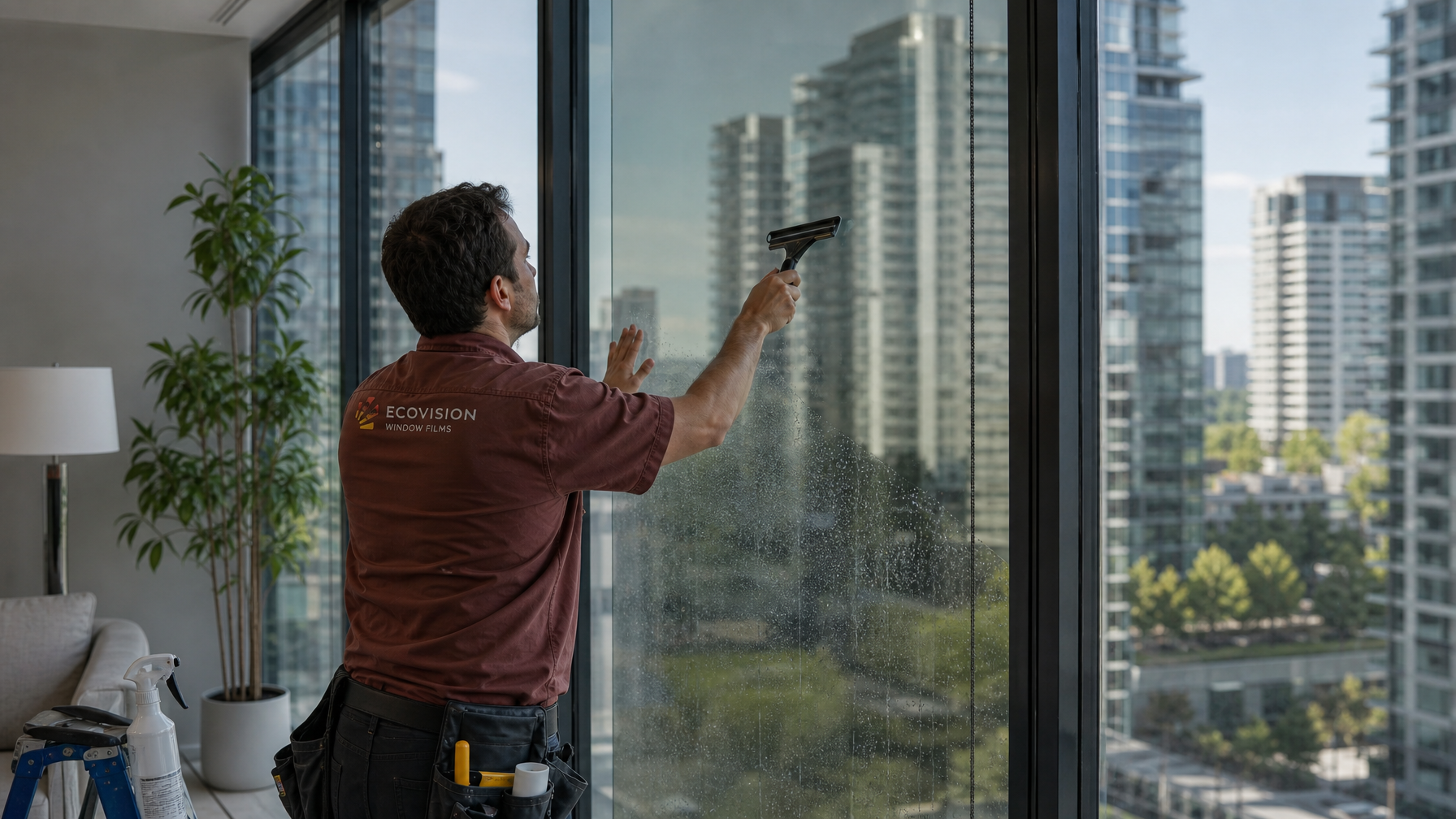
Ecovision’s proposal process includes a pre-installation documentation package that you can submit directly to your strata council. We include product specification sheets, sample renders of how the film will appear on the building exterior, and a written description of the installation scope. This makes the approval process as smooth as possible.
Note: interior-applied film that is not visible from outside the building (for instance, in an interior corridor or on glass partitions inside the unit) does not require strata approval in most bylaws, as it does not affect exterior appearance.
LLumar and Vista Film Lines for BC Residential
Ecovision installs LLumar and Vista window films exclusively, two of the leading commercial-grade film lines available in Canada, both manufactured by Eastman Chemical. Here’s how their residential-oriented lines map to the selection framework above:
LLumar AIR series: The top-of-line spectrally selective ceramic solar film. Designed for maximum heat rejection with maximum clarity, AIR grades maintain 50, 60% VLT while achieving SHGC as low as 0.20. The benchmark choice for high-end residential applications in Metro Vancouver where view quality and performance are both priorities. Covered by LLumar’s lifetime warranty.
LLumar neutral solar films: Mid-range films that deliver meaningful solar control in a low-appearance-change format. SHGC in the 0.28, 0.40 range with minimal exterior appearance change. Well-suited to strata condos where approval for more visible film is uncertain.
Vista V-Series: Vista’s residential ceramic line, providing excellent heat rejection and UV protection at a strong price-to-performance ratio. A practical choice for detached homes and townhouses where cost efficiency matters and the premium of LLumar AIR isn’t required.
Vista S-Series: Vista’s reflective solar line for applications where maximum performance at the lowest cost per square foot is the priority. Exterior appearance is reflective/metallic; appropriate for commercial and non-strata residential applications.
Cost Comparison by Film Type for BC Homes
| Film Type | SHGC | VLT | Strata-Friendly? | Installed Cost (CAD/sq ft) | 150 sq ft Project Estimate |
|---|---|---|---|---|---|
| Ceramic Solar (LLumar AIR / Vista ceramic) | 0.20, 0.25 | 40, 60% | Yes, near-clear exterior | $12, $18 | $1,800, $2,700 |
| Reflective Solar | 0.22, 0.30 | 20, 35% | Case by case, reflective exterior | $9, $12 | $1,350, $1,800 |
| Neutral Tint | 0.28, 0.40 | 55, 70% | Yes, minimal appearance change | $10, $15 | $1,500, $2,250 |
| Dual-Reflective | 0.22, 0.30 | 30, 45% | Case by case | $11, $16 | $1,650, $2,400 |
All prices are in Canadian dollars and include installation by Ecovision’s certified technicians. Prices vary by project size, access difficulty, and window type (IGU vs single pane). For a full discussion of what drives cost up or down, see our complete BC solar window film pricing guide.
For a practical look at how heat-blocking performance translates into daily comfort, read our post on what window film heat blocking looks like in Vancouver’s climate.
Ready to Choose? Free Estimates Across Metro Vancouver
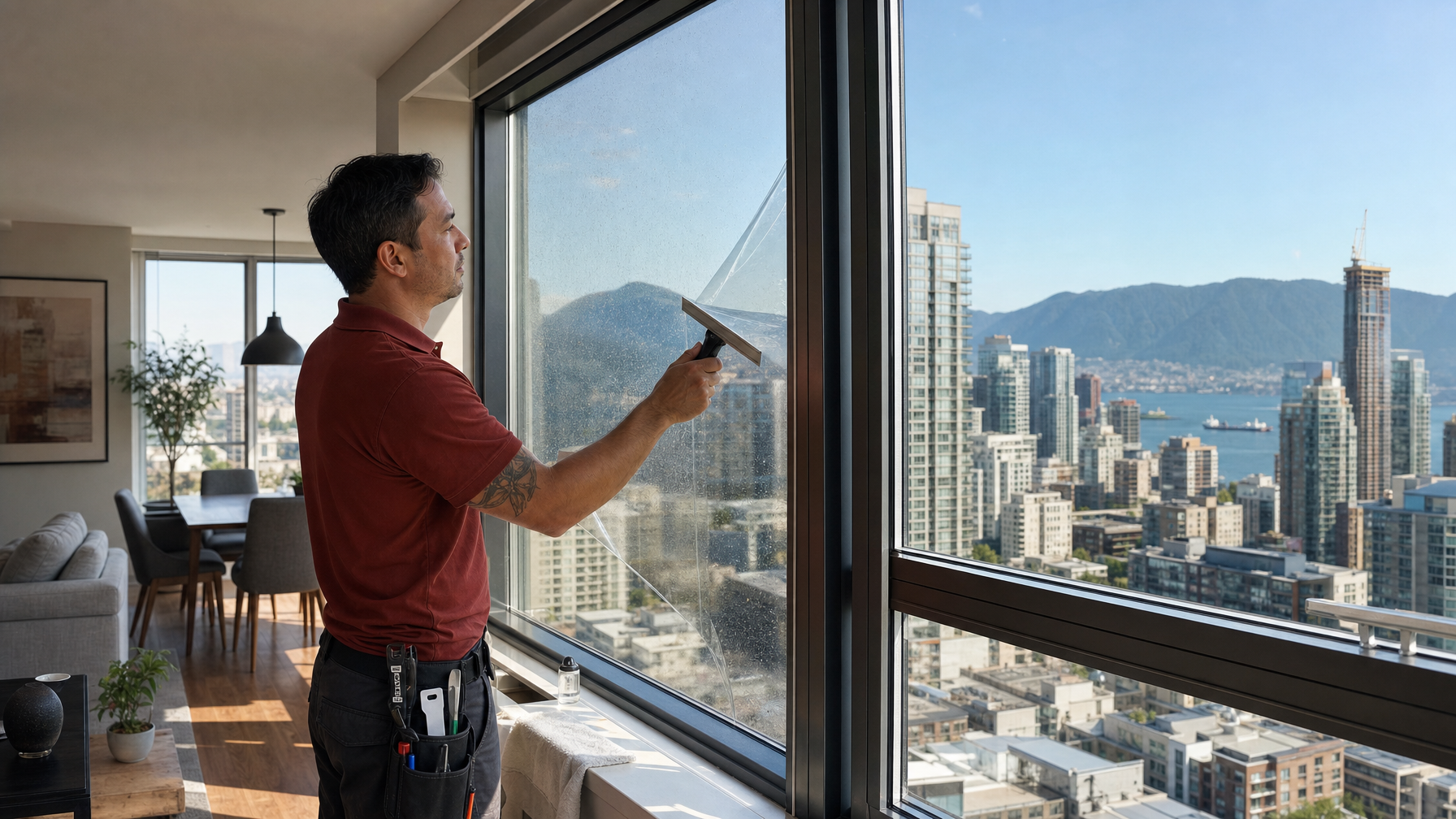
The best way to make a final film selection is to see film samples on your actual glass. Ecovision brings samples to every estimate appointment, you can compare how different grades look and feel on your specific windows, in your specific light conditions, before making a decision.
We serve all of Metro Vancouver and the Lower Mainland: Vancouver, Burnaby, Richmond, Surrey, North Vancouver, West Vancouver, Coquitlam, Port Moody, New Westminster, Delta, Langley, Abbotsford, and Maple Ridge. Explore our energy-saving window film services, then call (236) 862-0052 or visit our contact page to book a free on-site estimate.