
Does Window Film Block Heat in BC? What to Expect in Vancouver’s Climate
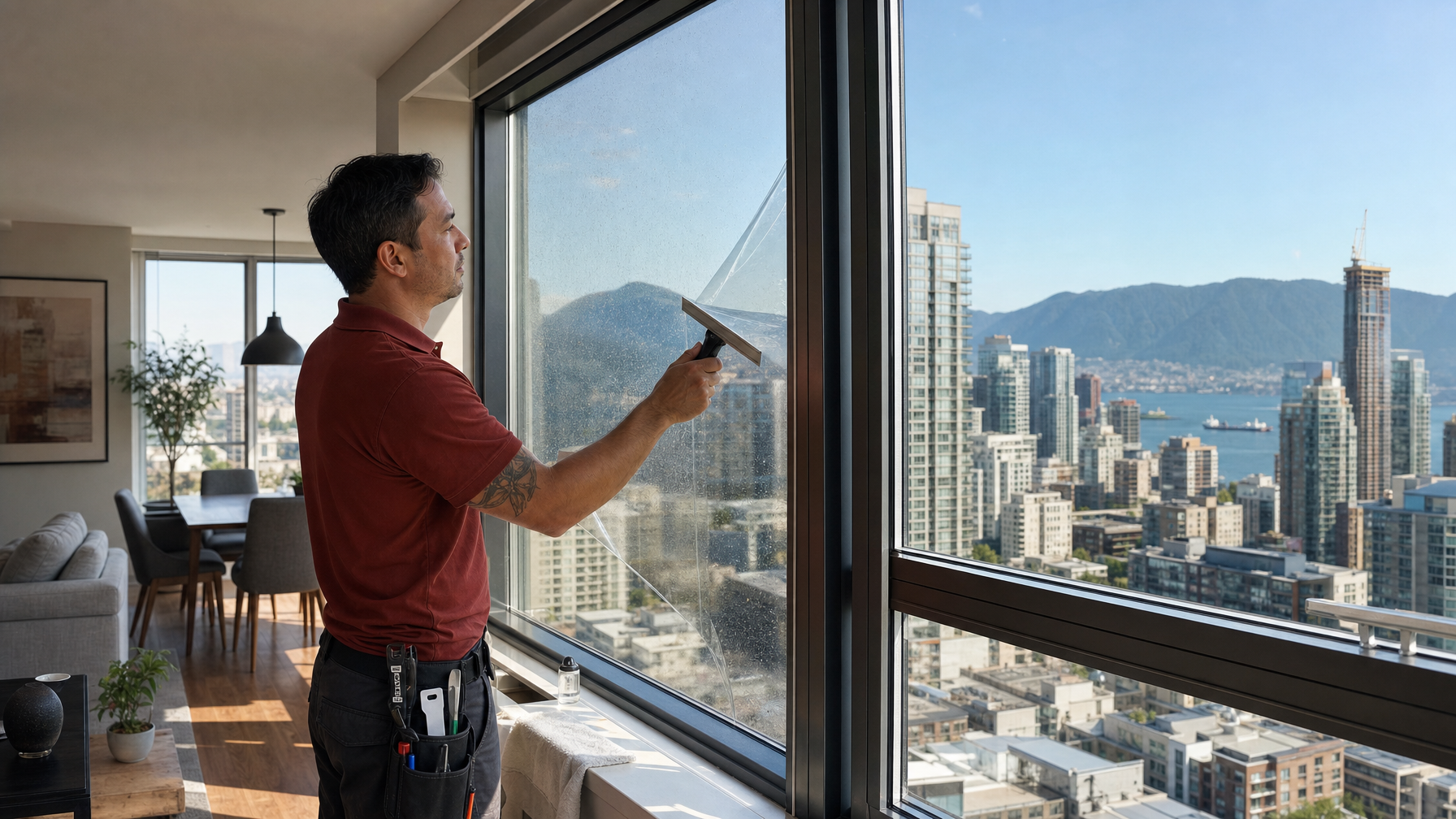
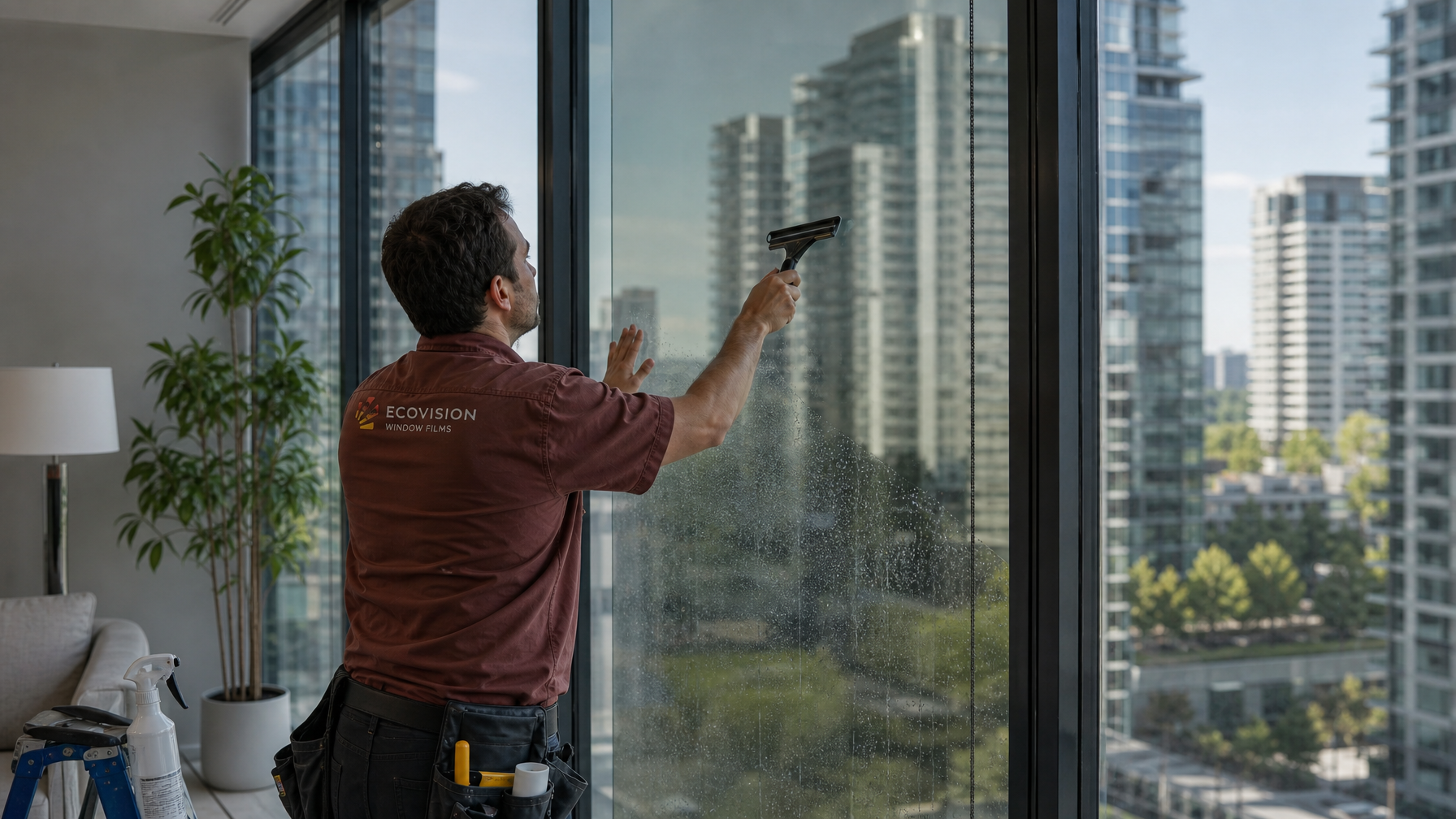
Yes, quality solar control window film blocks 40, 80% of solar heat entering through glass, depending on the film grade. In Metro Vancouver’s climate, where west-facing and south-facing rooms can run 8, 12°C above ambient temperature on summer afternoons, professionally installed solar film delivers an immediate and measurable reduction in heat load without blocking views or requiring a building permit.
It’s a fair question to ask, because window film has a complicated reputation. There’s a lot of cheap, low-quality tint on the market, the kind sold in auto supply stores and online marketplaces, that gives mediocre results and often fails within a few years. There’s also a history of overstatement in marketing claims for solar film products. So let’s be precise about what professionally installed solar control film actually does, and what it doesn’t do, in the specific context of Vancouver’s climate.
For the full technical breakdown of solar film types and performance metrics, see our Complete Guide to Solar Control Window Film in Vancouver. This post focuses specifically on the heat-blocking question.
How Window Film Blocks Heat: The Mechanics
Solar radiation is composed of three components: ultraviolet light (UV, about 5% of solar energy), visible light (about 44%), and near-infrared radiation (NIR, about 51%). The heat you feel through a window, the radiant warmth on your face or arm near a south-facing window on a sunny day, is almost entirely NIR. Visible light contributes very little to heat load. UV contributes none.
Standard clear glass allows most of this spectrum through. A typical uncoated double-pane window has a Solar Heat Gain Coefficient (SHGC) of around 0.55, 0.70, meaning it allows 55, 70% of total solar energy (across UV, visible, and NIR) to pass into the building as heat. Modern energy-efficient windows with factory-applied low-e coatings perform better, SHGC of 0.20, 0.40, but the installed base of older windows in Metro Vancouver’s building stock still skews much higher.
Solar control window film works by intercepting the solar spectrum before it fully penetrates the glass. The mechanism differs by film type:
- Reflective film uses a metallic sputtered layer to reflect solar radiation back before it enters the glass, think of it like a one-way mirror for solar energy
- Ceramic film uses nano-ceramic particles that absorb and dissipate NIR at the glass surface, with the heat venting outward rather than inward
- Hybrid film combines both mechanisms for a middle-ground performance and appearance profile
The result of any of these mechanisms is a lower SHGC for the glazing system, less solar heat gets through to the interior.
What to Realistically Expect in Vancouver Summers
Let’s ground this in what Vancouver summers actually look like. Environment Canada data for the Metro Vancouver area shows the city now averages 28 or more days above 25°C between May and September. Peak solar intensity hits west-facing windows between roughly 2:00 PM and 7:00 PM from June through August, exactly the hours when offices and homes are most occupied and most uncomfortable.
A typical west-facing condo suite in a glass-heavy tower without any solar film can see interior surface temperatures (the temperature of the glass surface and adjacent air) running 10, 15°C above the air temperature outside. The air conditioning or mini-split has to work continuously to compensate. Even with HVAC running, the radiant heat from the glass makes occupants near the windows uncomfortable, the air may be 22°C, but the radiant load from a hot glass surface makes it feel much warmer.
After solar film installation:
- Surface temperatures on the glass drop noticeably, a high-performance ceramic film can reduce glass surface temperature by 5, 8°C on a hot afternoon
- The radiant heat load on occupants near windows is dramatically reduced
- Air conditioning cycles less frequently and achieves the set temperature more reliably
- Rooms that were previously unusable during peak sun hours become comfortable
The change is not subtle. Most Vancouver homeowners and office managers who install solar film describe the difference as immediately obvious, not something they need to measure on a thermometer, but something they feel as soon as they’re near the windows on a sunny afternoon. Learn more about how this applies to specific film choices on our energy-saving window film page.
With Film vs Without Film: Performance Comparison
Here’s a practical comparison of glazing system performance with and without solar film, using typical Metro Vancouver conditions:
| Condition | Uncoated Double-Pane (Typical Pre-2016) | With Reflective Solar Film | With Ceramic Solar Film |
|---|---|---|---|
| SHGC | 0.55, 0.70 | 0.22, 0.30 | 0.20, 0.28 |
| Solar heat blocked | 30, 45% | 60, 75% | 65, 80% |
| Visible light transmission | 70, 80% | 20, 35% | 40, 60% |
| UV rejection | 25, 40% | 99% | 99% |
| Exterior appearance | Clear | Reflective/mirrored | Near-clear to lightly tinted |
| Interior feel on hot afternoon | Noticeably warm near glass | Significantly cooler | Significantly cooler |
The numbers show the effect clearly: adding solar film to a standard pre-2016 double-pane window can roughly double the glazing system’s solar rejection performance. An uncoated double-pane blocking 35% of solar heat becomes a film-coated system blocking 70, 80%, moving from “ineffective” to “high performance” without replacing the window.
Which Film Grades Block the Most Heat?
Heat-blocking performance varies significantly across film grades. Here’s the ranking from highest to lowest heat rejection, based on the LLumar and Vista product lines that Ecovision installs:
Ceramic solar film (highest heat rejection): LLumar AIR series and Vista’s ceramic-grade films achieve SHGC of 0.20, 0.25, the highest performance available in commercially installed solar film. These films use nano-ceramic technology to block NIR without the reflective appearance of metallic film. They maintain 40, 60% visible light transmission, making them appropriate for residential condos and commercial offices where views matter. Installed cost: $12, $18/sq ft CAD.
Reflective solar film (high heat rejection, lower cost): Metallic reflective film achieves comparable SHGC performance (0.22, 0.30) at a lower installed cost ($9, $12/sq ft). The trade-off is appearance: reflective film gives windows a mirrored exterior look. For industrial or commercial buildings where appearance is secondary to performance, or for residential applications where the reflective look is acceptable, this is the most cost-effective high-performance option.
Dual-reflective film (strong heat rejection + daytime privacy): Dual-reflective film is engineered to appear less reflective from the inside than from the outside. It achieves SHGC of 0.22, 0.30 and adds a daytime privacy benefit, people outside cannot easily see in during daylight hours. For west-facing offices in central Vancouver where afternoon sun and external sightlines are both concerns, dual-reflective is a popular choice. Installed cost: $11, $16/sq ft.
Neutral/subtle tint film (moderate heat rejection): These films offer a moderate SHGC improvement (0.28, 0.40) while preserving the most natural appearance of the window. Heat rejection is real, significantly better than no film, but not as dramatic as the other categories. Best suited to heritage buildings, strata complexes with strict exterior uniformity requirements, or situations where the primary goal is UV protection and modest glare reduction. Installed cost: $10, $15/sq ft.
What Solar Film Doesn’t Do
It’s worth being honest about the limits of solar film, because overselling leads to disappointed customers.
Solar film does not insulate glass in the traditional sense, it does not stop conductive heat transfer the way adding mass or insulation to a wall does. On a cold Vancouver winter night, a window with solar film is not dramatically warmer to the touch than the same window without it (though some low-e grades have a modest insulating effect). The primary benefit is solar heat gain reduction, which is a summer and bright-afternoon phenomenon.
Solar film does not make a poorly ventilated building comfortable on its own. If a room has no air movement and is significantly overheated due to other sources (equipment, people, hot air infiltration), solar film reduces one input but can’t compensate for all of them. In most Metro Vancouver residential and commercial overheating situations, however, the glass is the dominant heat source, and that’s precisely what solar film addresses.
Finally, solar film is not a substitute for mechanical cooling when cooling is required. It reduces the peak load and reduces how often mechanical cooling is needed, which is where the energy savings come from, but on Vancouver’s occasional very hot days (above 32°C, as happened in 2021 and has been increasingly common since), mechanical cooling remains necessary.
Cost and Next Steps
Professional solar control window film installation in Metro Vancouver costs $9, $18 per square foot CAD for residential projects (LLumar or Vista certified film, installed by Ecovision). Commercial projects run $9, $22 per square foot depending on access, floor height, and film grade. For a detailed breakdown of what drives cost, see our 2026 BC solar window film pricing guide.
Ecovision provides free on-site estimates across Metro Vancouver and the Lower Mainland. Call (236) 862-0052 or visit our contact page to book your estimate. We bring film samples so you can see exactly how each grade will look on your glass before committing.