
If you are managing a commercial property, strata building, or home in the Lower Mainland and your window film is peeling, bubbling, or simply past its useful life, one question comes up constantly: can you remove window film and put it back on? The short answer is no, and understanding why matters before you commit to a removal job.
Most professionally installed window film can be removed from glass without damage, but it cannot be reapplied after removal. The adhesive is single-use and loses its bonding properties during the peel process. Ecovision Window Films serves property owners and managers across Vancouver, BC and the Lower Mainland, and recommends complete removal followed by a fresh installation, starting at $9 per square foot.
Can Window Film Be Removed Without Damaging the Glass?
Yes, when removed correctly, professionally installed window film comes off glass without leaving permanent damage. The key variables are film age, adhesive type, and application method. Film installed within the last 5 to 10 years on standard float glass typically peels cleanly. Film that has been on glass for 15 or more years can leave stubborn adhesive residue that requires additional solvents to remove.
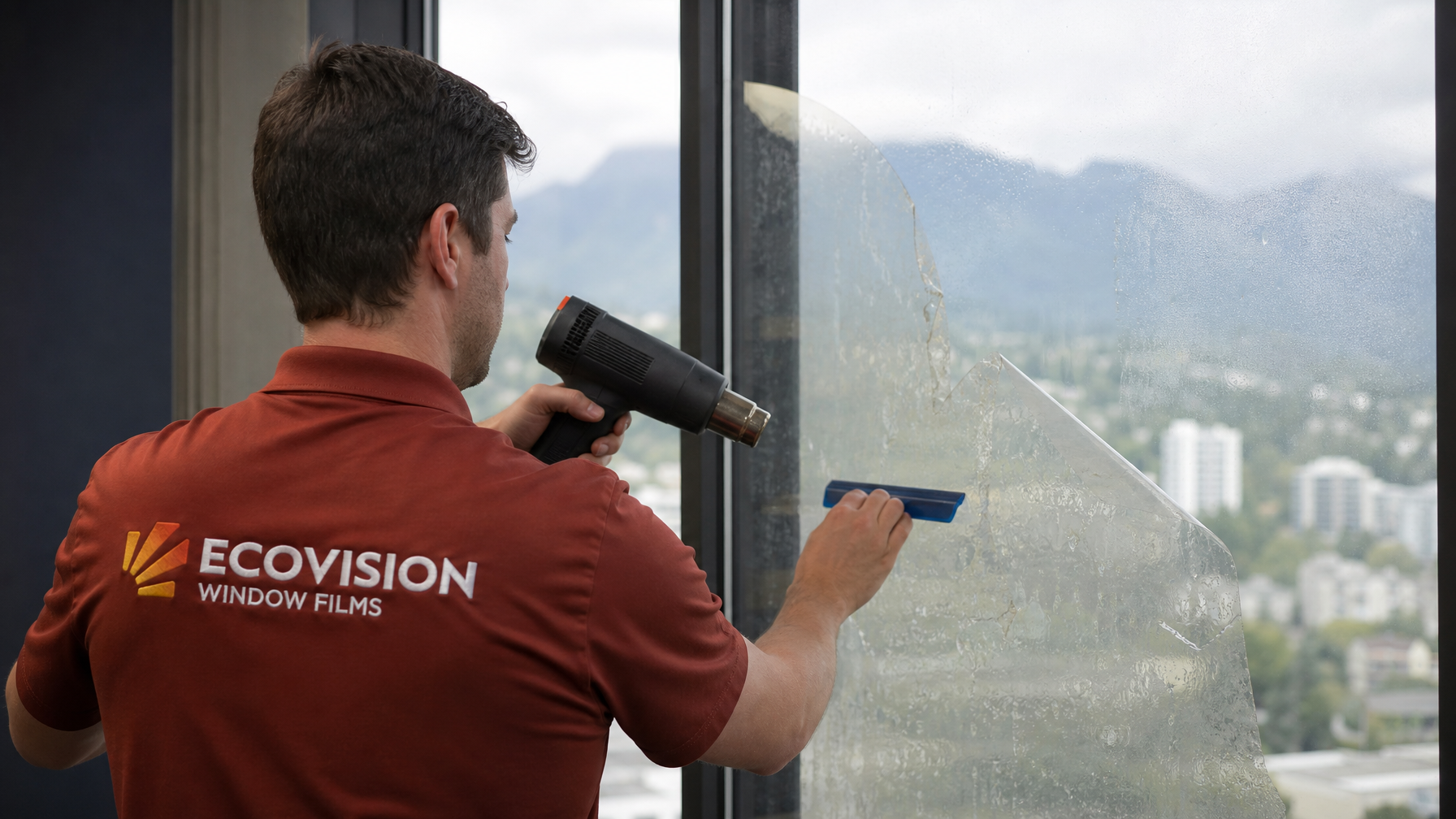
The main risk during DIY removal is scratching the glass surface with metal tools. Professional removal teams use non-scratch plastic scrapers and heat application (typically 120, 150°F using a heat gun or steamer) to soften the adhesive before peeling. At commercial properties such as Bentall 4 in downtown Vancouver, Ecovision has removed aging solar control film across multi-floor glazing systems and restored the glass to a clean, residue-free surface ready for new LLumar film, without a single pane replacement.
One important exception: tempered, coated, or low-e glass requires extra care. Certain factory-applied coatings on low-e double-pane units can be disturbed by aggressive solvent use. Always verify your glass type before removal.
Why Can’t Window Film Be Reapplied After Removal?
Professionally installed window film uses a pressure-sensitive adhesive (PSA) that forms a permanent bond with the glass surface on contact. Once the film is peeled away, the adhesive either stays on the glass (and must be cleaned off) or tears and fragments on the film itself. In either case, the adhesive layer is no longer intact or evenly distributed, meaning the film cannot re-bond to glass without bubbles, lifting edges, and gaps.
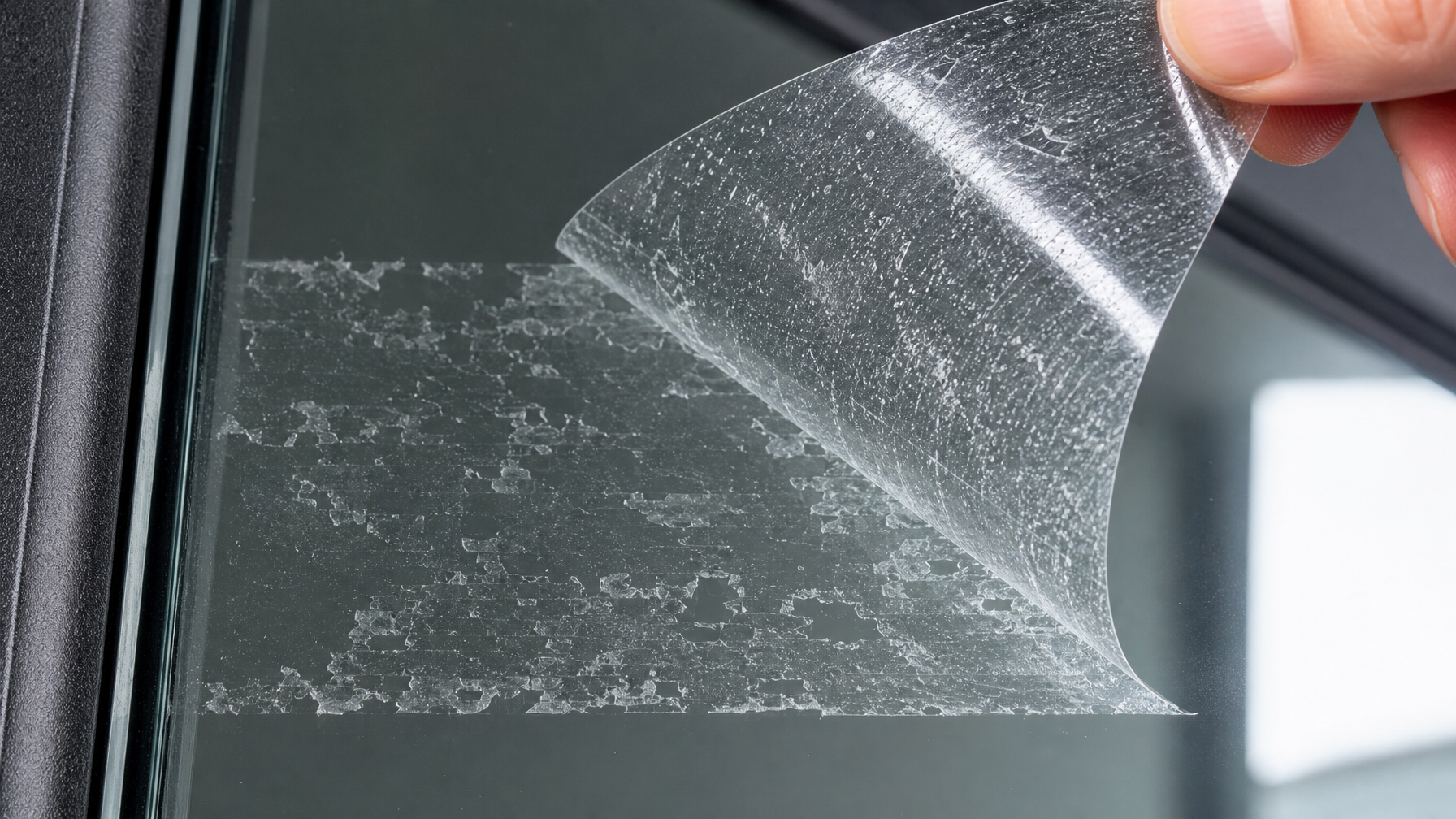
LLumar and Vista films, the two certified brands Ecovision installs, both use single-use PSA construction. This is by design: the adhesive is formulated for maximum optical clarity and long-term bond stability, not repositionability. In testing, peeled PSA film retains less than 20% of its original bond strength. For a product expected to perform in BC’s temperature swings, from below 0°C in January to 35°C+ in July, that residual adhesion is insufficient.
The only window film products that can be repositioned are static-cling films and certain short-term decorative films. These are not the same products used in professional architectural installations and typically offer lower heat rejection, UV blockage, and longevity.
What Are the Signs Your Window Film Needs Replacing?
Knowing when to replace rather than repair window film saves property owners time and money. The five most common indicators are:
- Bubbling or blistering, small bubbles that do not disappear after the cure period (typically 30, 60 days post-install) indicate adhesive failure or moisture intrusion
- Peeling or lifting at edges, once an edge begins to lift on a PSA film, the entire pane typically needs replacement within 1, 2 seasons
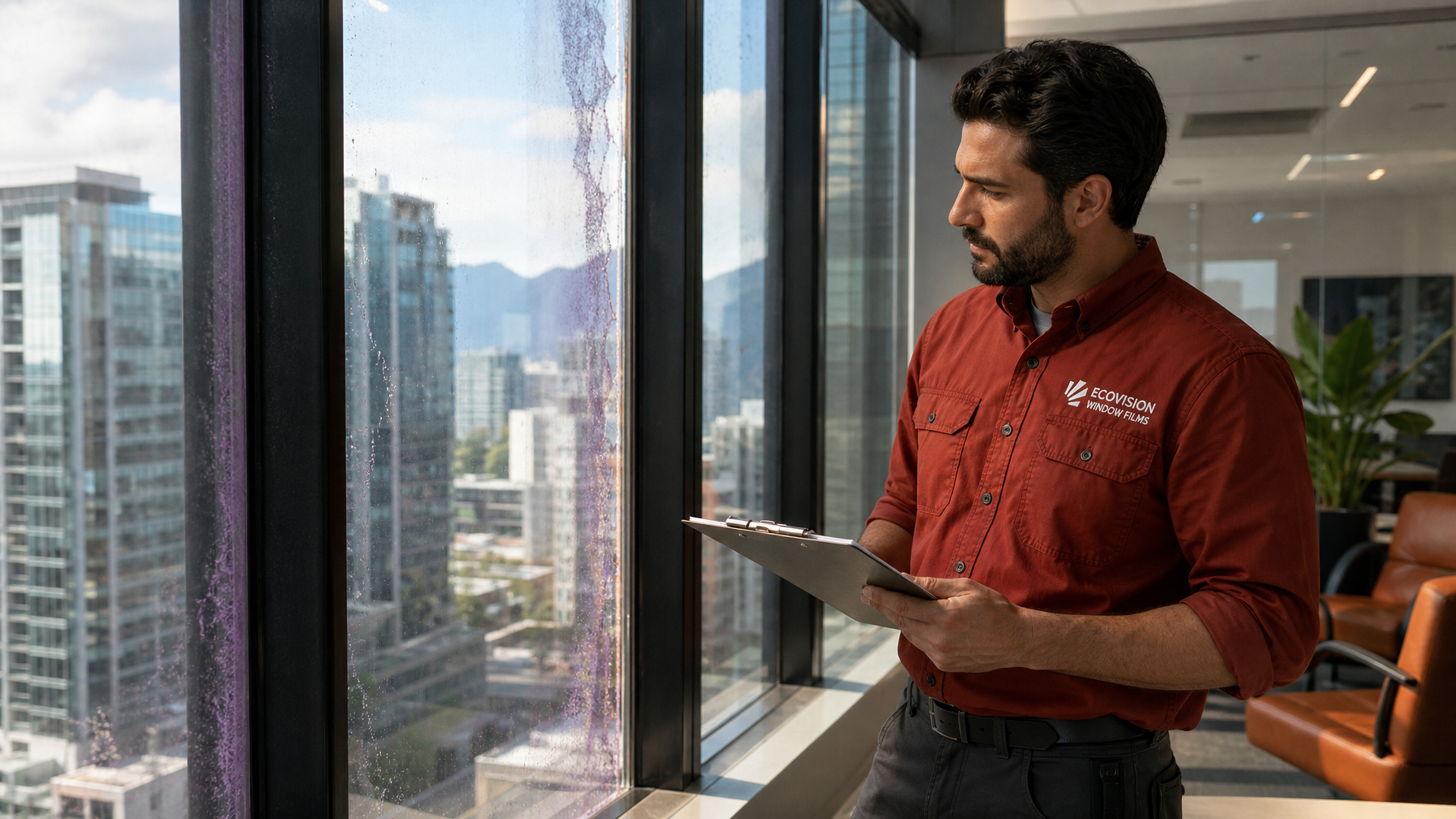
- Purple or pink discolouration, a sign of UV degradation specific to dyed films; ceramic and sputtered films do not turn purple
- Hazing or reduced clarity, caused by adhesive breakdown, often accelerating after the 15-year mark on lower-grade films
- Significantly reduced heat rejection, if tenants are reporting heat gain has increased noticeably, the film’s IR-blocking properties may have degraded
Under the BC Energy Step Code and CleanBC targets for existing commercial buildings, property managers have additional incentive to upgrade aging solar control film, newer ceramic film technology can block up to 80% of solar heat gain compared to 40, 55% for older dyed films, meaningfully reducing HVAC loads.
How Does Professional Window Film Removal Work in BC?
A professional window film removal in Vancouver follows a consistent process regardless of building type:
- Glass assessment, the installer identifies the glass type (float, tempered, coated, low-e) and the film age and condition. This determines the removal method: dry peel, steam assist, or solvent-assisted.
- Workspace prep, window sills, frames, and adjacent surfaces are protected. On commercial sites, WorkSafeBC protocols for working at height may apply if lifts or ladders are needed.
- Peel and remove, film is scored at the corner and peeled at a 30, 45 degree angle. Heat is applied continuously ahead of the peel line to prevent tearing. Large commercial panes are typically sectioned to manage peel tension.
- Adhesive clean-up, residual adhesive is removed using 91% isopropyl alcohol, commercial adhesive remover, or a diluted mineral spirits solution. Razor blades on a wet surface can be used on float glass; never on tempered.
- Surface inspection, glass is cleaned and inspected under raking light to confirm no scratches, hazing, or residue before new film installation begins.
For residential window film removal in the Lower Mainland, a standard home (10, 15 windows) typically takes 4, 6 hours. Commercial floor-plate removal on a mid-rise building can take 2, 4 days depending on access and film condition.
Window Film Types and Removal Difficulty in BC
Not all films remove the same way. The table below summarises what to expect based on film type:
| Film Type | Typical Lifespan | Removal Difficulty | Replacement Cost (per sq ft installed) |
|---|---|---|---|
| Dyed solar control | 7, 10 years | Easy, peels cleanly | $9 – $14 |
| Metalized solar control | 10, 15 years | Moderate, residue common | $10 – $18 |
| Ceramic solar control | 15, 20+ years | Easy, minimal residue | $12 – $18 |
| Frosted / privacy film | 10, 15 years | Easy to moderate | $9 – $14 |
| Safety film (4, 7 mil) | 10, 15 years | Moderate, thicker film, tears less | $12 – $18 |
| Security film (8, 14 mil) | 15, 20+ years | Difficult, adhesive penetrates micro-etches | $16 – $22 |
| Bird-safe patterned film | 10, 15 years | Easy, similar to solar film | $10 – $16 |
What Does It Cost to Remove and Replace Window Film in Vancouver?
Professional removal is typically quoted separately from the new film installation. In Metro Vancouver, removal labour runs $2 – $5 per square foot depending on access complexity, film age, and adhesive condition. New film installation starts at $9 per square foot for standard solar control film, up to $22 per square foot for 14-mil security-grade film.
For a typical 1,500 sq ft office suite replacing aging solar film: expect $3,000, $6,500 for removal and $13,500, $27,000 for new LLumar or Vista ceramic installation. Strata buildings and commercial property managers often negotiate volume rates for multi-floor or multi-unit removal-and-replacement projects. At Rosemary Heights Seniors Village in Surrey, Ecovision completed a full removal-and-replacement of privacy and UV film across the common areas, the volume scope brought the per-square-foot rate to the lower end of the range while meeting the facility’s resident comfort and UV protection requirements.
For a free on-site assessment of your existing film condition and replacement quote, call Ecovision at (236) 862-0052 or visit ecovisioncanada.com/contact.
Is DIY Window Film Removal Worth Attempting?
For a single residential window with accessible, well-maintained film, DIY removal is reasonable. For anything involving tempered glass, commercial glazing, high-access windows, or film older than 15 years, professional removal is strongly recommended. The risks in a DIY attempt on aged film include:
- Scratching glass with metal tools, replacing a scratched pane can cost $300, $1,200+ in Metro Vancouver
- Incomplete adhesive removal leaving a hazy surface that reduces privacy window film optical clarity after reinstallation
- Voiding any warranty on the new film, LLumar and Vista certified installers require a clean glass surface for warranty coverage
If you are replacing film as part of a strata building or commercial property upgrade, professional removal-and-replace also creates documentation: installation records, adhesive specification sheets, and energy performance data that can support CleanBC reporting or WorkSafeBC compliance records for the building file.
Related Articles
- How to Remove Window Film Without Damaging Your Windows
- How to Remove Frosted Window Film Without Damaging the Glass
- How to Remove Window Film Adhesive: What Works, What Does Not, and What BC Property Owners Need to Know
- How Long Does Professionally Installed Window Film Last in BC?
- How Much Does Window Film Cost in BC? (2026 Pricing Guide)
Frequently Asked Questions
About the Author: This article was written by the Ecovision Window Films team, led by Xander, Co-Founder and Director of Operations at Ecovision. Xander brings over 10 years of hands-on installation experience, backed by a family with over 50 years in the installation trades, including window film. His military background reinforces the precision and discipline Ecovision applies to every project. Ecovision is a certified installer for leading film brands with completed projects for healthcare facilities, government buildings, and commercial properties throughout the Lower Mainland. For a free site assessment, call (236) 862-0052 or visit ecovisioncanada.com/contact/.