
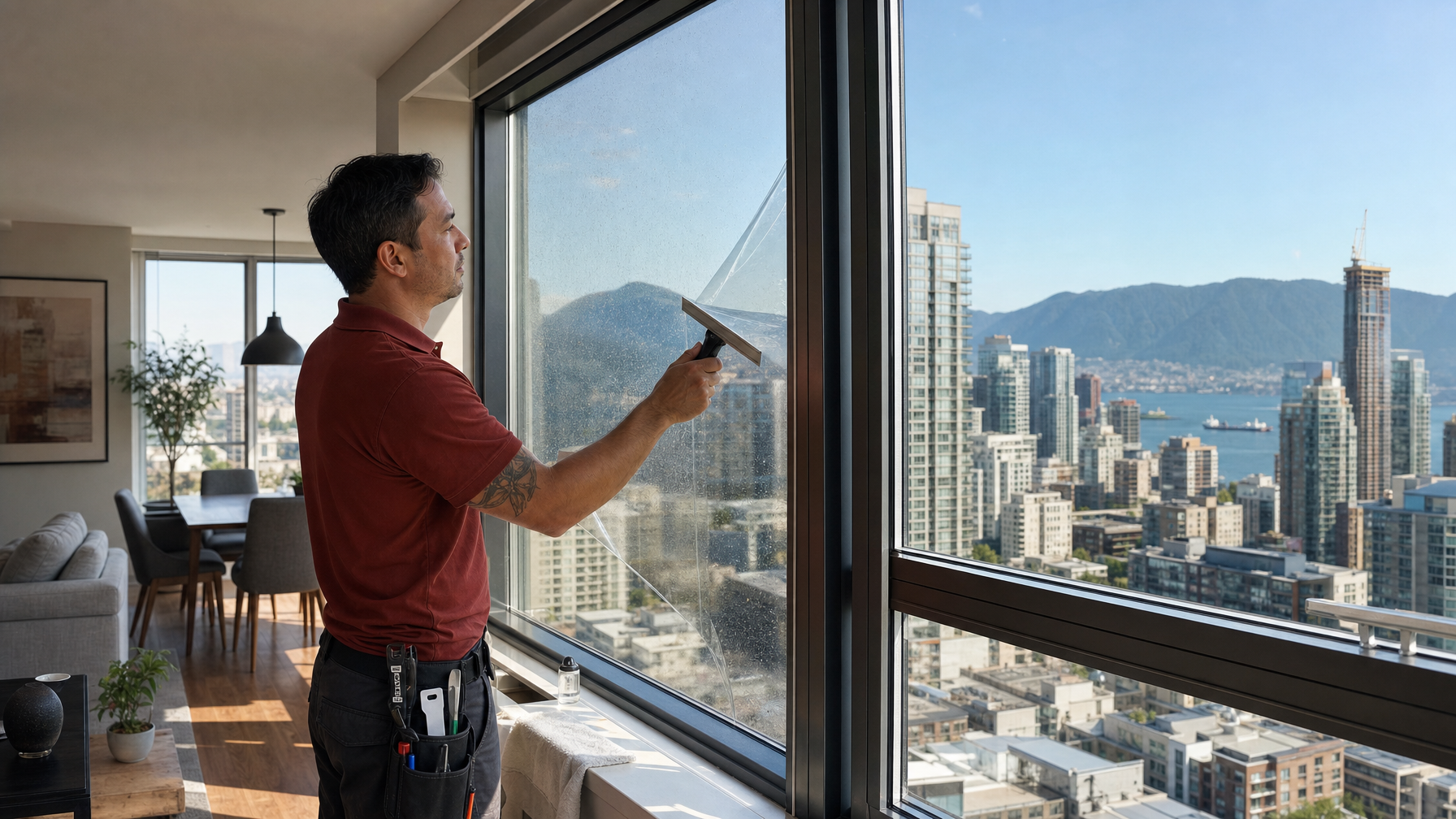
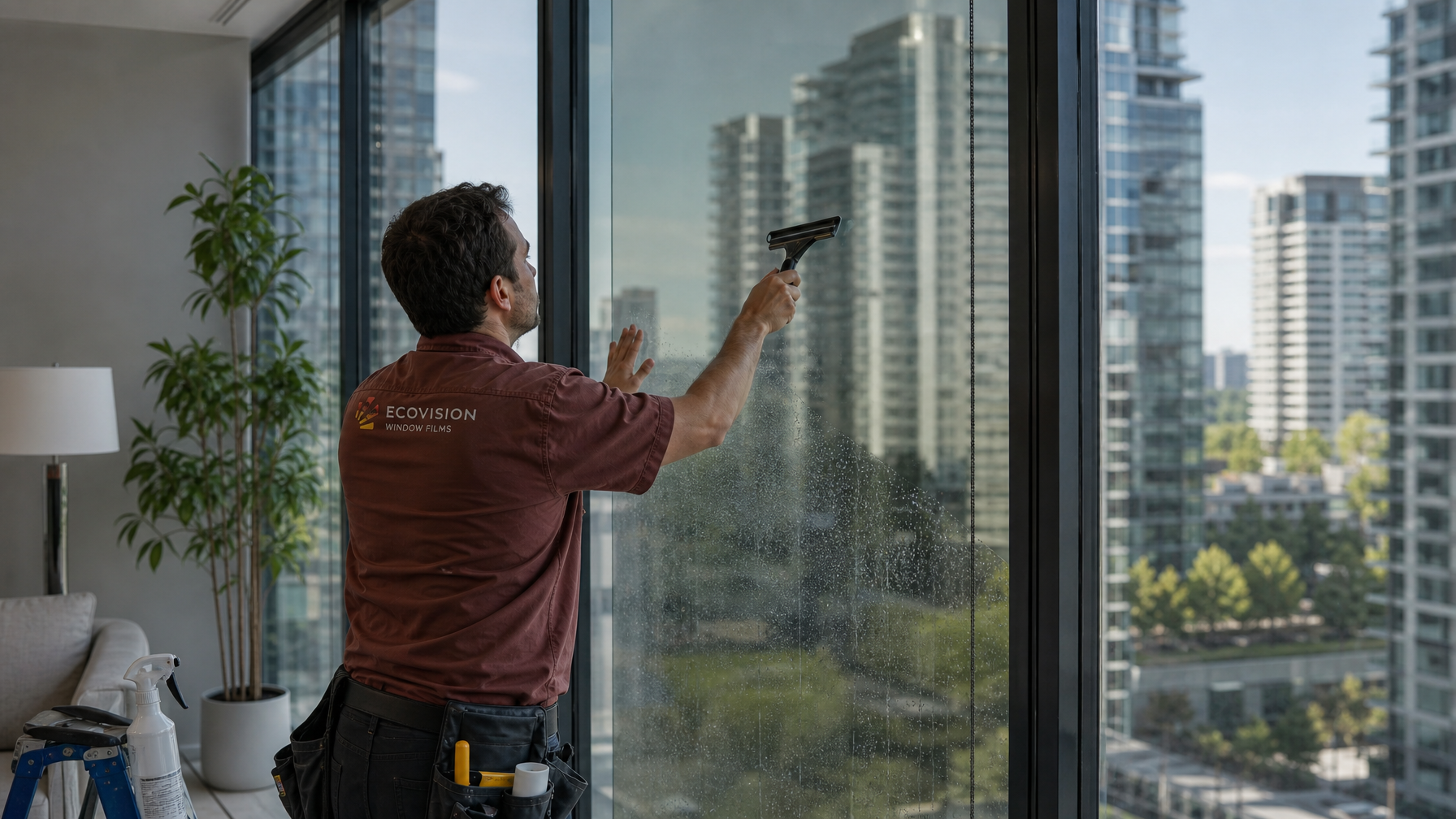
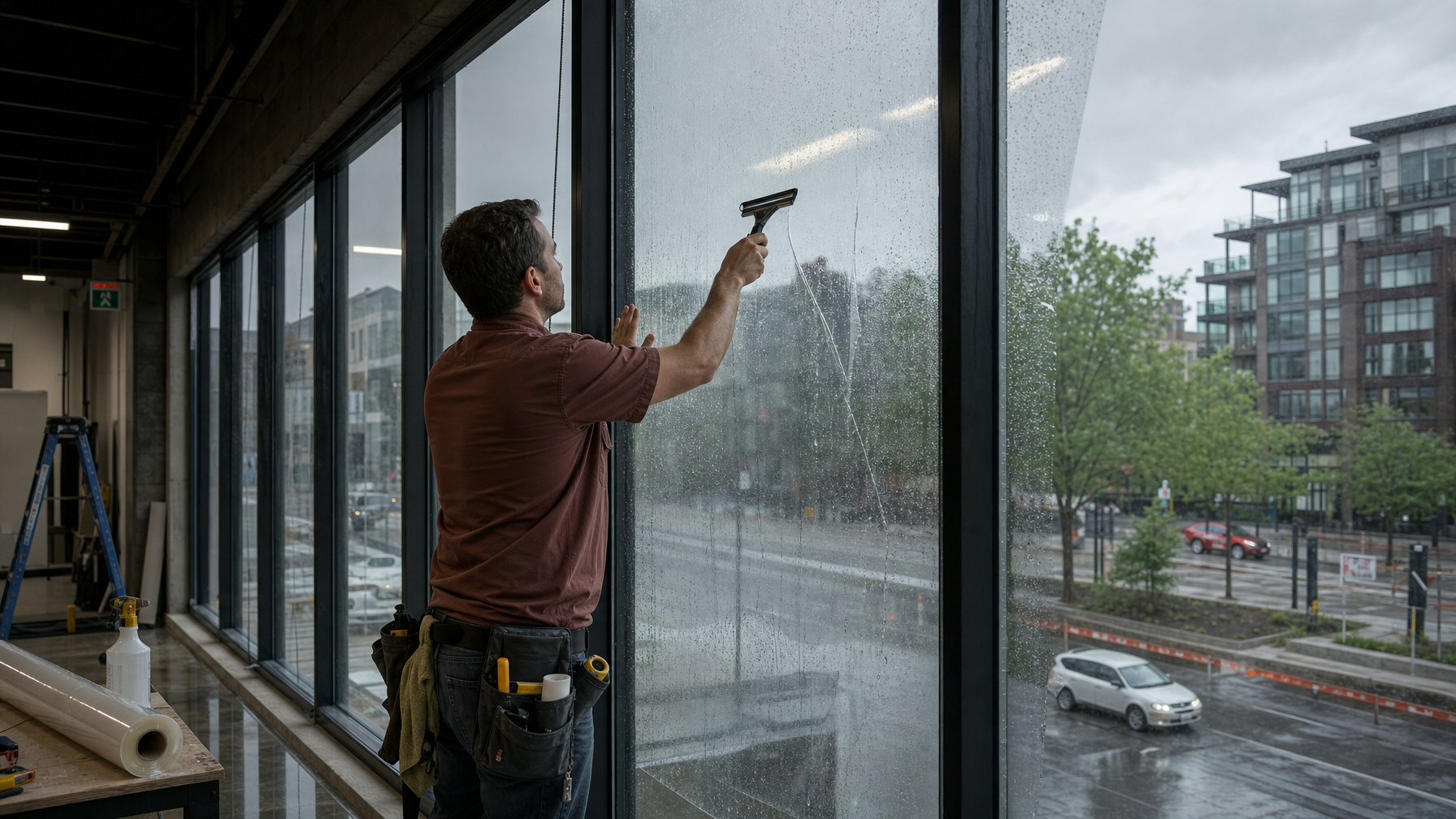
Solar heat gain reduction in Vancouver commercial buildings is achieved by applying spectrally selective window film that reduces the Solar Heat Gain Coefficient (SHGC) of existing glazing from a typical 0.55, 0.70 to 0.20, 0.30. In BC office buildings with large south or west-facing glass, this translates to a 40, 80% reduction in solar heat load without replacing windows or modifying the building envelope.
What Is Solar Heat Gain and Why Does It Matter in BC Commercial Buildings?
Solar Heat Gain Coefficient (SHGC) is the fraction of solar radiation admitted through a window, both directly transmitted and absorbed and re-radiated inward. A window with an SHGC of 0.70 allows 70% of incident solar energy into the building as heat. For a commercial floor with 500 square feet of south-facing glazing, that difference between SHGC 0.70 and SHGC 0.25 can represent thousands of BTUs per hour of unwanted heat load every sunny afternoon.
Metro Vancouver records 28 or more days above 25°C between May and September, and west-facing office facades regularly reach surface temperatures that push indoor ambient air well above the 24°C upper comfort threshold. The thermal comfort cascade is predictable: overheating zones trigger calls to facilities, HVAC systems run beyond design capacity, energy costs spike, and affected tenants begin questioning lease renewals. Reducing solar heat gain at the glass intercepts the problem before it enters the building.
BC Energy Step Code context: BC’s Energy Step Code establishes tiered glazing performance targets for commercial building envelopes. While the Step Code primarily governs new construction, window film applied as a post-construction retrofit can help bring existing glazing closer to current performance benchmarks, an increasingly important consideration as buildings undergo energy audits for BOMA BEST certification or BC Hydro program eligibility.
WorkSafeBC thermal comfort obligations: Under the BC Occupational Health and Safety Regulation, employers are required to maintain thermal comfort conditions that do not endanger worker health. Persistent solar heat gain in glass-heavy workspaces, particularly in buildings without supplemental perimeter cooling, creates documented WorkSafeBC exposure risk. Window film is a recognized engineering control for reducing radiant heat at the source.
How Window Film Reduces Solar Heat Gain in Existing Buildings
Spectrally selective window film works by targeting the near-infrared (NIR) portion of the solar spectrum, the wavelengths responsible for heat without contributing to visible light. High-performance ceramic and sputtered metal alloy films block 50, 80% of near-infrared radiation while transmitting the majority of visible light. The result is a cooler interior without the cave-like darkness associated with older reflective bronze or charcoal films.
The table below summarizes typical SHGC improvements across the glazing types most common in Metro Vancouver’s commercial building stock:
| Glazing Condition | Before Film SHGC | After Film SHGC | Heat Reduction |
|---|---|---|---|
| Single pane (older stock) | 0.70, 0.86 | 0.18, 0.25 | ~70% |
| Double pane standard IGU | 0.55, 0.70 | 0.20, 0.32 | ~50, 65% |
| Double pane low-e | 0.30, 0.45 | 0.18, 0.28 | ~35, 45% |
Visible light transmission (VLT) is preserved in modern ceramic film lines. LLumar’s AIR series and Vista’s V-Series and S-Series commercial solar films maintain 40, 60% VLT, enough to sustain daylit work environments and avoid triggering supplemental artificial lighting loads. For property managers balancing comfort, energy performance, and tenant satisfaction, this combination of high heat rejection and preserved natural light is the key differentiator from older film technologies.
Buildings in Metro Vancouver That See the Highest Solar Heat Gain Impact
Not all commercial buildings experience solar heat gain equally. The following property categories in Metro Vancouver consistently present the strongest case for solar film installation:
- Burrard Corridor office towers: South and west facade exposure combined with curtain wall glazing ratios above 60% creates sustained afternoon heat load from June through September. Many buildings in this corridor were constructed before modern low-e glass became standard.
- Broadway Plan commercial buildings: The Broadway Plan’s density corridor is producing high-glazing-ratio mixed-use commercial floors where solar heat gain is a design-stage challenge. Retrofit film addresses heat problems in existing stock while new construction standards catch up.
- Surrey City Centre and Metrotown high-rises: Afternoon west sun on Surrey Central and Metrotown commercial towers is among the most intense in the region. Properties in these nodes frequently see tenant complaints concentrated in the 2, 5 PM window.
- Healthcare facilities: Patient comfort and temperature regulation are clinical requirements, not just preference. Solar film in patient rooms, waiting areas, and procedure spaces reduces radiant heat exposure for both patients and clinical staff.
- Schools and post-secondary institutions: South-facing classrooms experience peak heat load during spring and fall shoulder seasons when HVAC systems are not in full cooling mode. Film provides passive heat control without mechanical system upgrades.
- Government and institutional buildings: PSPC (Public Services and Procurement Canada) sustainability requirements and BC government GHG reduction targets make solar film a documentable energy conservation measure for federal and provincial facilities.
Solar Heat Gain Reduction Cost and Payback in BC
LLumar and Vista certified commercial solar film installed by a professional window film contractor in Metro Vancouver typically runs $9, $22 per square foot depending on film specification, access complexity, and glazing configuration. For a typical single commercial floor with 500 square feet of treated glass, the installed cost ranges from approximately $4,500 to $9,000 CAD.
The financial case is built on cooling load reduction. Glass-heavy commercial floors in BC’s climate typically see a 10, 30% reduction in cooling energy after solar film installation, with the higher end of that range applying to buildings with older single-pane or clear double-pane glazing on south and west facades. In a building where summer cooling represents a significant share of electricity spend, that reduction compounds quickly.
BC Hydro commercial rebates: BC Hydro’s Commercial Energy Saving Incentives program offers rebates for qualifying energy efficiency measures. Window film installations that can demonstrate measurable cooling load reduction may be eligible, Ecovision can provide the SHGC documentation and energy modelling support needed for rebate applications.
Accounting for energy savings alone, most commercial solar film installations in BC achieve a payback period of 3, 7 years. When tenant retention, reduced HVAC maintenance load, and deferred mechanical upgrades are included in the analysis, the effective payback is often shorter.
SHGC Requirements Under BC’s Energy Step Code
BC’s Energy Step Code sets prescriptive and performance-based glazing targets for commercial buildings, with SHGC requirements tightening at higher Steps. While window film is a post-construction measure and does not alter a building’s original as-built compliance record, it does improve the effective thermal performance of existing glazing, and that improvement is documentable.
For buildings undergoing energy audits, BOMA BEST recertification, or targeting LEED Operations and Maintenance credits, Ecovision provides:
- SHGC improvement data for the specific film and glazing combination installed
- Manufacturer performance documentation from LLumar and Vista
- Installation records suitable for inclusion in building energy audit files
- Support documentation for BC Hydro rebate applications
LEED and BREEAM credits: Solar window film contributes to Energy and Atmosphere credits under LEED v4 O+M and to Energy category credits under BREEAM In-Use. For property managers managing certified buildings or pursuing certification for existing stock, film installation is one of the lower-cost interventions with direct credit pathway relevance.
Frequently Asked Questions
What SHGC should I target for a Vancouver office building?
For south and west-facing commercial glazing in Metro Vancouver, targeting a post-film SHGC of 0.20, 0.30 is the practical sweet spot. This range achieves meaningful heat load reduction while preserving adequate visible light transmission for occupied workspaces. Buildings with particularly intense afternoon west exposure, or with WorkSafeBC thermal comfort concerns, may benefit from film specifications that bring SHGC closer to 0.18, 0.22.
Can solar heat gain reduction film be applied to existing double-pane windows?
Yes, with important caveats. Most commercial solar films are suitable for the interior surface of double-pane insulated glass units (IGUs). However, some high-absorption films applied to sealed IGUs can cause thermal stress that voids the IGU seal warranty. Ecovision assesses glazing type before recommending a film specification, LLumar and Vista both offer film lines specifically rated for dual-pane application with low seal-stress profiles.
How do I know if my building needs solar heat gain reduction?
The clearest indicators are: tenant complaints about heat concentrated on specific facades or floors, HVAC systems that cannot maintain comfort targets on sunny afternoons, perimeter offices that are uncomfortably warm even when the building’s core areas are fine, and energy bills that spike disproportionately in summer months. If your building has south or west-facing glass with an SHGC above 0.45 and no supplemental shading, solar film is almost certainly cost-effective.
Does solar heat gain reduction film affect natural light?
Modern spectrally selective ceramic films are engineered to minimize the trade-off between heat rejection and visible light. LLumar AIR series and Vista V-Series films maintain 40, 60% visible light transmission (VLT) while rejecting the majority of near-infrared heat. Occupants typically notice a modest reduction in glare rather than a significant darkening effect. In most office environments, this is perceived as an improvement in visual comfort rather than a drawback.
What’s the difference between solar heat gain reduction film and standard window tinting?
Standard window tinting refers to dyed or basic metallic films that reduce heat primarily by absorbing solar energy, which can cause thermal stress in sealed glazing units and often results in significant visible light reduction. Spectrally selective solar heat gain reduction film uses ceramic or multi-layer sputtered technology to block near-infrared radiation selectively, rejecting heat without the same degree of visible light sacrifice. The performance gap between the two is significant: a modern spectrally selective film can achieve the same SHGC as an older bronze tint while maintaining two to three times the visible light transmission.
Ready to assess solar heat gain in your building? Call Ecovision at (236) 862-0052 to schedule a glazing assessment, or submit a project inquiry online.
Learn more: Solar Control Window Film Vancouver | Energy Saving Window Film | Office Window Tinting Vancouver