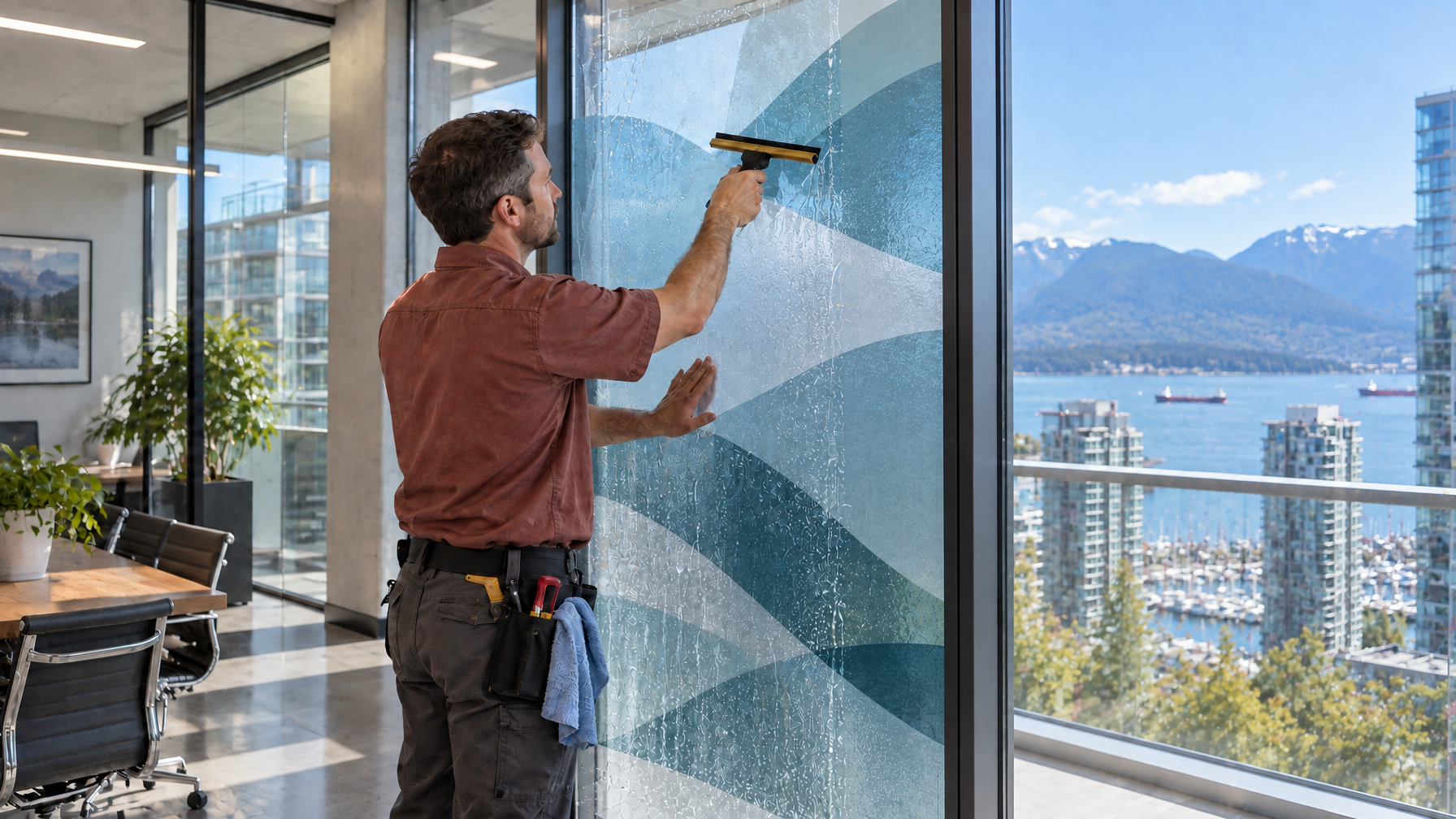
Coloured Window Film in BC: Types, Costs, and What Offices Need
Coloured window film in BC typically costs $9 – $16 per sq ft installed. Ecovision covers decorative colour, frost, and UV on office glass.

Coloured window film in BC typically costs $9 – $16 per sq ft installed. Ecovision covers decorative colour, frost, and UV on office glass.
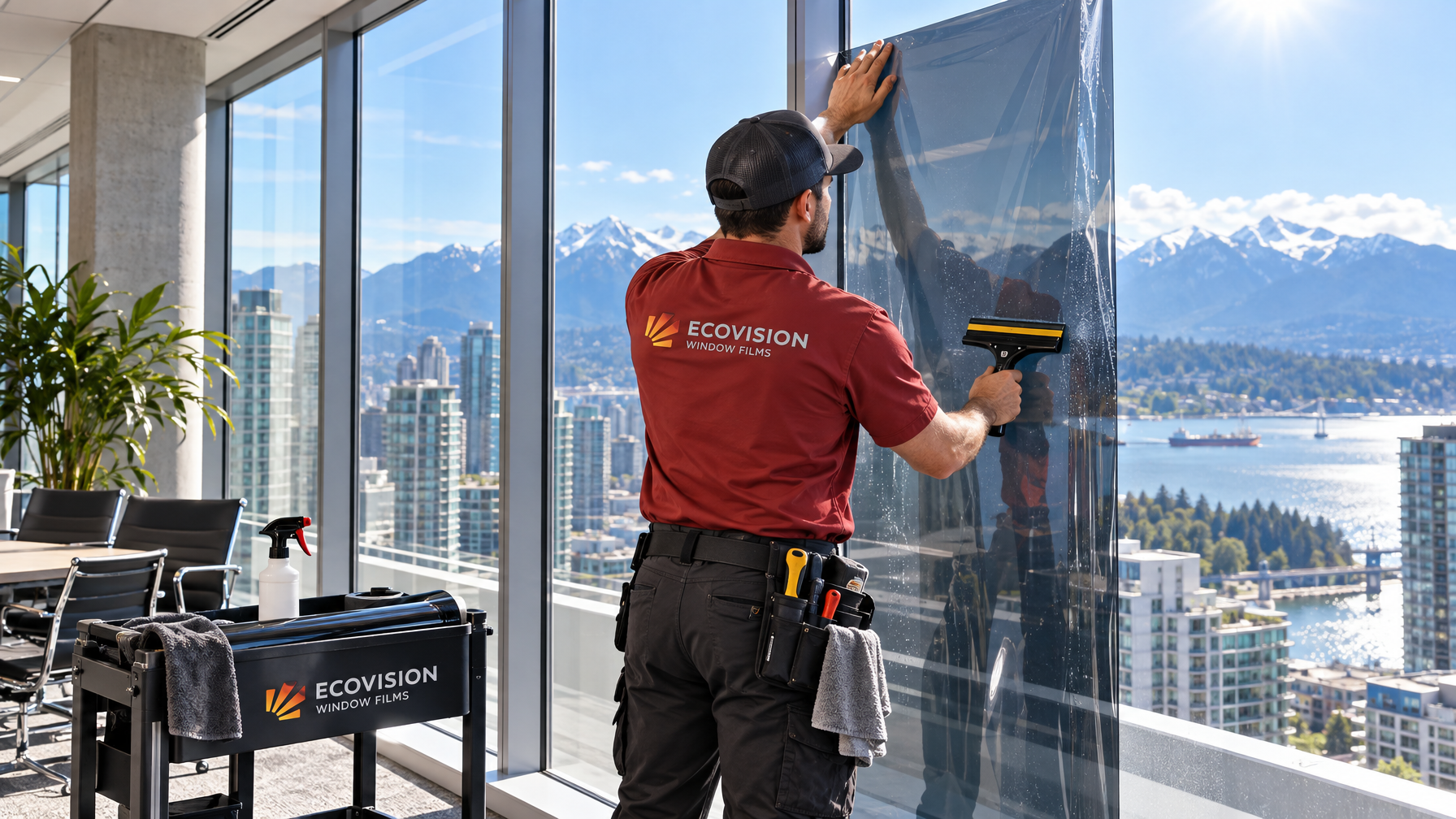
Does Window Film Block UVA Rays? What BC Property Owners Need to Know Ecovision Window Films installs solar and UV-protective film across Vancouver, Burnaby, Surrey, and the broader Lower Mainland. A question that comes up often in client consultations, particularly from strata managers, healthcare facilities, and homeowners near south-facing glass, is whether window film actually blocks UV radiation. The short answer is yes, but the more useful answer starts with understanding what type of UV you're dealing with. Does window film block UVA rays? Yes. Quality architectural window film blocks the majority of UVA radiation that passes through ordinary glass. Standard clear glass already filters most UVB, but it transmits significant UVA, particularly the longer UVA1 band (340-400 nm) responsible for photoaging and oxidative skin damage. Window film closes that gap. Products like LLumar VS60 and VS70, which Ecovision installs across residential and commercial buildings in BC, achieve greater than 99% rejection across the full UV spectrum when applied to standard clear glass. What Is the Difference Between UVA and UVB Rays? Ultraviolet radiation is not one uniform thing. The sun emits a spectrum, and UVA and UVB occupy different bands within that spectrum with meaningfully different biological effects. Radiation Wavelength Penetration Primary Biological Effect UVB 280-315 nm Superficial (epidermis) Sunburn, direct DNA damage, elevated skin cancer risk UVA2 315-340 nm Epidermis DNA and oxidative damage UVA1 340-400 nm Deeper (into dermis) Photoaging, oxidative stress, carcinogenic Visible blue 400-500 nm Varies Pigmentation effects, reactive oxygen species, not equivalent to UV cancer risk UVB photons carry more energy and directly damage DNA, which is why UVB is strongly associated with sunburn and skin cancer. UVA photons carry less energy individually but penetrate deeper into skin tissue and cause damage primarily through oxidative mechanisms. The American Cancer Society notes that both UVA and UVB contribute to skin cancer risk, and the Skin Cancer Foundation confirms that UVA passes through ordinary window glass at meaningful levels. The distinction between these two bands is exactly what makes window film relevant indoors. Does Ordinary Glass Already Block UV Rays? Yes, but only part of the UV spectrum. Standard silicate architectural glass absorbs strongly at shorter UV wavelengths. The American Cancer Society describes typical home and office windows as blocking most UVB while allowing meaningful UVA transmission. This is an important starting point for understanding what window film actually adds. Here is a simplified picture of what happens at a standard clear glass window: Radiation Ordinary Glass With UV Film UVB (280-315 nm) Mostly blocked Blocked (>99%) UVA (315-400 nm) Significant transmission Blocked (>99%) Visible light (400-700 nm) High transmission Dependent on film VLT The person sitting beside an untreated window in a Vancouver office building or strata unit is not receiving the same solar spectrum as someone standing outdoors. Glass has already altered the spectrum. But the UVA that does come through accumulates over hours each day, week after week, and that cumulative UVA exposure is where indoor UV risk is concentrated. This is why Ecovision's site assessments focus on south and southwest-facing glass in particular: prolonged direct sun exposure through untreated windows in Metro Vancouver's May-to-September season represents the highest indoor UV accumulation for most property types. Does Window Film Block UVA Specifically? Quality architectural window film blocks UVA across the full 315-400 nm band. The film achieves this through UV-absorbing compounds embedded in its polymer layers, these absorb UV photons before they transmit through the glass system into the interior. Importantly, UV rejection is not the same as visible light transmission (VLT). A film can be optically clear, appearing nearly invisible on the glass, while still blocking greater than 99% of UV radiation. LLumar VS60, for example, carries approximately 59% VLT with greater than 99% UV rejection on standard clear glass. VS70 achieves similar UV performance at approximately 62% VLT. Both are strata-friendly options in BC buildings where appearance rules restrict darker films. This also explains why the spectral transmission data from Eastman's 2026 performance workbook is more revealing than a single marketing headline. The AU85 film, measured on 3 mm clear glass, transmits approximately 26% at 400 nm but rises steeply to 88% at 450 nm, illustrating that UV rejection performance is measured across a specific wavelength range, not a uniform wall that cuts off everything below a single line. What Does ">99% UV Rejection" Actually Mean? The ">99% UV rejection" figure that appears on most quality window film specifications refers to the film's rejection of UV radiation across the defined ultraviolet wavelength band, typically 280-380 nm or 280-400 nm depending on the test method and standard applied. It does not mean the film blocks 99% of all photobiologically active radiation. Here is why that distinction matters: At approximately 400 nm, the spectrum transitions from long-wave UVA into visible violet and blue light. Film performance across this boundary varies by product. A film achieving >99% UV rejection may simultaneously transmit a substantial portion of visible light above 400 nm, which is, in fact, the desired outcome for most architectural applications, where occupant comfort and daylighting are priorities alongside UV control. The practical implication: when evaluating a film's UV protection for a specific application, such as a healthcare facility treating photosensitive patients, or a strata building with south-facing common areas, it is more useful to ask for spectral transmission data across the 300-500 nm range than to rely on a single summary figure. Ecovision's team can provide film-specific spectral performance data from Eastman's certified product workbook for any project in the Lower Mainland. Does Window Film Protect Against Blue Light? Solar-control films do reduce a portion of visible blue light (approximately 400-500 nm) depending on the product's spectral characteristics. However, it is important not to conflate blue light reduction with UV skin cancer protection. They are different biological questions. Research published in peer-reviewed photobiology journals confirms that visible blue light can influence reactive oxygen species production, pigmentation, and inflammatory signaling in skin tissue, with effects that differ meaningfully by skin phototype. That
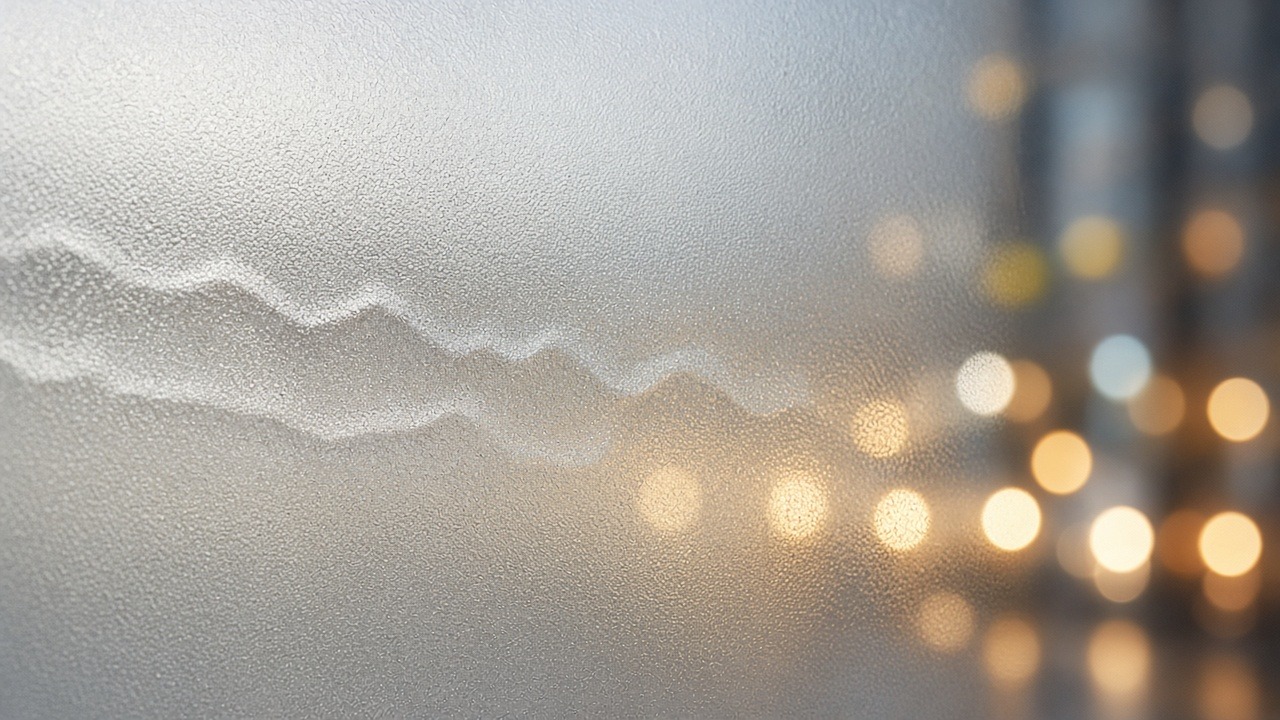
Yes. Frosted window film keeps 24-hour privacy in BC homes because it scatters light, not because of a one-way mirror. Ecovision installs LLumar and Vista architectural frost across Vancouver and the Lower Mainland.
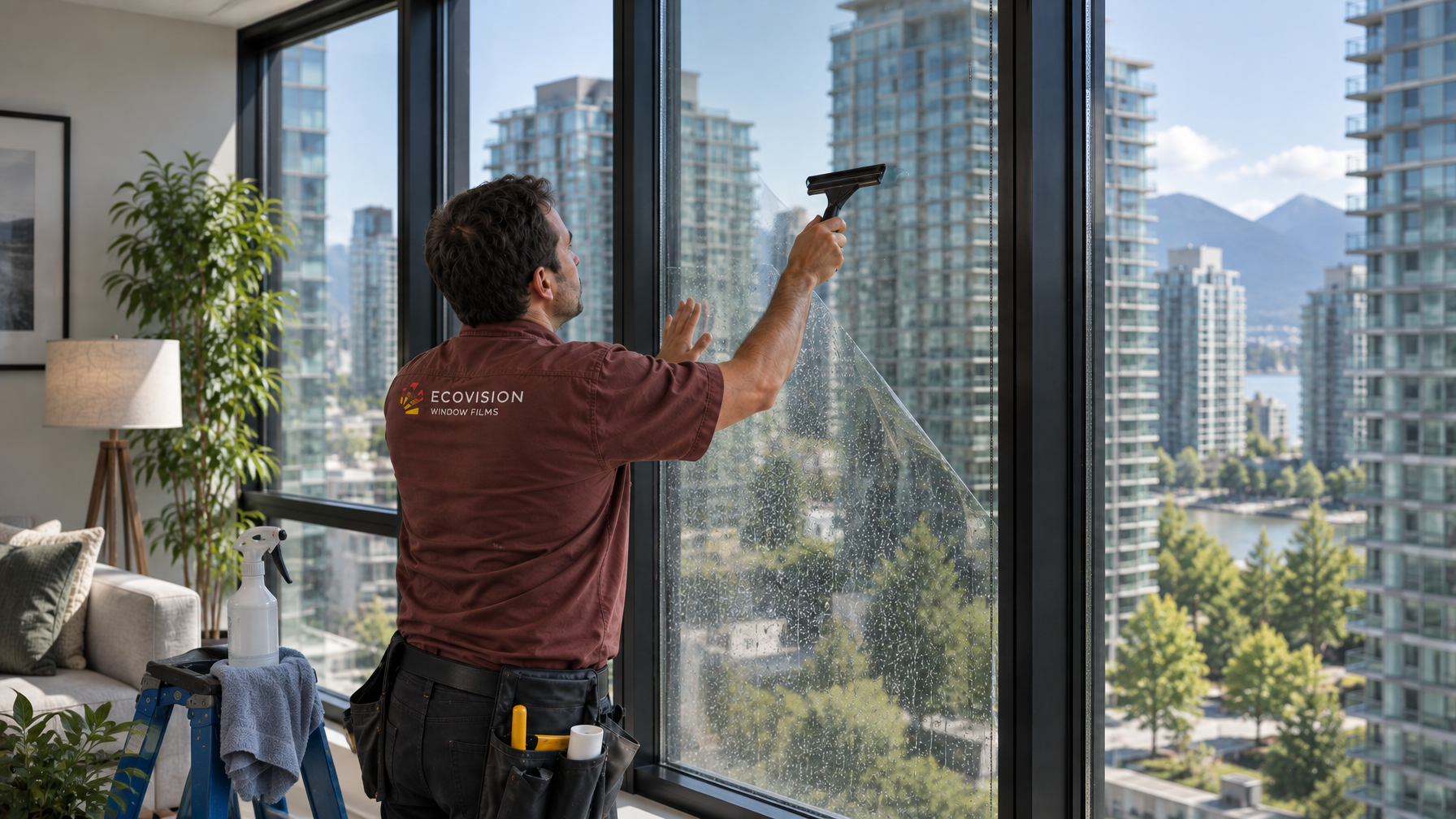
Yes. Architectural window film works on double pane IGUs in BC when the film is specified for dual-pane glass. See our 2026 BC pricing guide for installed bands.
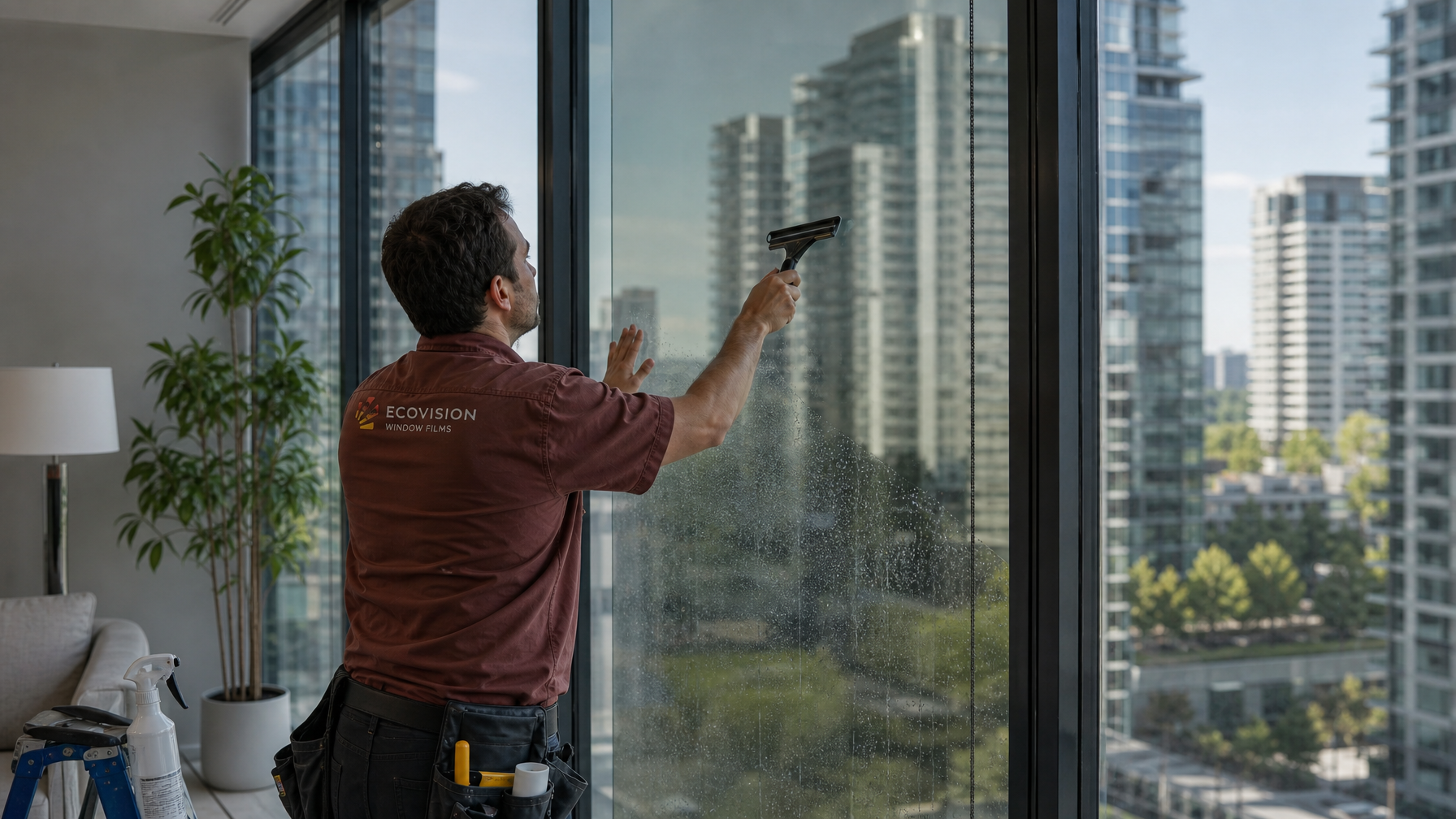
One-sided glass works by light imbalance, not magic. Dual-reflective window film from Ecovision gives daytime privacy in Vancouver when the street is brighter than the room.
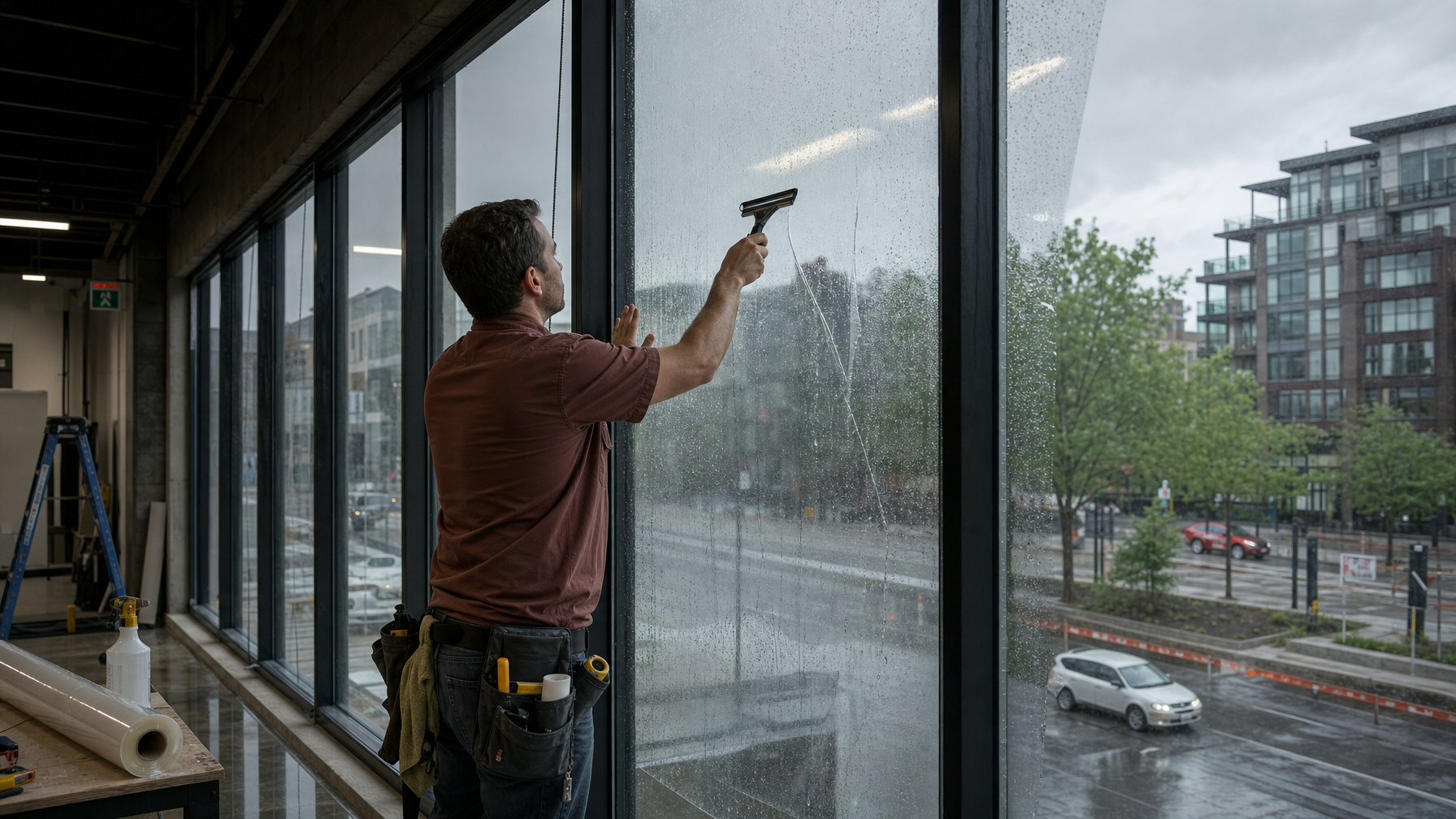
Commercial security window film in Vancouver holds glass together on impact. Typical BC installed pricing is $16 – $22 per sq ft.
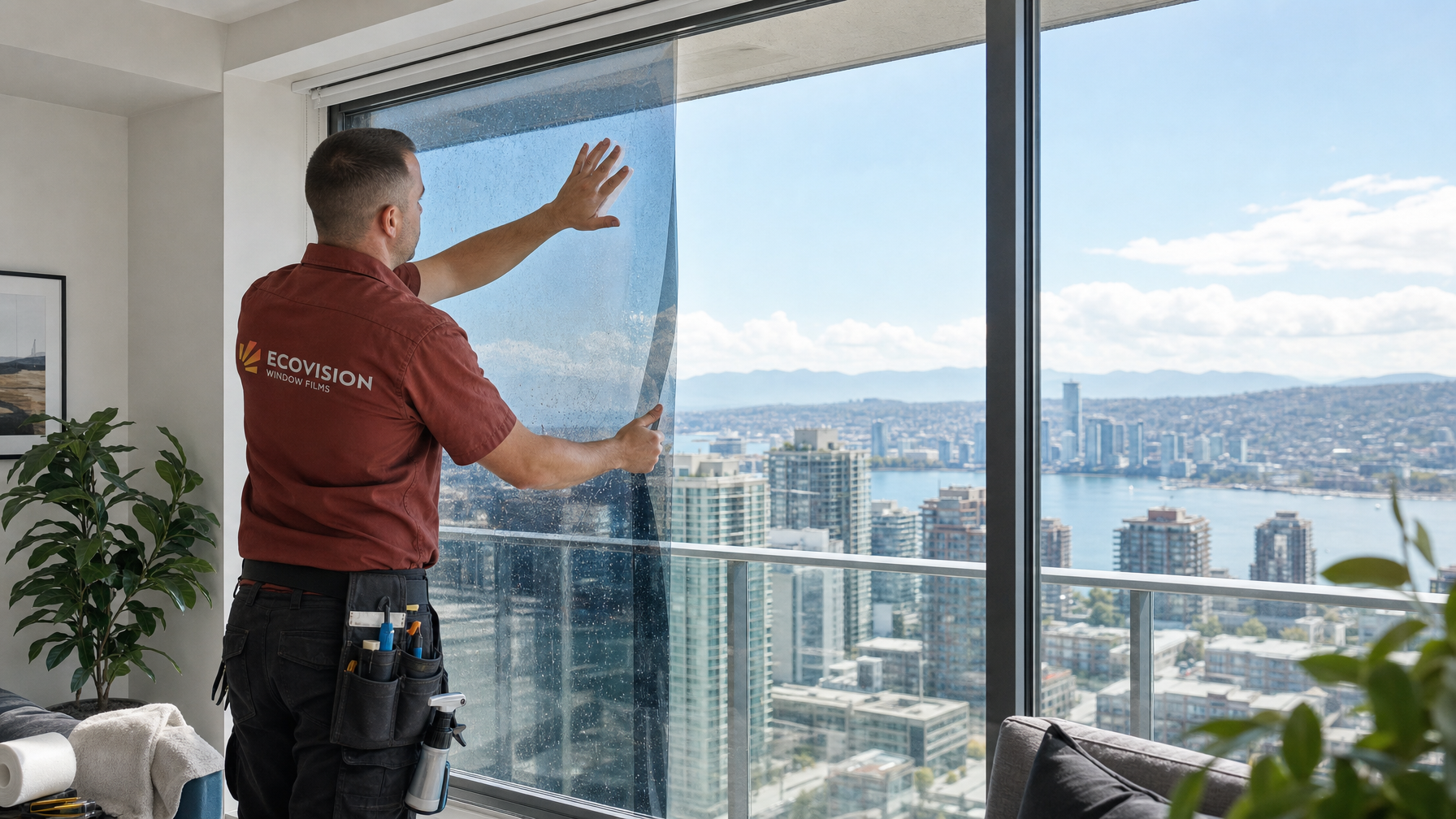
Discover how solar window film controls indoor heat in BC condos and MURBs without air conditioning. Product comparisons, costs, and strata rules.
Professional window film in Port Moody, BC costs $9 to $22 per square foot CAD installed in 2026. Complete guide to solar heat control, privacy, and security window films for Port Moody homes and strata condos.
Retail storefront owners across Metro Vancouver are increasingly turning to clear heat control window film to reduce solar heat gain without darkening their display glass. Ecovision Window Films, certified LLumar and Vista installers serving Vancouver, Burnaby, Surrey, and the Lower Mainland, has completed clear solar film installations on retail properties throughout BC. Call (236) 862-0052 for a free on-site assessment. Clear heat control window film costs $9 – $18 per square foot installed for commercial retail applications, depending on film grade and glass type. High-VLT films like LLumar VS60 (59% visible light transmission, 50% total solar energy rejection) and VS70 (62% VLT, 49% TSER) block up to half of incoming solar heat while remaining virtually invisible on retail glass. Most retail storefront installations complete in 1 to 2 days with no disruption to business operations. Clear heat control window film is a spectrally selective solar film that blocks 40 to 50% of solar heat gain while allowing 59 to 62% of visible light to pass through. Applied to the interior surface of retail storefront glass, it reduces interior temperatures by 5 to 8 degrees Celsius without changing the appearance of display windows. Ecovision Window Films installs LLumar VS60 and VS70 certified films for retail clients across Vancouver and the Lower Mainland, with typical project costs of $9 – $18 per square foot. What Is Clear Heat Control Window Film? Clear heat control window film is a spectrally selective polyester laminate applied to the interior surface of existing glass. Unlike traditional tinted film, which achieves heat rejection by darkening the glass, clear solar film uses advanced multilayer coating technology to reflect infrared radiation while allowing visible light to pass through. The result is a film that blocks significant solar heat without any noticeable change to the glass appearance, which is critical for retail storefronts where product visibility and natural display lighting matter. The two primary products Ecovision installs for clear heat control in retail settings are LLumar VS60 and LLumar VS70. VS60 transmits 59% of visible light while rejecting 50% of total solar energy, making it the stronger heat rejection option. VS70 transmits 62% of visible light with 49% total solar energy rejection, providing the clearest possible appearance while still cutting nearly half of incoming heat. Both films block over 99% of UV radiation, which protects retail merchandise, displays, and flooring from fading. For retail businesses, the UV protection aspect is as important as the heat reduction. UV radiation passing through untreated storefront glass fades clothing, artwork, furniture, and packaged goods at an accelerated rate. The International Window Film Association reports that clear solar film with 99% UV block can extend the display life of retail merchandise by 3 to 5 times compared to unprotected glass. How Does Clear Solar Film Compare to Tinted Film for Retail? Most retail business owners assume that effective heat control requires dark tinted glass. For storefronts, that assumption is expensive. Tinted film reduces product visibility from the street, darkens interior display areas, and can create an unwelcoming appearance that reduces foot traffic. Clear heat control film solves the heat problem while keeping the storefront bright, open, and visually identical to untreated glass. Property Clear Solar Film (VS60/VS70) Standard Tinted Film (Ceramic 35) Visible Light Transmission 59 to 62% 31% Total Solar Energy Rejected 49 to 50% 46% UV Block Over 99% Over 99% Glass Appearance Change Minimal to none Noticeably darker Glare Reduction 22 to 25% 61% Cost (per sq ft installed) $9 – $18 $9 – $18 Best For Retail storefronts, display windows Offices, south-facing homes For retail environments where glare on display screens is a secondary concern, the lower glare reduction of clear film is a worthwhile trade-off for maintaining full product visibility. If glare is a significant issue in a specific retail space, Ecovision can apply VS60 on the most sun-exposed elevations and Ceramic 45 on side windows where appearance matters less. Which LLumar and Vista Products Work Best for Retail Storefronts? Ecovision installs two certified brands, LLumar and Vista, across all retail projects. For clear heat control specifically, the LLumar VS series is the primary recommendation. The VS line is engineered for high visible light transmission with strong infrared rejection, making it the standard choice for retail storefronts where appearance cannot change. LLumar VS60 is the default specification for south and west-facing retail storefronts with direct sun exposure. Its 50% total solar energy rejection delivers measurable interior temperature reduction during peak afternoon hours. LLumar VS70 is specified for north and east-facing storefronts where heat gain is moderate but UV protection for merchandise is still important. Both films carry a 10-year commercial warranty against bubbling, peeling, cracking, and adhesive failure. For retail properties that also need security protection, LLumar offers solar-security hybrid films that combine heat rejection with impact resistance. These products are thicker (8 to 14 mil) and cost $16 – $22 per square foot installed, but they address both heat and forced-entry concerns in a single application. Ecovision has installed similar hybrid films at storefront security projects across Metro Vancouver. How Much Does Clear Heat Control Film Cost for Retail Storefronts? Clear heat control window film for retail storefronts costs $9 – $18 per square foot installed, with most projects landing between $10 and $16 per square foot. A standard ground-floor retail storefront with 200 sq ft of south-facing glass typically costs $2,000 – $3,600 installed for LLumar VS60 or VS70. Larger storefronts with 400+ sq ft of glass benefit from volume pricing, reducing the per-square-foot cost by 10 to 15%. Three factors affect the final price: glass type (single-pane, double-pane insulated, or tempered), building access (ground-floor versus upper-floor requiring lift equipment), and total project size. Most retail storefront installations on ground-floor glass in Vancouver, Burnaby, and Surrey complete without access equipment charges. For upper-floor retail or glass above awning height, add $1 to $3 per square foot for lift or scaffolding. The payback period for clear heat control film on a typical retail storefront runs 3 to 5