
This guide covers window film for homes and buildings. Ecovision does not tint vehicles. For architectural glass only.
Quick Answer
Old plastic film on glass is usually leftover construction protection, not solar tint. On most Metro Vancouver panes it takes 15 to 40 minutes per lite: lift a corner, apply low heat, peel at 30 to 45 degrees, then scrape adhesive. Keep steam off insulated-glass edge seals. Ecovision Window Films handles this work on homes and towers across Vancouver, Burnaby, Surrey, and the Lower Mainland. Call (236) 862-0052.
What Is Old Plastic Film on Glass?
Builders apply a thin polyethylene or PVC sheet to new windows so plaster, paint, and grinding dust never reach the lite. Manufacturers such as Andersen tell owners to pull that sheet soon after install because UV and heat bake it onto the glass. Left for months on a south or west elevation in BC, the sheet yellows, tears into flakes, and leaves a sticky haze. That is different from polyester solar or security window film, which uses a pressure-sensitive adhesive designed for a 10 to 15 year service life.
Ecovision crews see this most on new condos in Burnaby and Surrey, and on commercial fit-outs where protective sheeting sat through a full heating season. At Bentall 4, we treat leftover construction plastic as a glass-prep step before any LLumar VS60 or VS70 solar film goes on. If you confuse baked construction plastic with failed solar tint, you will use the wrong solvent and risk scratching Low-E coatings.
How Do You Remove Old Plastic Film From Glass Safely?
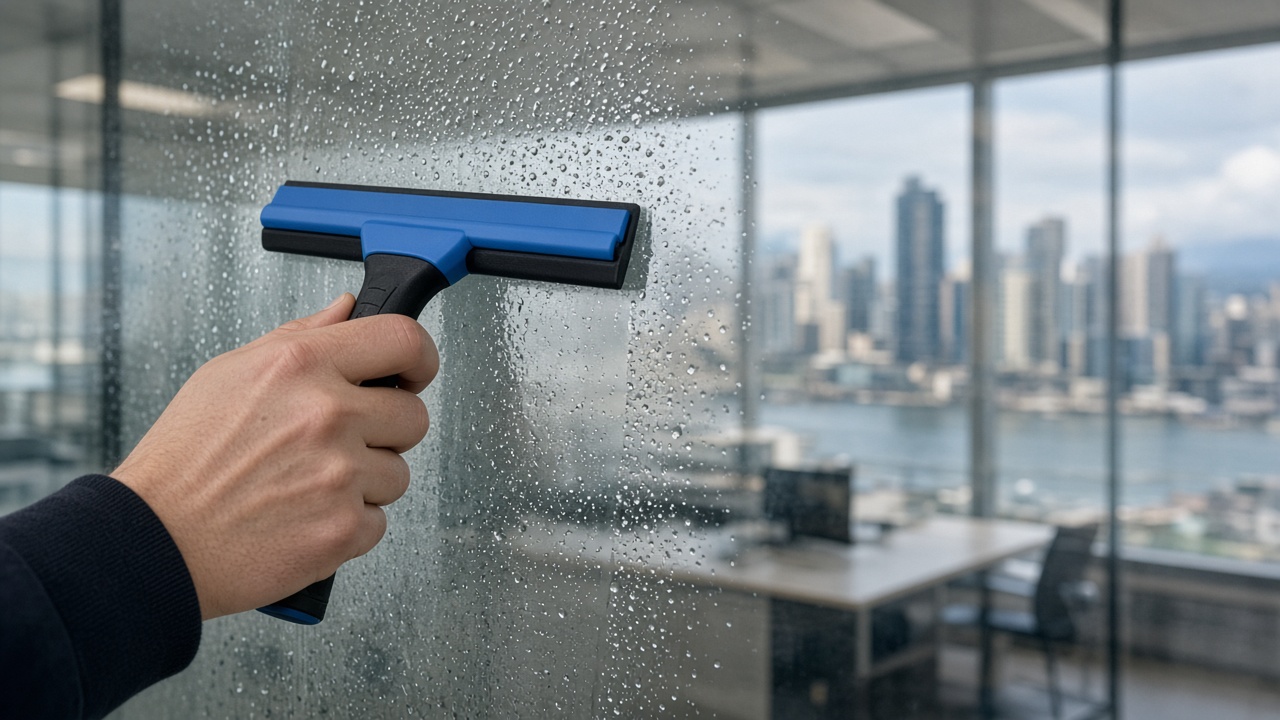
Start at a top corner with a plastic scraper, not a dry yank. If the sheet comes off in one piece and adhesive stays on the plastic, you can peel by hand. If it tears into 2-centimetre flakes, apply a handheld steamer or heat gun held 15 to 20 centimetres from the glass for 3 to 5 seconds per section, then peel at a 30 to 45 degree angle. Never hold heat on one spot longer than 5 seconds on an insulated glass unit.
- Test a 2-centimetre corner. Note whether adhesive stays on the film or the glass.
- Warm the top edge. Steam or medium heat gun, keep the tool moving.
- Peel downward in 10 to 20 centimetre strips. Reheat ahead of the peel line.
- Spray isopropyl alcohol (70 to 99%) on residue. Wait 60 seconds. Scrape with a new single-edge blade held flat.
- Wash with 2 drops of dish soap in 500 millilitres of water. Squeegee, then buff with a microfibre cloth.
Window-cleaning forums document the failure mode when plastic is left in sun: it “bakes” and comes off in tiny pieces with adhesive still on the glass. That matches what we see on west-facing lites in Kitsilano and Port Moody after a dry July. Patience beats force. If a pane takes more than 45 minutes, stop and call a film crew rather than grinding the coating.
Is It Safe on Double-Pane and Low-E Glass?
Yes, if heat stays on the interior face and never on the spacer. Most homes built after 1995 in Metro Vancouver use dual-pane IGUs. Steam that soaks the butyl edge seal can cause fogging between panes. IGU replacement in the Lower Mainland typically runs $200 – $600 per lite. Keep steam 5 centimetres inside the sightline. On Low-E coatings, use a new blade, light pressure, and overlapping wet passes. Do not dry-scrape.
At Rosemary Heights Seniors Village in Surrey, Ecovision inspects seals before any heat-based removal. The same rule applies in a 600-square-foot condo: one failed IGU costs more than professional film prep on the whole suite.
What Tools and Chemicals Work on Baked Plastic?
A DIY kit for 8 to 12 residential lites costs about $60 – $120 at a Lower Mainland hardware store. Skip ammonia on tinted or Low-E glass. Skip razor work on plastic glazing or acrylic inserts.
| Item | Use | Typical cost |
|---|---|---|
| Plastic scraper | Lift corners without gouging | $8 – $15 |
| Handheld steamer | Soften baked adhesive | $40 – $80 |
| Single-edge blades | Wet scrape residue | $6 – $12 |
| Isopropyl alcohol | Dissolve leftover adhesive | $8 – $15 |
| Microfibre + squeegee | Final clean | $10 – $20 |
How Much Does Professional Removal Cost in BC?
Ecovision prices construction-film strip-out as glass prep, not as a full film install. Simple peel work on a handful of residential panes see BC window film pricing guideresidential window film. Heavy baked plastic with full adhesive scrape see BC window film pricing guide. Security or solar replacement on the same glass is see BC window film pricing guide, see BC window film pricing guide. see BC window film pricing guide
Rocky Mountaineer glass in Vancouver needed clean interior lites before solar film. Construction plastic left on those elevations would have trapped grit under the new laminate. Stripping first is cheaper than a callback.
When Should You Call Ecovision Instead of DIY?
Call if the plastic is on an IGU that already shows fog, if the coating looks like Low-E (a faint metallic hue), if you are above the second storey, or if the sheet has been in sun for more than one summer. WorkSafeBC fall-protection rules apply on commercial elevations. Our LLumar and Vista certified crews prep glass, then install the specified architectural film in one visit. Cure time for new film is always 30 to 60 days. Do not clean with ammonia during that window.
Related Articles
- How to Remove Window Film Without Damaging Your Windows
- How to Remove Window Film Adhesive
- How to Remove Solar Window Film
- Can You Use a Steamer to Remove Window Film?
- How to Remove Frosted Window Film Without Damaging the Glass
FAQ
About the Author: This article was written by the Ecovision Window Films team. Edward, Director at Ecovision, brings a distinctive perspective to the window film industry, with over a decade in real estate development, including roles as Executive Director at a real estate development firm and Director of Strategic Partnerships, before joining Ecovision. That background gives the company a sharp edge in serving BC property managers and building owners. Ecovision is a certified installer for leading film brands with completed projects for healthcare facilities, government buildings, and commercial properties throughout the Lower Mainland. For a free site assessment, call (236) 862-0052 or visit ecovisioncanada.com/contact/.