
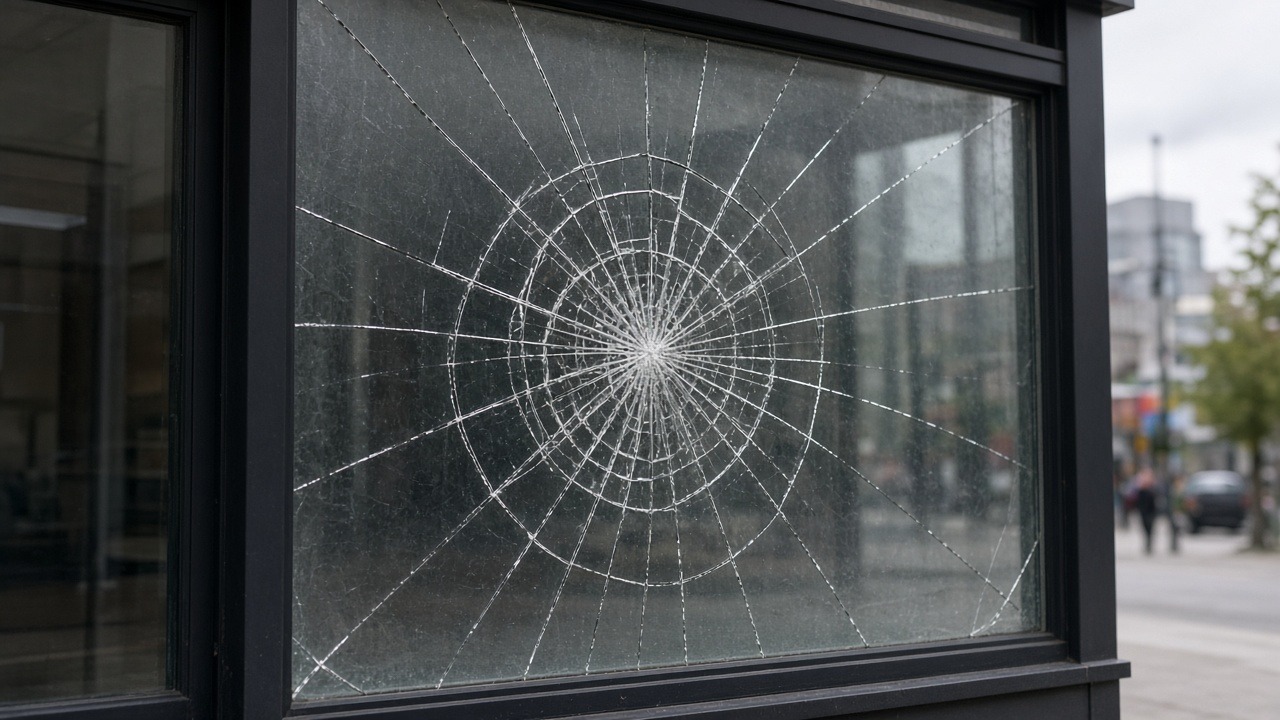
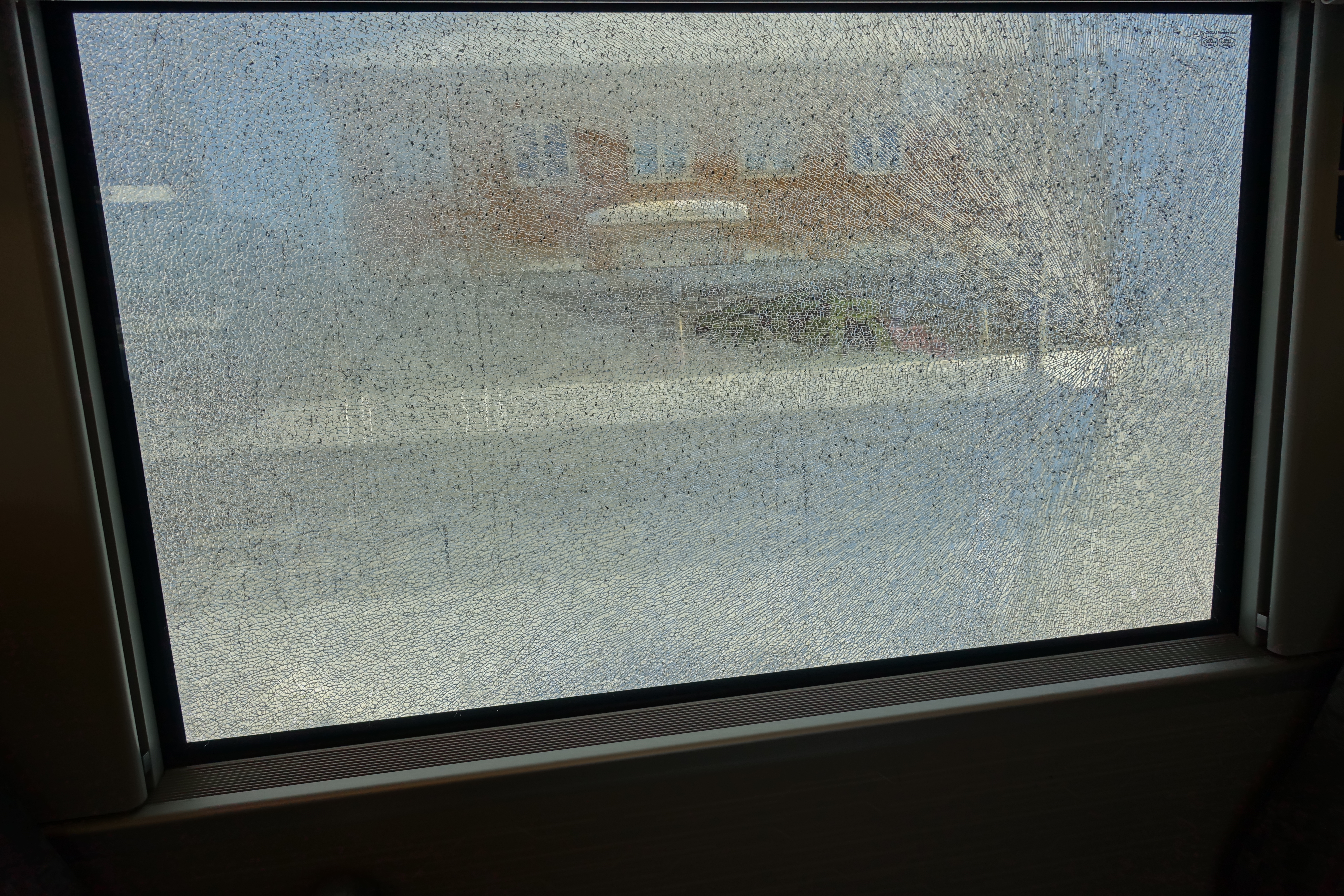
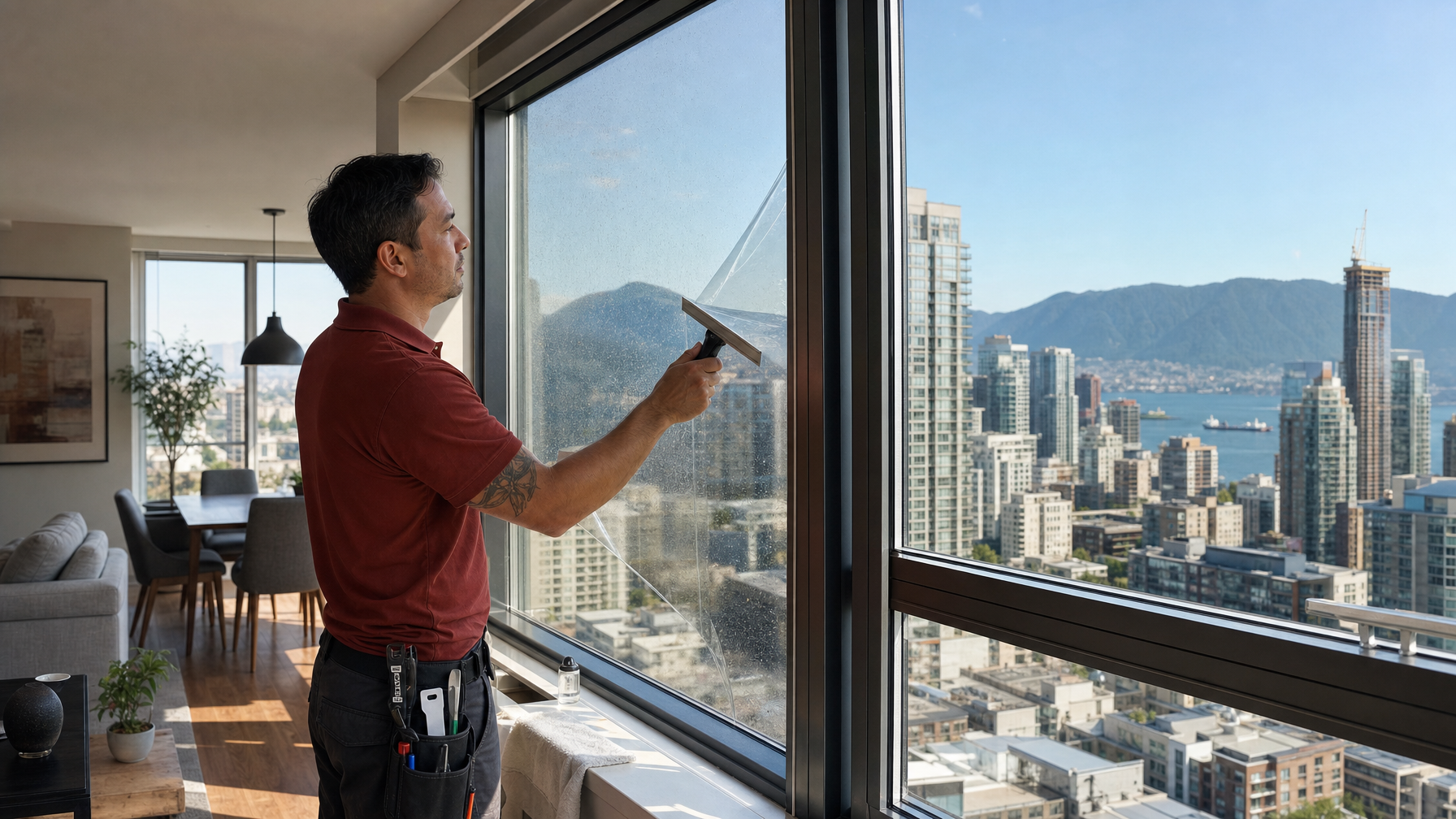
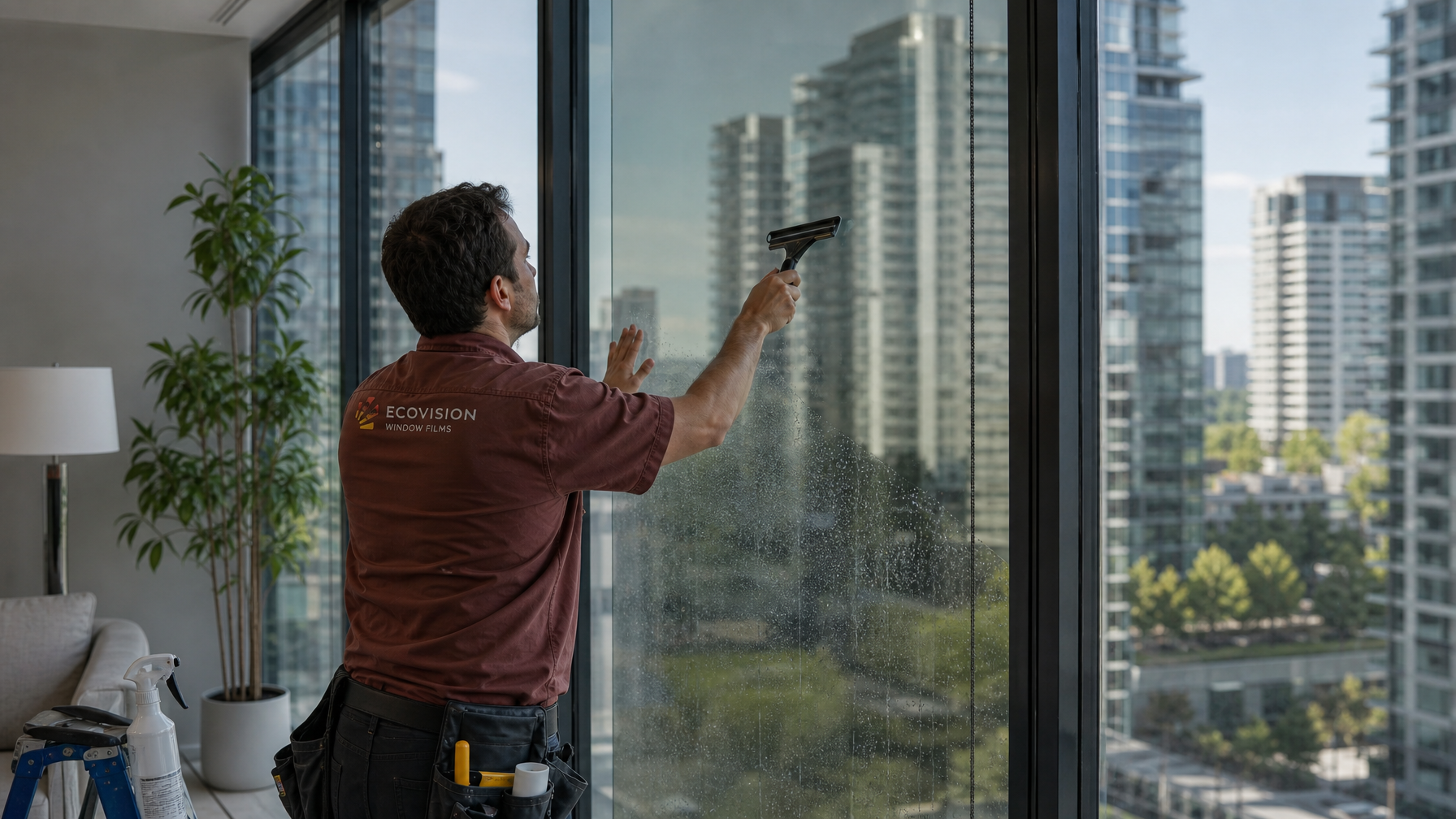
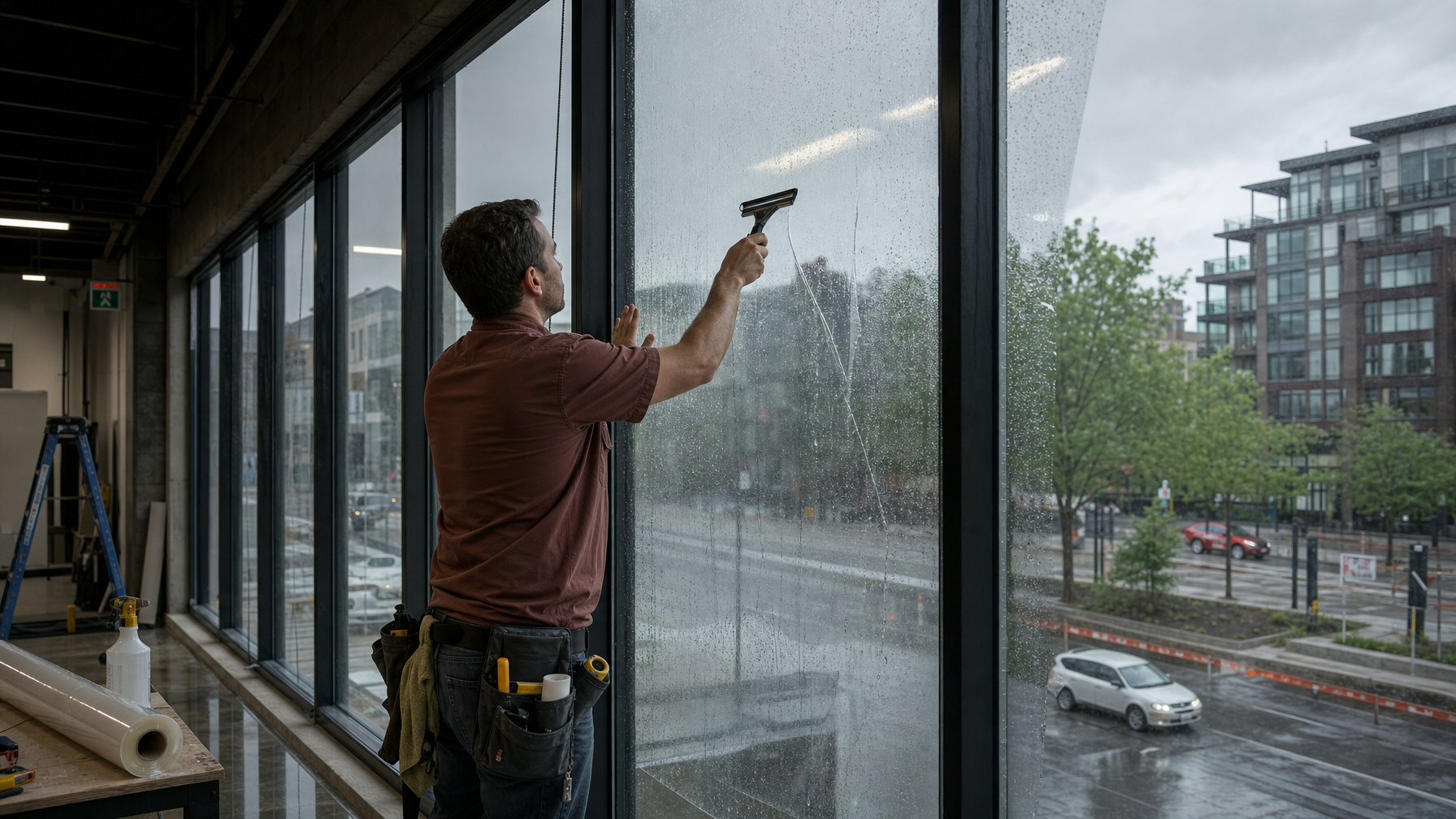
Vancouver property owners choose from four main film categories: solar control (heat and glare reduction), privacy/decorative (frosted, one-way, patterned), security (impact resistance and forced-entry delay), and bird-safe (collision prevention). Most commercial and strata projects combine solar control with one other function, the right combination depends on the building’s orientation, occupancy type, and primary pain point.
Vancouver property owners use window film to solve four distinct problems: solar heat and glare, UV fading, privacy, and security. The right film type depends on your glazing orientation, building use, and primary goal. Here is a breakdown of what is available, what each costs in BC, and where each is most commonly applied in the Vancouver market.
| Film Type | Primary Benefit | Typical Cost (Installed, BC) | Best For |
|---|---|---|---|
| Solar / Heat Control | Rejects up to 78% of solar heat | $9, $14/sq ft | South- and west-facing offices, condos, retail |
| Ceramic Solar | Maximum heat rejection without reflectivity | $14, $18/sq ft | Strata buildings, residential, heritage facades |
| Privacy / Frosted | Blocks sightlines while diffusing natural light | $10, $15/sq ft | Ground-floor retail, boardrooms, healthcare suites |
| Security Film (8 mil) | Holds shattered glass on impact; meets ANSI Z97.1 | $14, $20/sq ft | Storefronts, schools, ground-floor commercial |
| Security Film (12 mil) | Forced-entry delay and blast resistance | $18, $22/sq ft | Government buildings, healthcare, high-risk retail |
| Decorative / Graphic | Custom patterns, logos, and branding on glass | $10, $16/sq ft | Retail, corporate lobbies, restaurants |
| Bird-Safe Film | UV-visible dot patterns reduce bird strikes | $11, $16/sq ft | High-rises, schools, glass curtain-wall buildings |
How Much Does Window Film Cost in Vancouver?
For a typical Vancouver strata condo with 6 to 8 standard windows, solar or ceramic film runs $900 to $2,400 installed. A ground-floor retail unit on Robson Street or Main Street with 3 large panes of privacy film averages $1,200 to $2,000. A full floor of south-facing commercial office space in a Yaletown or Downtown Vancouver office tower, typically 800 to 1,500 square feet of glazing, runs $8,000 to $22,000 depending on film grade and access complexity.
For a detailed breakdown by film type and building category, the 2026 BC window film cost guide covers real Vancouver and Lower Mainland project examples with installed pricing across all major film grades. Glass replacement in Vancouver runs $500 to $1,500 per window. Professionally installed film delivers comparable thermal and UV performance at a fraction of that cost, with return on investment typically reached within two to four years on south-facing commercial glazing.
Which Vancouver Buildings Benefit Most from Window Film?
Vancouver’s building stock spans over a century of construction, from single-pane heritage storefronts in Gastown and Strathcona to post-2000 glass curtain-wall towers in Coal Harbour and False Creek. Window film delivers measurable performance gains across all of them, but the highest-value applications cluster around three building categories.
Strata condominiums and residential towers represent Vancouver’s dominant building form, particularly in the West End, Yaletown, Olympic Village, and Coal Harbour. Floor-to-ceiling glazing that creates the views also creates heat gain on south and west exposures, UV damage to hardwood floors and upholstery, and privacy exposure on lower floors and street-facing units. Ceramic solar film is the most common residential specification in Vancouver strata buildings, blocking heat without adding reflectivity that could trigger strata bylaw compliance issues. Ecovision works directly with strata councils and building managers to ensure film selection meets strata requirements and IGU (insulated glazing unit) compatibility guidelines before any work begins.
Commercial office buildings along the Georgia Street and Burrard Street corridors, in Yaletown, and across the Broadway tech corridor face persistent glare problems on south and west exposures that affect screen visibility, occupant comfort, and HVAC loads. Vancouver’s green building requirements under the BC Energy Step Code make thermal performance retrofits increasingly relevant for older commercial stock. Window film is consistently the most cost-effective first step, it does not require structural modification, does not trigger permit requirements in most Vancouver jurisdictions, and delivers immediate measurable reductions in solar heat gain. For a detailed breakdown of commercial options, the commercial window film Vancouver guide covers specifications, timelines, and what to expect during a multi-floor installation.
Ground-floor retail and hospitality along Robson Street, Granville Street, Main Street, Commercial Drive, and in Gastown and Chinatown regularly use window film for two purposes: privacy film on service areas and staff spaces, and security film on storefront glazing. Vancouver’s commercial break-and-enter rate makes security window film a practical risk-management tool, not just a compliance measure. An 8 mil film holds glass intact on impact, eliminating the smash-and-grab window of vulnerability between a strike and a police response.
Why Does Vancouver’s Glass Architecture Make Window Film Essential?
Vancouver’s floor-to-ceiling glass towers and south/west-facing condo walls trap solar heat far beyond what HVAC systems can efficiently offset. Window film addresses this directly: a properly specified solar control film cuts peak indoor temperatures 5, 8°C on sun-exposed floors and reduces cooling loads by 20, 30%, without changing the building’s exterior appearance or requiring strata approval for construction work.
Vancouver builds more aggressively with glass than most North American cities. The city’s mild coastal climate and mountain views make full-glazed facades architecturally desirable, but the same conditions that make Vancouver livable also create predictable glazing challenges that window film is specifically designed to address.
UV exposure in Vancouver is substantial despite the city’s reputation for rain. Cloud cover does not filter UV radiation, it scatters it. Ground-level UV in Vancouver is comparable to cities significantly further south, and the cumulative effect on flooring, upholstery, artwork, and merchandise is the same. LLumar and Vista solar films reject up to 99% of UV radiation without altering natural light levels or changing the visual character of glazing. That protection matters as much in Vancouver’s overcast winters as in peak July sun.
Vancouver also sits in a seismic zone. While window film is not a seismic mitigation product, safety film serves a directly relevant function: in an earthquake, glass is one of the primary sources of injury from flying or collapsing fragments. Safety attachment film, specified and installed by a certified installer, holds glass intact when glazing fails under seismic loading, the same mechanism that makes security film effective against forced entry.
Bird strikes are a significant environmental concern for Vancouver’s glass-heavy building stock. The City of Vancouver’s Bird Friendly Design Guidelines, adopted for new construction, increasingly apply retroactively as older buildings undergo renovation. Ecovision installs bird-safe film systems with UV-visible dot or line patterns that are invisible to human eyes from street level but detectable by birds, reducing strikes by 60 to 90% in independently verified studies.
Neighbourhoods Ecovision Serves Across Vancouver
Ecovision Window Films services all Vancouver neighbourhoods with the same certified installation team and no travel surcharge within Metro Vancouver. The most common project locations include:
Downtown Vancouver and the West End, office towers, hotel lobbies, ground-floor retail, and residential high-rises. Common specifications: solar film on south/west commercial glazing, privacy film on hotel and healthcare ground floors, security film on retail storefronts.
Yaletown and False Creek, converted warehouse office buildings with large industrial windows, strata condos with south-facing floor-to-ceiling glazing. Common specifications: ceramic solar on residential, privacy film on lower-floor units, decorative film in restaurant and retail spaces.
Kitsilano and Point Grey, single-family residential, character homes with heritage windows, and UBC-adjacent academic and research buildings. Common specifications: residential solar film on south-facing rooms, safety film for older single-pane glazing.
Mount Pleasant and East Vancouver, creative office buildings, tech studios, ground-floor retail on Main Street and Commercial Drive, and older residential stock. Common specifications: solar film for commercial office suites, privacy and decorative film for retail and hospitality, security film for high-traffic storefronts.
Gastown and Chinatown, heritage commercial buildings with single-pane storefront glazing, boutique retail, restaurants, and creative agencies. Common specifications: security film to protect against break-and-enter, decorative film for brand expression on glass facades.
Coal Harbour and Waterfront, luxury residential towers, corporate headquarters, and hotel properties with premium glazing requirements. Common specifications: ceramic solar film that does not alter building aesthetics, privacy film on waterfront-facing suites.
What Sets Ecovision Apart from Other Vancouver Window Film Companies
Three things separate professional-grade window film installation from budget alternatives in the Vancouver market: brand certification, compatibility assessment, and written warranty coverage that actually holds.
Ecovision is a certified installer for LLumar and Vista films, two of the highest-rated film brands for commercial and residential performance, with manufacturer-backed warranties of 10 to 15 years on commercial film and lifetime coverage on residential applications. These warranties are only valid when film is installed by an authorized dealer using certified adhesive application methods. An uncertified installation, regardless of the film brand used, voids manufacturer warranty coverage from day one.
IGU (insulated glazing unit) compatibility is the issue most Vancouver property owners do not know to ask about. Applying the wrong film to a sealed dual-pane unit creates thermal stress that fractures the glass and voids the IGU manufacturer’s warranty, a $500 to $1,500 per-window consequence that falls entirely on the building owner. Ecovision conducts a compatibility assessment on every project as part of the free site visit, checking glazing construction, orientation, and existing coating before recommending any film grade.
Vancouver’s strata-heavy residential market also creates a layer of complexity that most window film companies do not navigate well. Strata bylaws frequently specify what can and cannot be applied to common-property glazing, and some buildings require strata council approval before exterior-facing film is applied. Ecovision’s team is experienced with strata approval processes across Metro Vancouver and can provide documentation, specifications, and technical summaries to support a strata council submission, at no additional cost.
For property owners across the broader Metro Vancouver region, Ecovision serves adjacent cities with the same team and no additional travel fees. See the guides for window film in Burnaby, window film in Richmond, and window film in North Vancouver for local detail on each market.
Frequently Asked Questions, Window Film Vancouver
Does window film work on dual-pane windows?
Yes, but film grade selection matters. Certain high-absorption films can create thermal stress in sealed IGUs. Ecovision assesses your glazing type before recommending a film grade to ensure compatibility. LLumar and Vista both offer IGU-safe solar film lines specifically rated for dual-pane applications.
Will window film make my Vancouver condo darker?
Most solar films reduce visible light transmission by 15 to 35%, which most occupants describe as comparable to light cloud cover, a difference that is noticeable on direct comparison but not experienced as darkness under normal conditions. Ceramic films offer the highest heat rejection with the least visible light reduction, making them the standard residential specification in Vancouver strata buildings where occupants are sensitive to any perceived darkening.
How long does window film installation take in Vancouver?
A standard residential strata unit with 6 to 10 windows takes 4 to 6 hours. A full commercial floor of 1,000 square feet of glazing typically takes 6 to 8 hours. Multi-floor commercial projects are usually scheduled across consecutive days. Occupants do not need to vacate, work is done room by room with minimal disruption.
Does window film require a permit in Vancouver?
In most residential and commercial applications, window film does not require a building permit from the City of Vancouver. Exceptions can arise for heritage-designated buildings or when film is specified as part of a larger renovation. Strata buildings may require council approval as an internal governance matter, independent of City permit requirements. Ecovision can confirm the applicable requirements for your specific property during the free site assessment.
How long does window film last in Vancouver’s climate?
LLumar and Vista films are warranted for 10 to 15 years on commercial applications and lifetime on residential under normal conditions. Vancouver’s mild, maritime climate is actually one of the better environments for film longevity, extreme UV and heat cycling are the primary causes of premature film failure, and Vancouver’s coastal moderation reduces both stress factors compared to hotter inland markets.
Can window film be removed if I change my mind?
Yes. Professional-grade film applied with proper adhesive can be removed by a trained installer without damaging the glass. DIY removal attempts on older film frequently cause adhesive residue or scratching. Ecovision’s installation team can remove and replace existing film at any time.
Related Articles
- Commercial Window Film Installation in Vancouver: Types, Costs, and What to Expect
- Security Window Film: What It Is, How It Works, and When You Need It
- How Much Does Window Film Cost in BC? 2026 Pricing Guide
- Window Film in Burnaby, BC: Types, Costs, and What to Know Before You Buy
- Window Film in Richmond, BC: Types, Costs, and What to Know Before You Buy
- Window Film in North Vancouver, BC: Types, Costs, and What to Know Before You Buy
About the Author: This article was written by the Ecovision Window Films team. Edward, Director at Ecovision, brings over a decade in real estate development, including roles as Executive Director at a real estate development firm and Director of Strategic Partnerships, before joining Ecovision. That background gives the company a sharp edge in serving BC property managers, strata councils, and building owners navigating glazing upgrades. Ecovision is a certified installer for LLumar and Vista films with completed projects for healthcare facilities, government buildings, strata corporations, and commercial properties throughout Metro Vancouver. For a free site assessment, call (236) 862-0052 or visit ecovisioncanada.com/contact/.
Ready to solve your Vancouver window film problem? Call Ecovision Window Films at (236) 862-0052 for a free site assessment and no-obligation quote. We serve residential, commercial, and institutional clients across Vancouver, Burnaby, Richmond, North Vancouver, and the broader Metro Vancouver region.
Vancouver’s skyline is defined by glass, curtain-wall office towers along Georgia Street, floor-to-ceiling condos in Yaletown and Coal Harbour, heritage storefronts in Gastown, and strata buildings stretching from Kitsilano to Mount Pleasant. That glass creates comfort, light, and views. It also creates heat gain, UV damage, privacy exposure, and security risk that standard glazing alone cannot solve. Ecovision Window Films provides professional window film installation in Vancouver, BC for residential, commercial, and institutional clients, using LLumar and Vista certified film systems with warranties that hold.
Window film in Vancouver costs between $9 and $22 per square foot installed, depending on film type, glazing configuration, and building access. Most residential projects complete in one day. Commercial installations on multi-floor office buildings or strata towers typically take two to three days. All work is done with occupants in place, no vacating required.
What Types of Window Film Are Available in Vancouver?
Vancouver property owners choose from four main film categories: solar control (heat and glare reduction), privacy/decorative (frosted, one-way, patterned), security (impact resistance and forced-entry delay), and bird-safe (collision prevention). Most commercial and strata projects combine solar control with one other function, the right combination depends on the building’s orientation, occupancy type, and primary pain point.
Vancouver property owners use window film to solve four distinct problems: solar heat and glare, UV fading, privacy, and security. The right film type depends on your glazing orientation, building use, and primary goal. Here is a breakdown of what is available, what each costs in BC, and where each is most commonly applied in the Vancouver market.
| Film Type | Primary Benefit | Typical Cost (Installed, BC) | Best For |
|---|---|---|---|
| Solar / Heat Control | Rejects up to 78% of solar heat | $9, $14/sq ft | South- and west-facing offices, condos, retail |
| Ceramic Solar | Maximum heat rejection without reflectivity | $14, $18/sq ft | Strata buildings, residential, heritage facades |
| Privacy / Frosted | Blocks sightlines while diffusing natural light | $10, $15/sq ft | Ground-floor retail, boardrooms, healthcare suites |
| Security Film (8 mil) | Holds shattered glass on impact; meets ANSI Z97.1 | $14, $20/sq ft | Storefronts, schools, ground-floor commercial |
| Security Film (12 mil) | Forced-entry delay and blast resistance | $18, $22/sq ft | Government buildings, healthcare, high-risk retail |
| Decorative / Graphic | Custom patterns, logos, and branding on glass | $10, $16/sq ft | Retail, corporate lobbies, restaurants |
| Bird-Safe Film | UV-visible dot patterns reduce bird strikes | $11, $16/sq ft | High-rises, schools, glass curtain-wall buildings |
How Much Does Window Film Cost in Vancouver?
For a typical Vancouver strata condo with 6 to 8 standard windows, solar or ceramic film runs $900 to $2,400 installed. A ground-floor retail unit on Robson Street or Main Street with 3 large panes of privacy film averages $1,200 to $2,000. A full floor of south-facing commercial office space in a Yaletown or Downtown Vancouver office tower, typically 800 to 1,500 square feet of glazing, runs $8,000 to $22,000 depending on film grade and access complexity.
For a detailed breakdown by film type and building category, the 2026 BC window film cost guide covers real Vancouver and Lower Mainland project examples with installed pricing across all major film grades. Glass replacement in Vancouver runs $500 to $1,500 per window. Professionally installed film delivers comparable thermal and UV performance at a fraction of that cost, with return on investment typically reached within two to four years on south-facing commercial glazing.
Which Vancouver Buildings Benefit Most from Window Film?
Vancouver’s building stock spans over a century of construction, from single-pane heritage storefronts in Gastown and Strathcona to post-2000 glass curtain-wall towers in Coal Harbour and False Creek. Window film delivers measurable performance gains across all of them, but the highest-value applications cluster around three building categories.
Strata condominiums and residential towers represent Vancouver’s dominant building form, particularly in the West End, Yaletown, Olympic Village, and Coal Harbour. Floor-to-ceiling glazing that creates the views also creates heat gain on south and west exposures, UV damage to hardwood floors and upholstery, and privacy exposure on lower floors and street-facing units. Ceramic solar film is the most common residential specification in Vancouver strata buildings, blocking heat without adding reflectivity that could trigger strata bylaw compliance issues. Ecovision works directly with strata councils and building managers to ensure film selection meets strata requirements and IGU (insulated glazing unit) compatibility guidelines before any work begins.
Commercial office buildings along the Georgia Street and Burrard Street corridors, in Yaletown, and across the Broadway tech corridor face persistent glare problems on south and west exposures that affect screen visibility, occupant comfort, and HVAC loads. Vancouver’s green building requirements under the BC Energy Step Code make thermal performance retrofits increasingly relevant for older commercial stock. Window film is consistently the most cost-effective first step, it does not require structural modification, does not trigger permit requirements in most Vancouver jurisdictions, and delivers immediate measurable reductions in solar heat gain. For a detailed breakdown of commercial options, the commercial window film Vancouver guide covers specifications, timelines, and what to expect during a multi-floor installation.
Ground-floor retail and hospitality along Robson Street, Granville Street, Main Street, Commercial Drive, and in Gastown and Chinatown regularly use window film for two purposes: privacy film on service areas and staff spaces, and security film on storefront glazing. Vancouver’s commercial break-and-enter rate makes security window film a practical risk-management tool, not just a compliance measure. An 8 mil film holds glass intact on impact, eliminating the smash-and-grab window of vulnerability between a strike and a police response.
Why Does Vancouver’s Glass Architecture Make Window Film Essential?
Vancouver’s floor-to-ceiling glass towers and south/west-facing condo walls trap solar heat far beyond what HVAC systems can efficiently offset. Window film addresses this directly: a properly specified solar control film cuts peak indoor temperatures 5, 8°C on sun-exposed floors and reduces cooling loads by 20, 30%, without changing the building’s exterior appearance or requiring strata approval for construction work.
Vancouver builds more aggressively with glass than most North American cities. The city’s mild coastal climate and mountain views make full-glazed facades architecturally desirable, but the same conditions that make Vancouver livable also create predictable glazing challenges that window film is specifically designed to address.
UV exposure in Vancouver is substantial despite the city’s reputation for rain. Cloud cover does not filter UV radiation, it scatters it. Ground-level UV in Vancouver is comparable to cities significantly further south, and the cumulative effect on flooring, upholstery, artwork, and merchandise is the same. LLumar and Vista solar films reject up to 99% of UV radiation without altering natural light levels or changing the visual character of glazing. That protection matters as much in Vancouver’s overcast winters as in peak July sun.
Vancouver also sits in a seismic zone. While window film is not a seismic mitigation product, safety film serves a directly relevant function: in an earthquake, glass is one of the primary sources of injury from flying or collapsing fragments. Safety attachment film, specified and installed by a certified installer, holds glass intact when glazing fails under seismic loading, the same mechanism that makes security film effective against forced entry.
Bird strikes are a significant environmental concern for Vancouver’s glass-heavy building stock. The City of Vancouver’s Bird Friendly Design Guidelines, adopted for new construction, increasingly apply retroactively as older buildings undergo renovation. Ecovision installs bird-safe film systems with UV-visible dot or line patterns that are invisible to human eyes from street level but detectable by birds, reducing strikes by 60 to 90% in independently verified studies.
Neighbourhoods Ecovision Serves Across Vancouver
Ecovision Window Films services all Vancouver neighbourhoods with the same certified installation team and no travel surcharge within Metro Vancouver. The most common project locations include:
Downtown Vancouver and the West End, office towers, hotel lobbies, ground-floor retail, and residential high-rises. Common specifications: solar film on south/west commercial glazing, privacy film on hotel and healthcare ground floors, security film on retail storefronts.
Yaletown and False Creek, converted warehouse office buildings with large industrial windows, strata condos with south-facing floor-to-ceiling glazing. Common specifications: ceramic solar on residential, privacy film on lower-floor units, decorative film in restaurant and retail spaces.
Kitsilano and Point Grey, single-family residential, character homes with heritage windows, and UBC-adjacent academic and research buildings. Common specifications: residential solar film on south-facing rooms, safety film for older single-pane glazing.
Mount Pleasant and East Vancouver, creative office buildings, tech studios, ground-floor retail on Main Street and Commercial Drive, and older residential stock. Common specifications: solar film for commercial office suites, privacy and decorative film for retail and hospitality, security film for high-traffic storefronts.
Gastown and Chinatown, heritage commercial buildings with single-pane storefront glazing, boutique retail, restaurants, and creative agencies. Common specifications: security film to protect against break-and-enter, decorative film for brand expression on glass facades.
Coal Harbour and Waterfront, luxury residential towers, corporate headquarters, and hotel properties with premium glazing requirements. Common specifications: ceramic solar film that does not alter building aesthetics, privacy film on waterfront-facing suites.
What Sets Ecovision Apart from Other Vancouver Window Film Companies
Three things separate professional-grade window film installation from budget alternatives in the Vancouver market: brand certification, compatibility assessment, and written warranty coverage that actually holds.
Ecovision is a certified installer for LLumar and Vista films, two of the highest-rated film brands for commercial and residential performance, with manufacturer-backed warranties of 10 to 15 years on commercial film and lifetime coverage on residential applications. These warranties are only valid when film is installed by an authorized dealer using certified adhesive application methods. An uncertified installation, regardless of the film brand used, voids manufacturer warranty coverage from day one.
IGU (insulated glazing unit) compatibility is the issue most Vancouver property owners do not know to ask about. Applying the wrong film to a sealed dual-pane unit creates thermal stress that fractures the glass and voids the IGU manufacturer’s warranty, a $500 to $1,500 per-window consequence that falls entirely on the building owner. Ecovision conducts a compatibility assessment on every project as part of the free site visit, checking glazing construction, orientation, and existing coating before recommending any film grade.
Vancouver’s strata-heavy residential market also creates a layer of complexity that most window film companies do not navigate well. Strata bylaws frequently specify what can and cannot be applied to common-property glazing, and some buildings require strata council approval before exterior-facing film is applied. Ecovision’s team is experienced with strata approval processes across Metro Vancouver and can provide documentation, specifications, and technical summaries to support a strata council submission, at no additional cost.
For property owners across the broader Metro Vancouver region, Ecovision serves adjacent cities with the same team and no additional travel fees. See the guides for window film in Burnaby, window film in Richmond, and window film in North Vancouver for local detail on each market.
Frequently Asked Questions, Window Film Vancouver
Does window film work on dual-pane windows?
Yes, but film grade selection matters. Certain high-absorption films can create thermal stress in sealed IGUs. Ecovision assesses your glazing type before recommending a film grade to ensure compatibility. LLumar and Vista both offer IGU-safe solar film lines specifically rated for dual-pane applications.
Will window film make my Vancouver condo darker?
Most solar films reduce visible light transmission by 15 to 35%, which most occupants describe as comparable to light cloud cover, a difference that is noticeable on direct comparison but not experienced as darkness under normal conditions. Ceramic films offer the highest heat rejection with the least visible light reduction, making them the standard residential specification in Vancouver strata buildings where occupants are sensitive to any perceived darkening.
How long does window film installation take in Vancouver?
A standard residential strata unit with 6 to 10 windows takes 4 to 6 hours. A full commercial floor of 1,000 square feet of glazing typically takes 6 to 8 hours. Multi-floor commercial projects are usually scheduled across consecutive days. Occupants do not need to vacate, work is done room by room with minimal disruption.
Does window film require a permit in Vancouver?
In most residential and commercial applications, window film does not require a building permit from the City of Vancouver. Exceptions can arise for heritage-designated buildings or when film is specified as part of a larger renovation. Strata buildings may require council approval as an internal governance matter, independent of City permit requirements. Ecovision can confirm the applicable requirements for your specific property during the free site assessment.
How long does window film last in Vancouver’s climate?
LLumar and Vista films are warranted for 10 to 15 years on commercial applications and lifetime on residential under normal conditions. Vancouver’s mild, maritime climate is actually one of the better environments for film longevity, extreme UV and heat cycling are the primary causes of premature film failure, and Vancouver’s coastal moderation reduces both stress factors compared to hotter inland markets.
Can window film be removed if I change my mind?
Yes. Professional-grade film applied with proper adhesive can be removed by a trained installer without damaging the glass. DIY removal attempts on older film frequently cause adhesive residue or scratching. Ecovision’s installation team can remove and replace existing film at any time.
Related Articles
- Commercial Window Film Installation in Vancouver: Types, Costs, and What to Expect
- Security Window Film: What It Is, How It Works, and When You Need It
- How Much Does Window Film Cost in BC? 2026 Pricing Guide
- Window Film in Burnaby, BC: Types, Costs, and What to Know Before You Buy
- Window Film in Richmond, BC: Types, Costs, and What to Know Before You Buy
- Window Film in North Vancouver, BC: Types, Costs, and What to Know Before You Buy
About the Author: This article was written by the Ecovision Window Films team. Edward, Director at Ecovision, brings over a decade in real estate development, including roles as Executive Director at a real estate development firm and Director of Strategic Partnerships, before joining Ecovision. That background gives the company a sharp edge in serving BC property managers, strata councils, and building owners navigating glazing upgrades. Ecovision is a certified installer for LLumar and Vista films with completed projects for healthcare facilities, government buildings, strata corporations, and commercial properties throughout Metro Vancouver. For a free site assessment, call (236) 862-0052 or visit ecovisioncanada.com/contact/.
Ready to solve your Vancouver window film problem? Call Ecovision Window Films at (236) 862-0052 for a free site assessment and no-obligation quote. We serve residential, commercial, and institutional clients across Vancouver, Burnaby, Richmond, North Vancouver, and the broader Metro Vancouver region.