
How to Remove Privacy Window Film: What BC Property Owners Need to Know
Privacy window film transforms ordinary glass into a visual barrier, but removing it is a question Ecovision Window Films hears constantly from BC homeowners, strata managers, and property managers. Whether you’re upgrading to a new film type, preparing a suite for new tenants, or dealing with film that has aged beyond its lifespan, understanding the removal process before you start will save you time, money, and the risk of scratched glass.
The short answer: Privacy window film can be removed from most residential and commercial windows in BC without damaging the glass, provided the correct tools and technique are used. Professionally installed film typically comes off in 30 to 90 minutes per window. DIY removal is possible for small areas, but professional removal from Ecovision Window Films costs $3 – $8 per square foot and eliminates the risk of adhesive damage or glass scratching, a risk that is real on older or coated glass common in Metro Vancouver buildings.
What Type of Privacy Film Do You Have? (This Determines How It Comes Off)
Not all privacy window film removes the same way. The removal technique depends on the film’s adhesive system, its age, and whether it was professionally installed with a mounting solution or simply pressed on dry.
| Film Type | Adhesive System | Typical Removal Difficulty |
|---|---|---|
| Frosted / etched privacy film (professional) | Pressure-sensitive acrylic | Moderate, peels in large sections with heat |
| Static-cling privacy film (DIY/retail) | No adhesive (static only) | Easy, peels off dry by hand |
| Reflective one-way privacy film | Pressure-sensitive acrylic | Moderate, heat required for clean removal |
| Dual-layer decorative film (aged 10+ years) | Hardened acrylic | Difficult, layers separate, adhesive bonds to glass |
| Solar privacy film (ceramic or metallic) | Pressure-sensitive acrylic | Moderate, similar to standard solar film removal |
At Ecovision, our technicians encounter all five types regularly across the Lower Mainland. The most common issue we see on removal jobs is aged adhesive on film that has been on glass for 12 years or more, particularly in condo buildings built in the early 2000s in Burnaby, Surrey, and New Westminster. When adhesive hardens to the glass, a heat gun and extended soaking time are required to avoid scratching.
Will Removing Privacy Window Film Damage Your Glass?
This is the most common concern from BC property owners, and it is a legitimate one. In the majority of cases, window film can be removed without any permanent damage. However, glass damage is possible in three specific situations: when older film’s adhesive has bonded chemically to low-e coatings on energy-efficient glazing, when installers use steel wool or unlubricated razor blades, or when tempering defects are present in the glass, a condition that occurs in roughly 2 to 4% of tempered residential windows according to BC building trade estimates.
The City of Vancouver’s Bird-Friendly Design Guidelines, which now govern many new developments, often specify low-e or patterned glazing. If your building was constructed or retrofitted under these guidelines, disclose this to your installer before removal, low-e coatings require different solvents and more gradual heat application.
How to Remove Privacy Window Film Step by Step
For small DIY removals, a single bathroom window or interior glass partition, the following process is appropriate for film under 8 years old on standard float glass:
- Score the corner, Use a plastic or rubber-edged tool (not a metal blade) to lift one corner of the film at a 45-degree angle. Avoid metal at this stage.
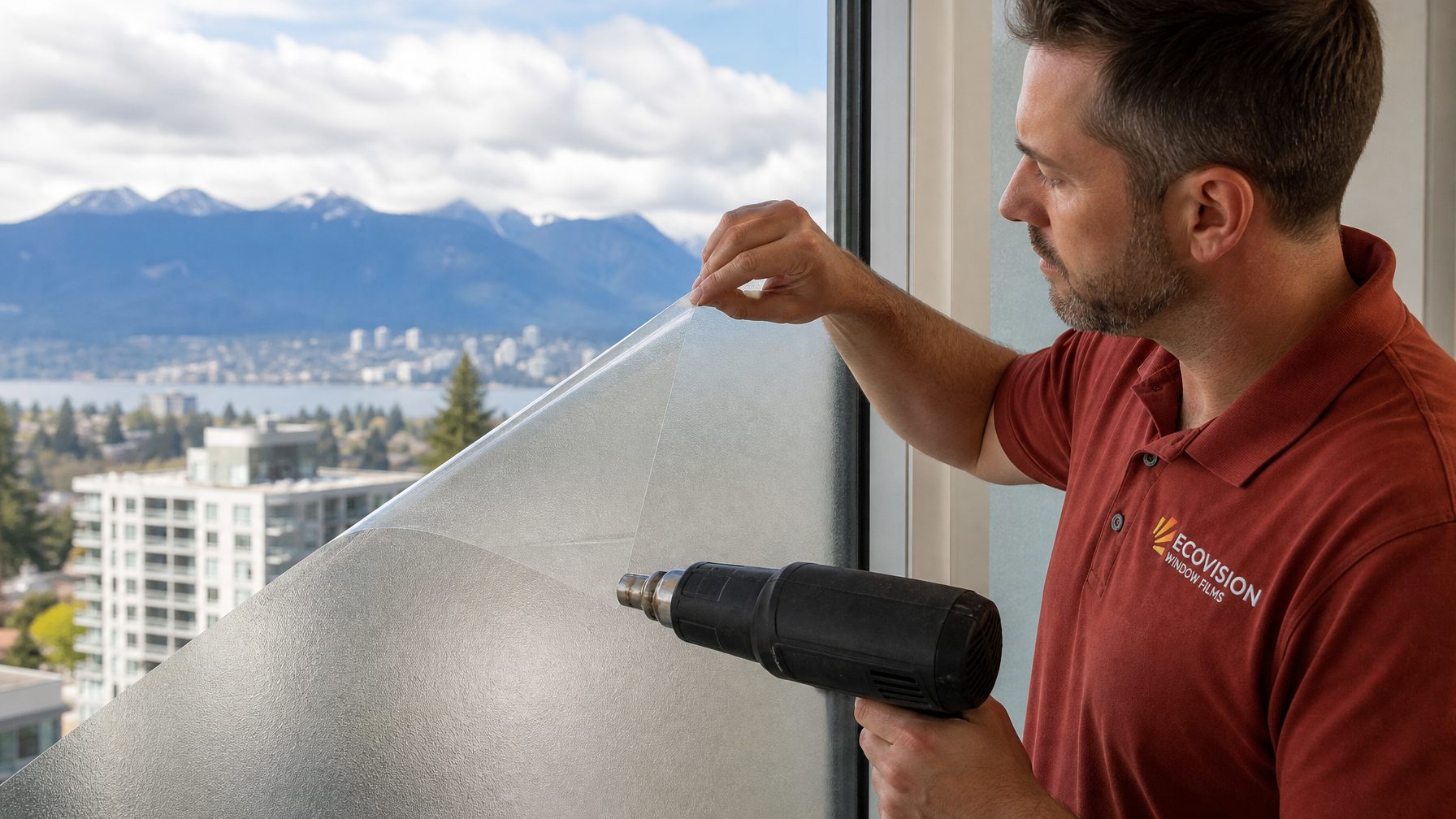
- Apply heat, Hold a hair dryer or heat gun on a low setting 5 to 8 cm from the film surface. Move in slow, sweeping passes for 30 to 45 seconds per section. This softens the adhesive without overheating tempered glass.
- Peel slowly at 180 degrees, Pull the film back over itself parallel to the glass surface, not away from the glass. This reduces adhesive tearing.
- Saturate residual adhesive, Spray the remaining adhesive with a diluted isopropyl alcohol solution (70% IPA in water) and allow it to soak for 3 to 5 minutes.
- Remove adhesive with a lubricated razor, Hold the blade at a 30-degree angle to the glass surface, always moving in the same direction. Never scrub back and forth, this is what causes scratches.
- Clean and inspect, Wipe the glass clean with a microfibre cloth and inspect for any remaining adhesive or light scratching before the glass cools and residue re-bonds.
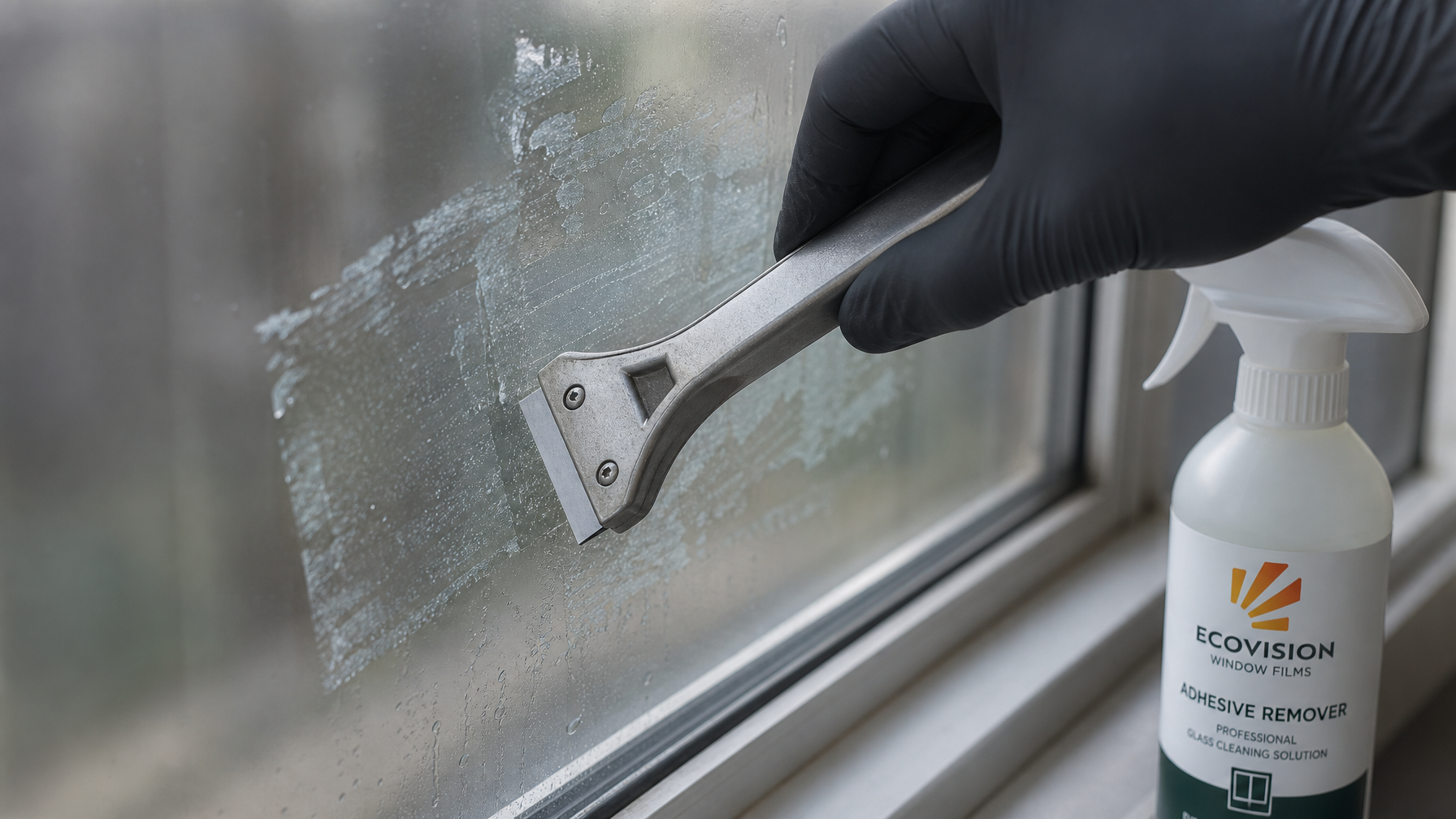
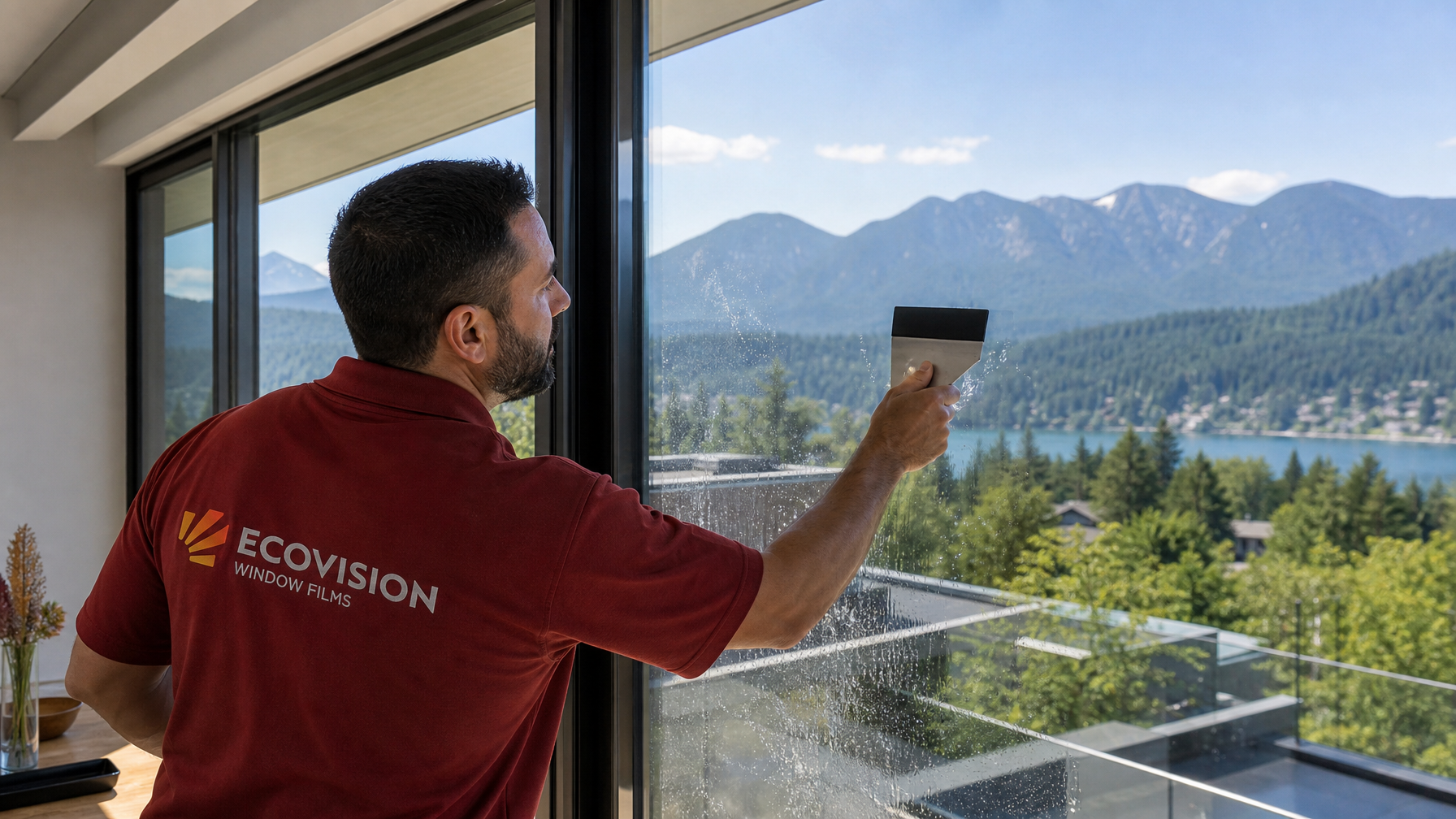
For windows larger than approximately 1.5 square metres, multi-storey access, or any glass with existing coatings, Ecovision recommends professional removal. Our technicians use a commercial-grade steam wand, a method that is significantly faster and more effective than a consumer heat gun, particularly for aged or multi-layer privacy window film.
Should You Remove Privacy Window Film Yourself or Hire a Professional in BC?
DIY removal is reasonable for static-cling film or small sections of professionally installed film under 5 years old on accessible, ground-floor windows. Beyond that, the risk-to-cost ratio shifts toward professional service for most BC property owners.
A scratch on a standard residential window costs $200 – $500 to replace in Vancouver. A scratch on a low-e or triple-glazed commercial unit runs $800 – $2,500 or more. Our removal service at $3 – $8 per square foot typically costs less than one pane replacement, and includes an inspection of the glass condition before work begins.
We recently completed a removal and re-film job at a Rosemary Heights retirement community in South Surrey, where the original decorative privacy film installed in 2012 had developed the adhesive hazing common after 10 to 12 years. The removal required a full steam treatment on 34 windows, and the glass was found to be in good condition once the adhesive was cleared. The building was then re-filmed with LLumar neutral privacy film, maintaining compliance with the facility’s privacy requirements while refreshing the visual appearance of the common-area windows.
How Much Does Privacy Window Film Removal Cost in BC?
Professional privacy window film removal in Metro Vancouver typically costs $3 – $8 per square foot installed, depending on film type, age, access requirements, and whether a cleaning pass is included. Below is a practical breakdown for typical BC property scenarios.
| Scenario | Approx. Area | Estimated Cost Range |
|---|---|---|
| Single bathroom window (frosted film, under 5 yrs) | 0.5, 1 sq m | $75 – $150 |
| Full residential suite (4, 6 windows) | 4, 8 sq m | $250 – $600 |
| Strata corridor or lobby glass partition | 8, 20 sq m | $400 – $1,200 |
| Commercial office floor (full perimeter) | 30, 80 sq m | $1,200 – $4,500 |
| Healthcare facility common-area windows | 20, 50 sq m | $800 – $3,000 |
If you are planning to re-film after removal, Ecovision often bundles removal and installation into a single job, which reduces overall cost versus scheduling them separately. New privacy window film installation in Vancouver ranges from $9 – $14 per square foot for frosted privacy film to $16 – $22 per square foot for dual-function solar-privacy film. For a complete view of current pricing across all film types, see our 2026 BC window film cost guide.
When Does It Make Sense to Replace Rather Than Just Remove?
Removal-only sometimes makes sense, for tenants returning a rental unit to original condition, or for properties where privacy is no longer needed. But in the majority of BC property management situations, the underlying reason for installing privacy film (heat, UV, privacy from neighbouring buildings) has not changed.
In those cases, the better question is whether the existing film can be refreshed or whether a full removal and reinstallation with an upgraded product is warranted. Film technology has advanced considerably since the early 2010s, current LLumar and Vista privacy films offer substantially better UV rejection (99% UVA/UVB versus 75 to 85% for older generation films) and significantly improved optical clarity at the same privacy level.
Ecovision’s technicians assessed a Bentall 4 office building in downtown Vancouver where reflective one-way privacy film installed in 2009 had developed a metallic discolouration visible from the lobby. The decision to remove and replace with a current-generation LLumar neutral film not only resolved the visual issue but improved visible light transmission by 12%, brightening the interior without sacrificing daytime privacy.
Related Articles
- Privacy Window Film in Vancouver: Types, Costs, and What to Know Before You Install
- Frosted Window Film in Vancouver: Types, Costs, and What to Know Before You Buy
- How to Remove Window Film Without Damaging Your Windows
- How to Remove Frosted Window Film Without Damaging the Glass
- How Much Does Window Film Cost in BC? (2026 Pricing Guide)
Frequently Asked Questions
About the Author: This article was written by the Ecovision Window Films team. Edward, Director at Ecovision, brings a distinctive perspective to the window film industry, with over a decade in real estate development, including roles as Executive Director at a real estate development firm and Director of Strategic Partnerships, before joining Ecovision. That background gives the company a sharp edge in serving BC property managers and building owners. Ecovision is a certified installer for leading film brands with completed projects for healthcare facilities, government buildings, and commercial properties throughout the Lower Mainland. For a free site assessment, call (236) 862-0052 or visit ecovisioncanada.com/contact/.