
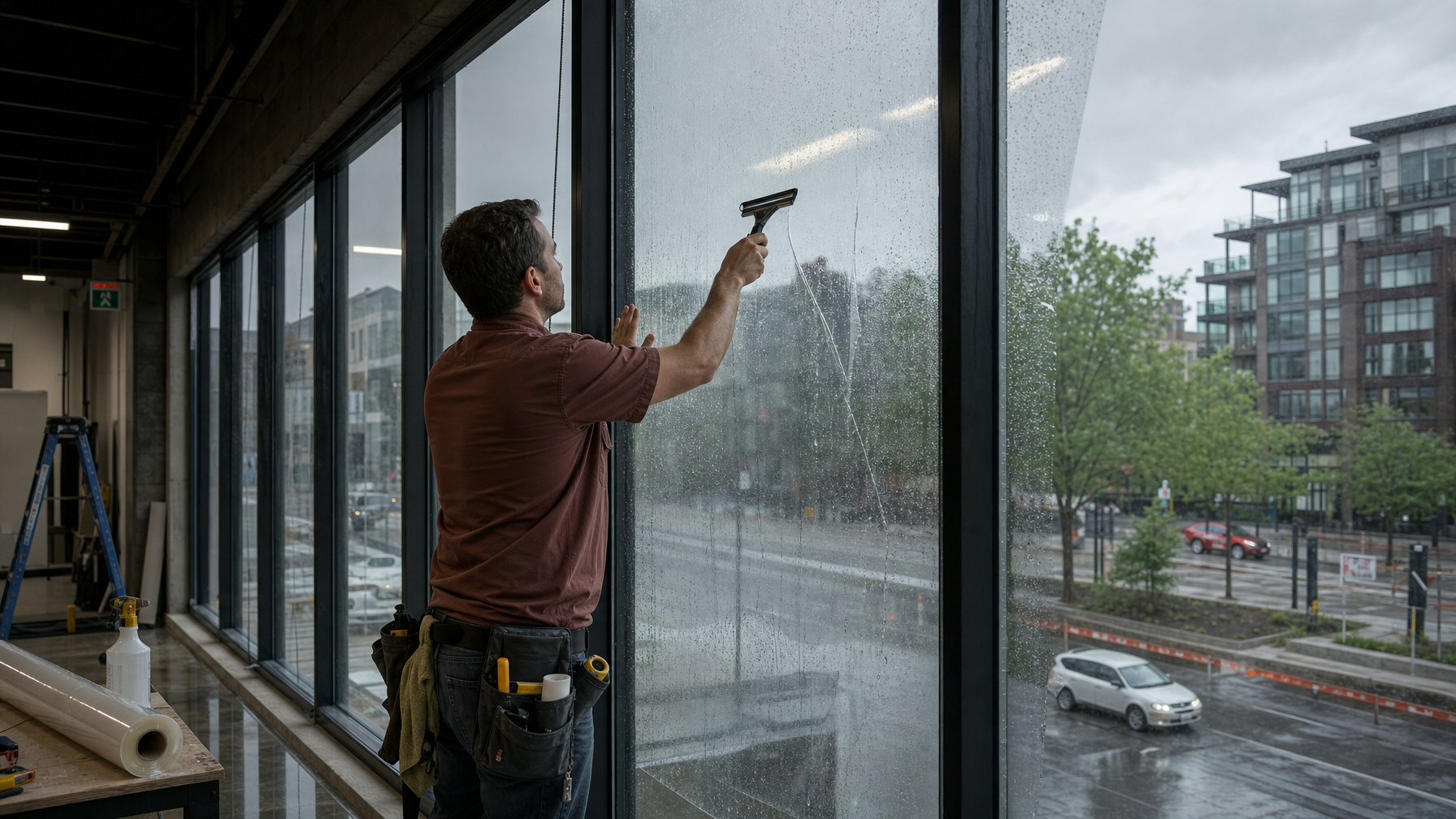
Window tinting for Vancouver townhouses is one of the most cost-effective upgrades a strata owner can make, and one of the most misunderstood. Townhouse units across the Lower Mainland face a combination of ground-level privacy exposure, intense south- and west-facing solar gain, and UV fading that high-rise condo dwellers simply do not deal with in the same way. Ecovision Window Films installs architectural window film on townhouses throughout Metro Vancouver, from Burnaby and Coquitlam to Surrey, Langley, and Port Coquitlam.
This guide covers window tinting for homes and buildings. Ecovision does not tint vehicles, for architectural glass only.
What Is Window Tinting for Townhouses, and Does It Actually Work?
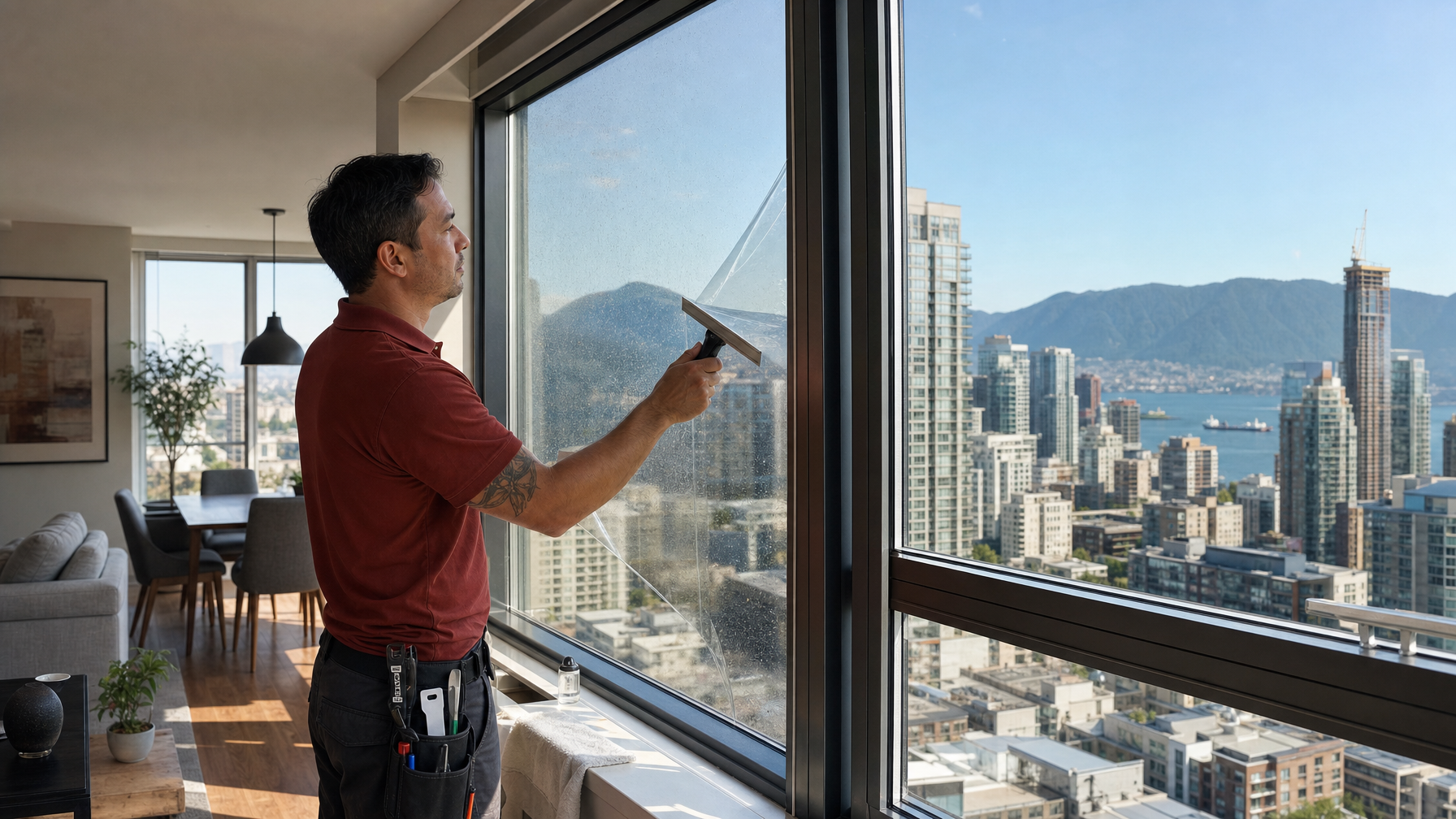
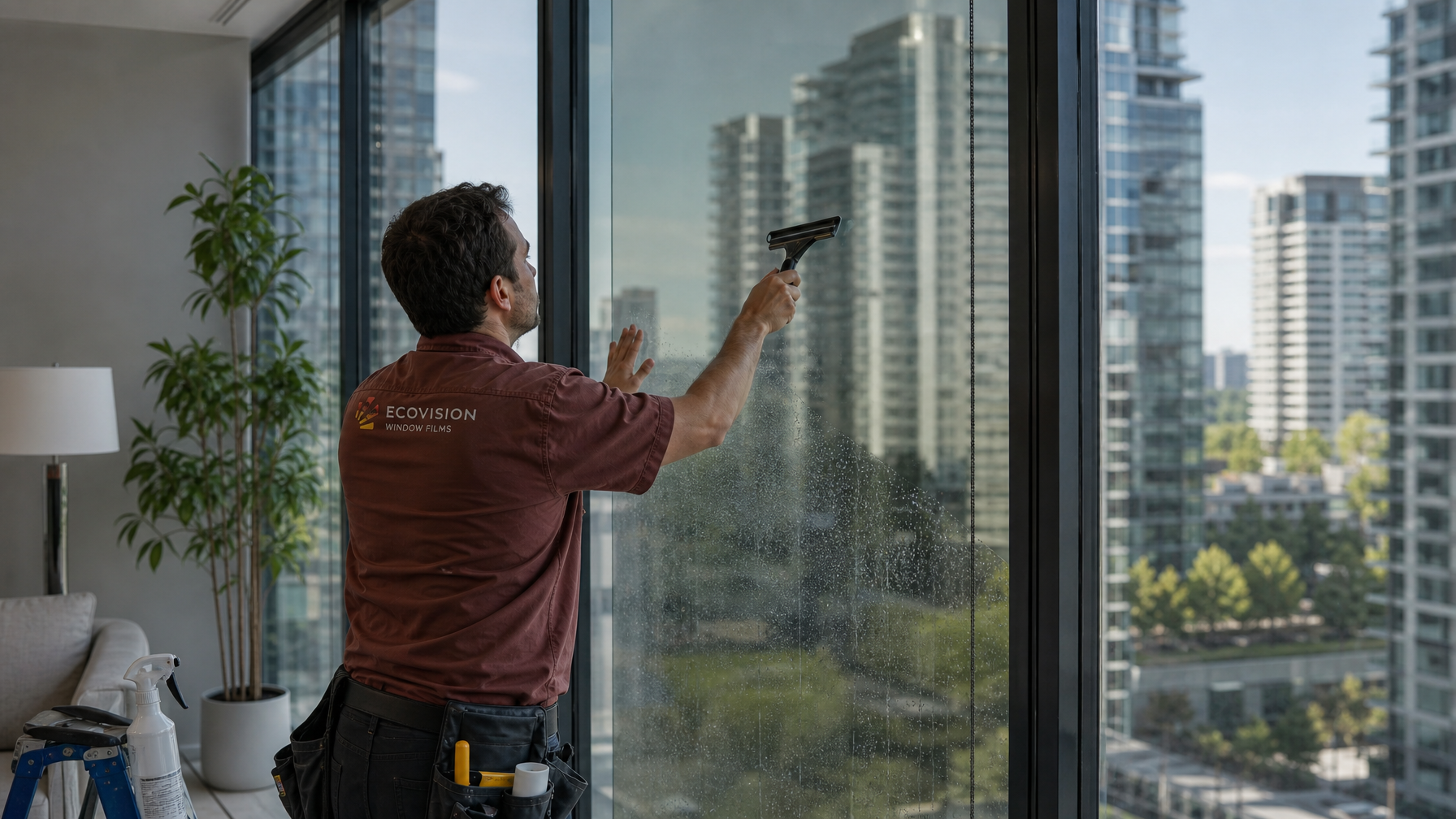
Window tinting for townhouses in Vancouver means applying a thin polyester film to the interior face of existing glass. Professionally installed solar control film can block 40 – 80% of solar heat gain, reject up to 99% of UV radiation, and, depending on the film chosen, add a degree of daytime privacy without obscuring the view. Ecovision Window Films uses only LLumar and Vista certified films, both of which carry manufacturer warranties of 10 – 15 years for interior residential applications. Installed costs for townhouse projects in Metro Vancouver typically run $10 – $18 per square foot depending on film type and the number of floors requiring access.
The short answer: yes, window tinting works measurably well for townhouses. The longer answer depends on which problem you are trying to solve, heat, UV fading, privacy, or a combination of all three, and whether your strata bylaws require prior approval.

Do You Need Strata Approval for Window Tinting in a BC Townhouse?
In most BC strata corporations, window film applied to the interior surface of a unit window does not require formal strata approval, because it does not alter the common property or the exterior appearance of the building beyond what the bylaw defines as a “significant change.” Under the Strata Property Act, owners are generally free to alter their own strata lot without approval unless the alteration affects common property, a limited common property area, or changes the external appearance of the building in a way restricted by bylaw. However, bylaws vary widely between complexes, and some strata councils, particularly in newer developments with uniform exterior standards, do require written approval before any film is installed.
Ecovision recommends the following three-step approach before booking an installation:
- Review your strata’s bylaws for any language about window coverings, exterior appearance, or alterations to windows.
- If unclear, submit a written request to the strata council describing the film type (e.g., “LLumar solar control film, neutral tone, interior application”) and ask for written confirmation that approval is not required.
- Keep a copy of the strata’s response, your installer will want to see it, and it protects you if the strata later raises a concern.
At Rosemary Heights Seniors Village, a strata-managed residential care campus in South Surrey, Ecovision coordinated directly with the strata management company to specify a film tone that met the building’s exterior uniformity standards, an approach that works just as well for townhouse complexes.
What Are the Best Film Types for Townhouse Windows in Vancouver?
Townhouses present a specific set of glazing challenges that differ from detached homes and high-rise condos. Ground-floor windows face direct pedestrian sightlines. Upper-floor windows often receive intense western afternoon sun from May through September. Sliding patio doors are a persistent heat and privacy problem. The table below maps the most common townhouse concerns to the right film category.
| Townhouse Problem | Recommended Film Type | Installed Cost (per sq ft) | Key Benefit |
|---|---|---|---|
| Afternoon solar heat gain (west/south-facing) | Ceramic solar control film | $14 – $18 | Blocks 60 – 80% solar heat, minimal interior colour shift |
| Ground-floor privacy (daytime) | Dual-reflective or one-way film | $10 – $16 | Exterior view blocked during daylight; interior view maintained |
| UV fading on floors and furniture | Clear UV-blocking film | $10 – $14 | Blocks up to 99% UV with no visible tint |
| Frosted bathroom or sidelight privacy | Frosted / decorative film | $9 – $14 | Full privacy day and night; lets diffused light through |
| Sliding patio door heat + privacy | Dual-function solar privacy film | $12 – $18 | Reduces glare, blocks heat, adds daytime privacy |
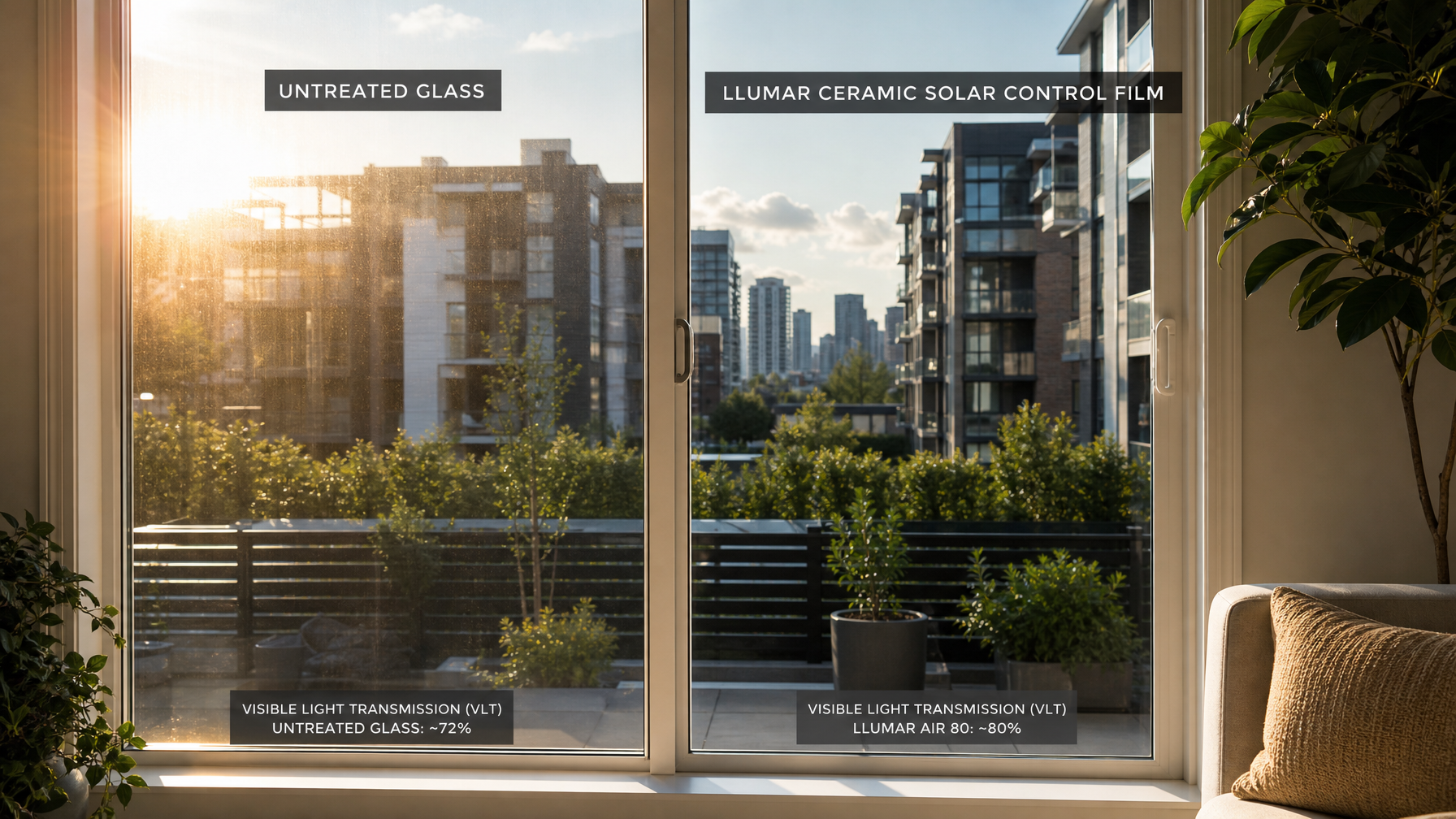
LLumar’s Ceramics Series and Vista’s V-Series Solar films are the two most commonly specified options for Metro Vancouver townhouses. Both films meet the BC Energy Step Code’s passive solar management intent for existing residential buildings, making them a logical complement to any CleanBC home upgrade already in progress.
How Much Does Window Tinting Cost for a Townhouse in Vancouver?
A typical two-storey townhouse in the Lower Mainland has between 180 and 320 square feet of glass, depending on the floor plan and whether there is a patio door or sidelight panels. At $10 – $18 per square foot installed, a full-unit tinting project runs roughly $1,800 – $5,760 for most townhouse configurations. Partial installations targeting only south- and west-facing glass, the most common approach, typically run $900 – $2,400.
Factors that affect the final cost include: number of floors requiring ladder or equipment access, the film specification chosen (standard dyed vs. premium ceramic), whether any glass is tempered or double-laminate (which requires compatibility testing), and the number of patio doors and sliding panels. Ecovision provides free on-site estimates for all townhouse projects, call (236) 862-0052 or visit the contact page.
For comparison: replacing a south-facing double-glazed window unit in Metro Vancouver typically costs $600 – $1,200 per window for glass and installation alone, without meaningfully improving solar heat rejection in an existing double-pane unit. Window film delivers 60 – 80% heat rejection at a fraction of that cost, with no structural work, no strata approval for glass replacement, and no multi-week lead time. For a detailed breakdown, see our guide on window film vs. window replacement in BC.
Does Window Tinting Work on Both Ground-Level and Upper-Floor Townhouse Windows?
Yes, and the application challenges are different for each floor. Ground-floor windows are generally easier to access and are the priority for privacy film because of direct pedestrian sightlines from sidewalks, shared walkways, and parking areas. Upper-floor windows typically face the steepest solar heat gain because of the unobstructed sun angle, making them the priority for ceramic solar control film.
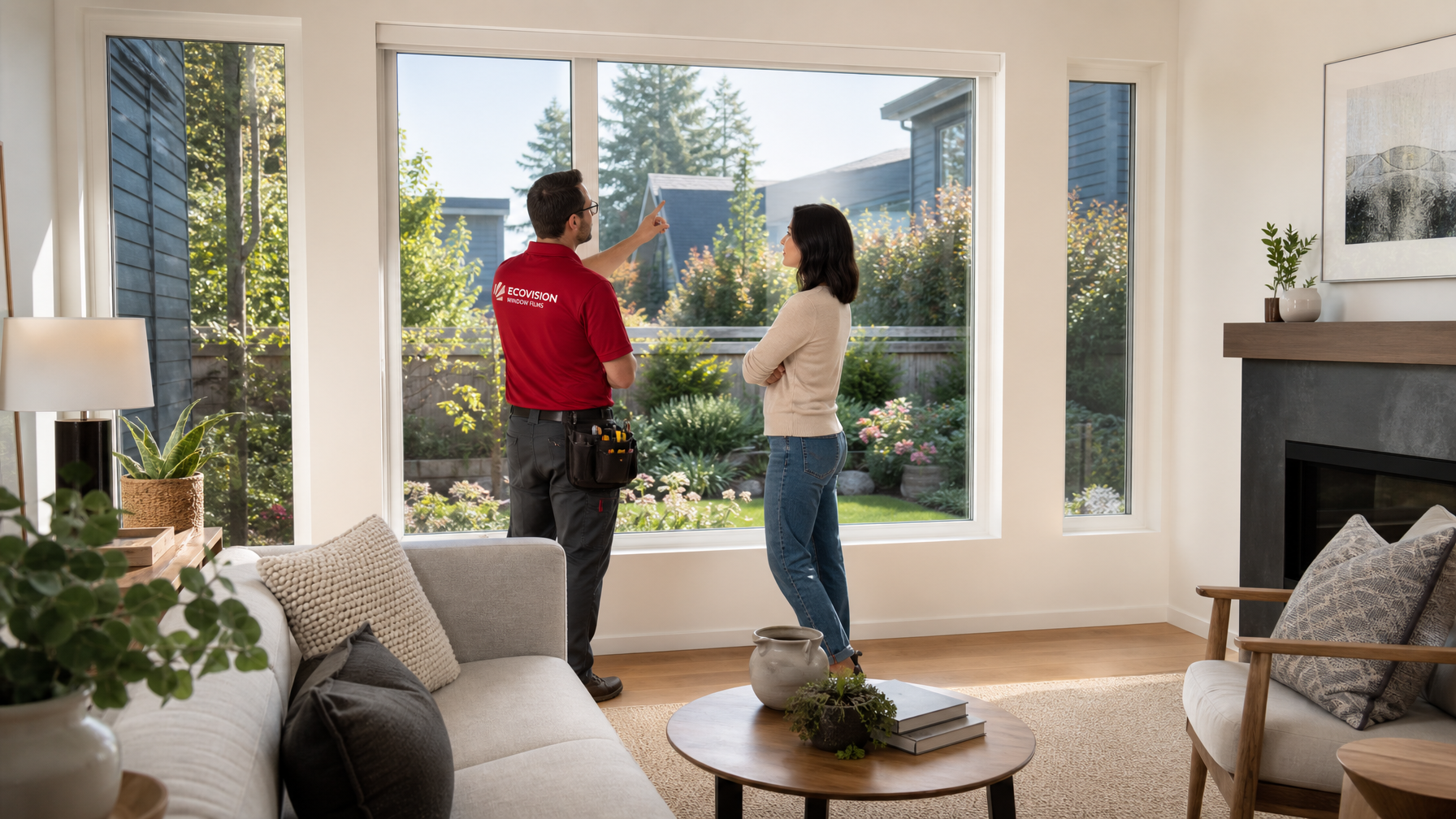
In townhouse complexes with shared exterior walkways or covered breezeways, Ecovision’s installers carry the necessary ladder equipment to reach second- and third-storey units without the full scaffold setup required for high-rise work. Installation on a two-storey townhouse is typically completed in a single day. Upper-floor film installation requires working from inside the unit, which means furniture may need to be shifted away from windows, Ecovision provides specific preparation instructions with every booking.
What Results Have Townhouse Owners Seen in the Lower Mainland?
The most consistent feedback from townhouse owners after window film installation is a reduction in afternoon indoor temperatures of 5 – 8°C on south- and west-facing floors, a meaningful difference in units that lack central air conditioning, which describes the majority of pre-2015 townhouse construction in Metro Vancouver.
At Bentall 4, the 35-storey mixed-use tower in downtown Vancouver, Ecovision installed commercial-grade solar film across multiple floors of south-facing curtain wall glass, a project where pre- and post-installation temperature logging by the property management team confirmed a 6°C average reduction in perimeter office surface temperatures during summer peak hours. While the glazing scale is different, the heat physics are identical to what townhouse owners experience on a smaller scale.
At Windermere Care Centre in Vancouver, Ecovision specified UV-blocking and privacy film for ground-floor resident rooms, an installation that the facility manager confirmed eliminated the need for interior roller blinds on the south wing. That same outcome, eliminating the need for blinds and curtains, is the most common practical benefit townhouse owners report after a full-unit tinting project. View is preserved, glare is reduced, and the unit feels noticeably cooler without adding any load to existing HVAC systems.
For privacy-specific applications, Ecovision’s work on the Guildford area of Surrey, a dense townhouse market, includes multiple residential complexes where dual-reflective film on ground-floor living room and dining room windows resolved long-standing privacy concerns without requiring strata council approval for exterior alterations.
Related Articles
- Window Film for Strata Buildings in Vancouver: What Strata Councils and Property Managers Need to Know
- Window Film for Condo Buildings in Vancouver: What Owners and Strata Councils Need to Know
- Privacy Window Film in Vancouver: Types, Costs, and What to Know Before You Install
- Window Film vs. Window Replacement in BC: Which Is the Better Investment?
- Ceramic Window Tinting for BC Homes and Buildings: What It Is, What It Costs, and Why It Outperforms Standard Film
Frequently Asked Questions
About the Author: This article was written by the Ecovision Window Films team. Edward, Director at Ecovision, brings a distinctive perspective to the window film industry, with over a decade in real estate development, including roles as Executive Director at a real estate development firm and Director of Strategic Partnerships, before joining Ecovision. That background gives the company a sharp edge in serving BC property managers and building owners. Ecovision is a certified installer for leading film brands with completed projects for healthcare facilities, government buildings, and commercial properties throughout the Lower Mainland. For a free site assessment, call (236) 862-0052 or visit ecovisioncanada.com/contact/.