
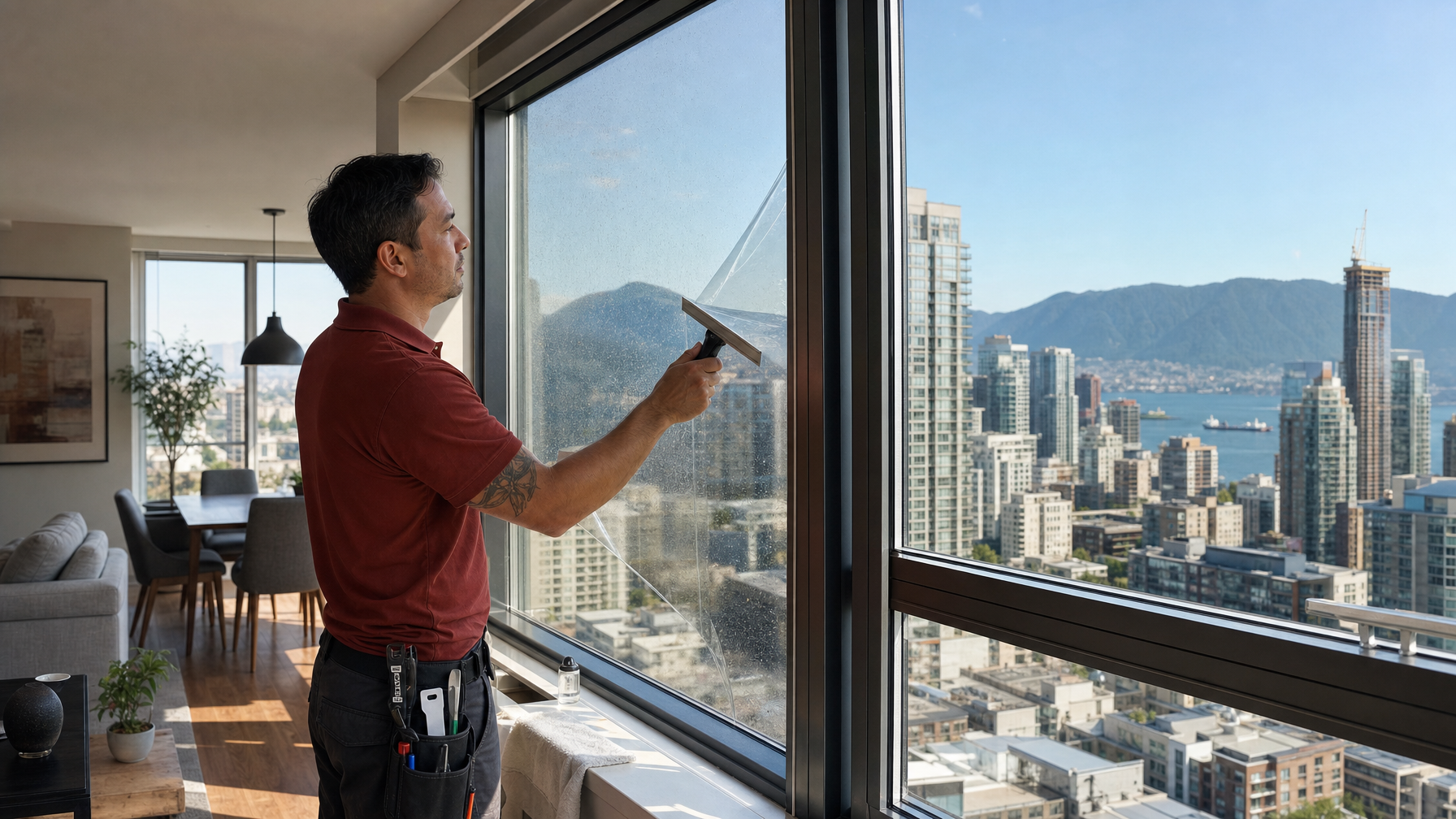
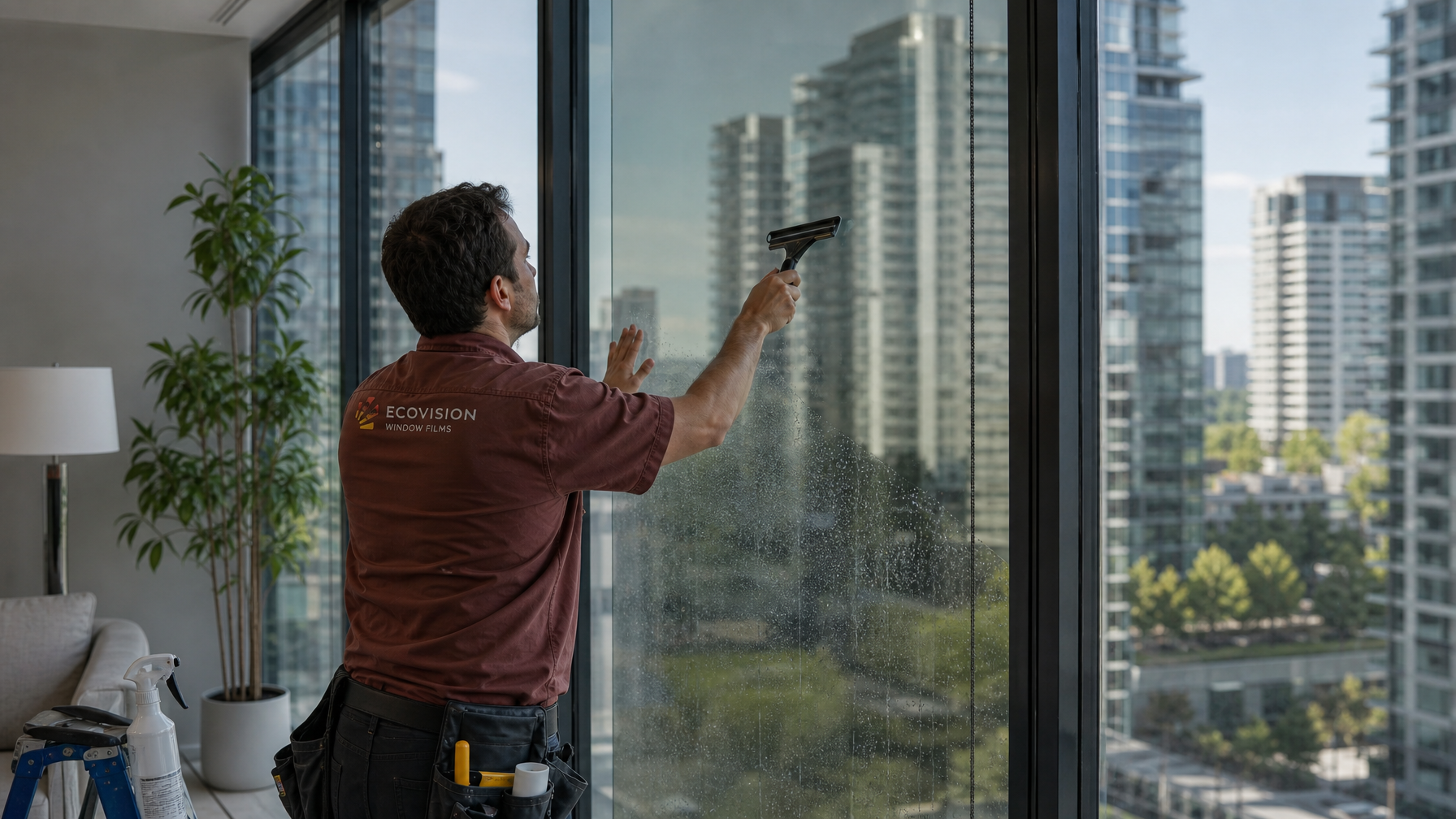
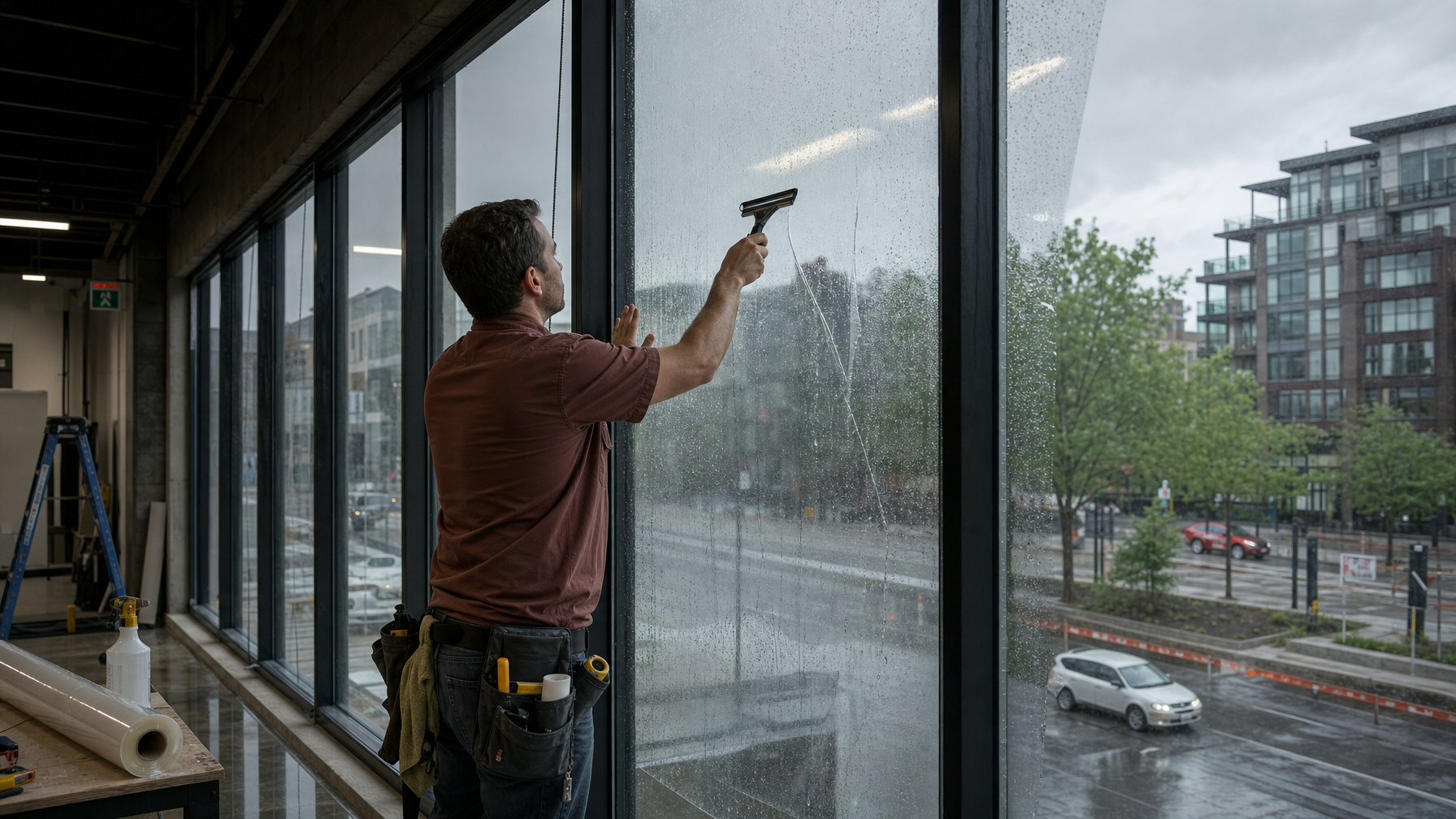
Heading illustration: an AI-generated decorative design concept, not a completed Ecovision project.
Frosted window film creates privacy by diffusing the view through glass while continuing to admit natural light. It is commonly used on office partitions, healthcare rooms, bathrooms, entrance sidelights and storefront glazing. Unlike reflective one-way film, frost obscures views from both directions; it does not “reverse” after dark.
The right choice depends on how much visibility must be blocked, whether full or partial coverage is appropriate, the desired design and branding, and the actual glass surface. Ecovision installs LLumar and Vista decorative films for residential and commercial projects across Vancouver and the Lower Mainland.
What Frosted Window Film Does
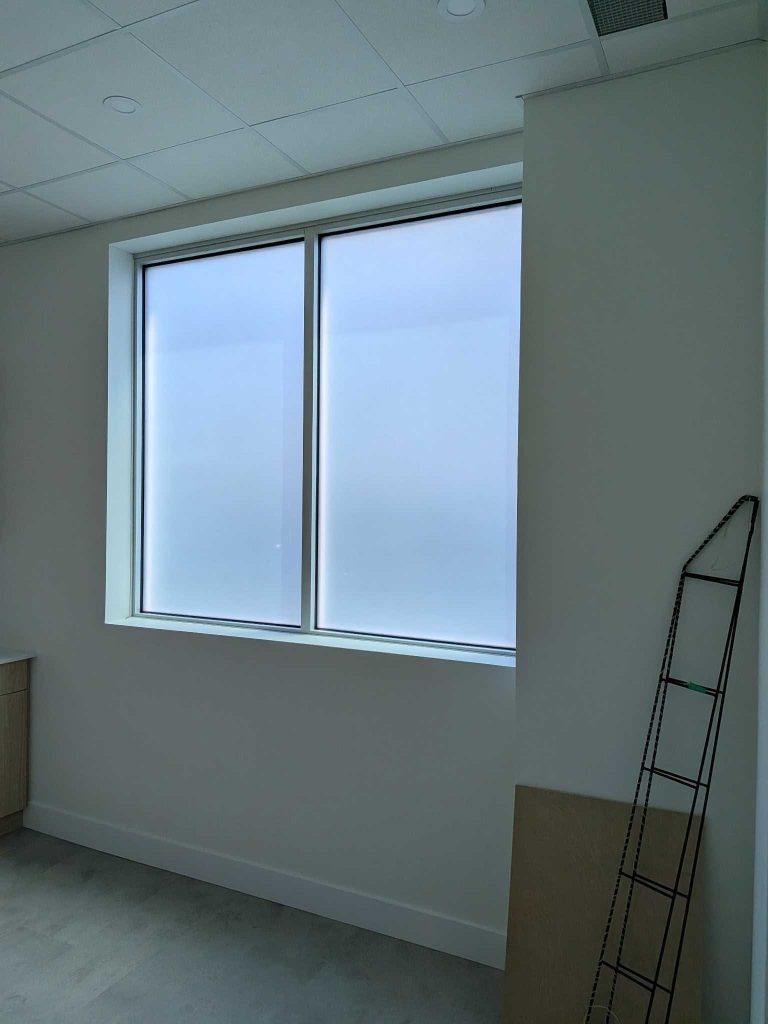
Frosted film is a translucent architectural film applied to smooth glass. Its finish scatters light and softens detail, creating the appearance of etched or sandblasted glass without permanently altering the pane. LLumar describes matte, coloured and textured frost options that can be selected for different light and privacy requirements.
| Film style | Best suited to | Design consideration |
|---|---|---|
| Matte frost | Bathrooms, doors, office partitions and sidelights | Clean, consistent diffusion across the covered area |
| Patterned or textured frost | Feature glass, hospitality and decorative applications | Privacy varies with the clear and printed areas |
| Gradient frost | Meeting rooms and collaborative spaces | Can preserve sightlines above or below the privacy band |
| Custom-cut graphics | Commercial branding and wayfinding | Artwork, line thickness and viewing distance affect the result |
Does Frosted Film Provide Privacy at Night?
Frosted film continues to diffuse views in both directions at night, but privacy is not absolute. Strong backlighting can reveal silhouettes, movement or objects close to the glass, especially with lighter or patterned products. Spaces needing sensitive visual privacy should use a higher-privacy frost, appropriate coverage and a physical window treatment where necessary.
This behaviour is different from reflective one-way film, whose privacy depends heavily on which side is brighter. If nighttime outward visibility matters, compare the options in our one-way window film guide.
Where Frosted Film Works Best in Vancouver
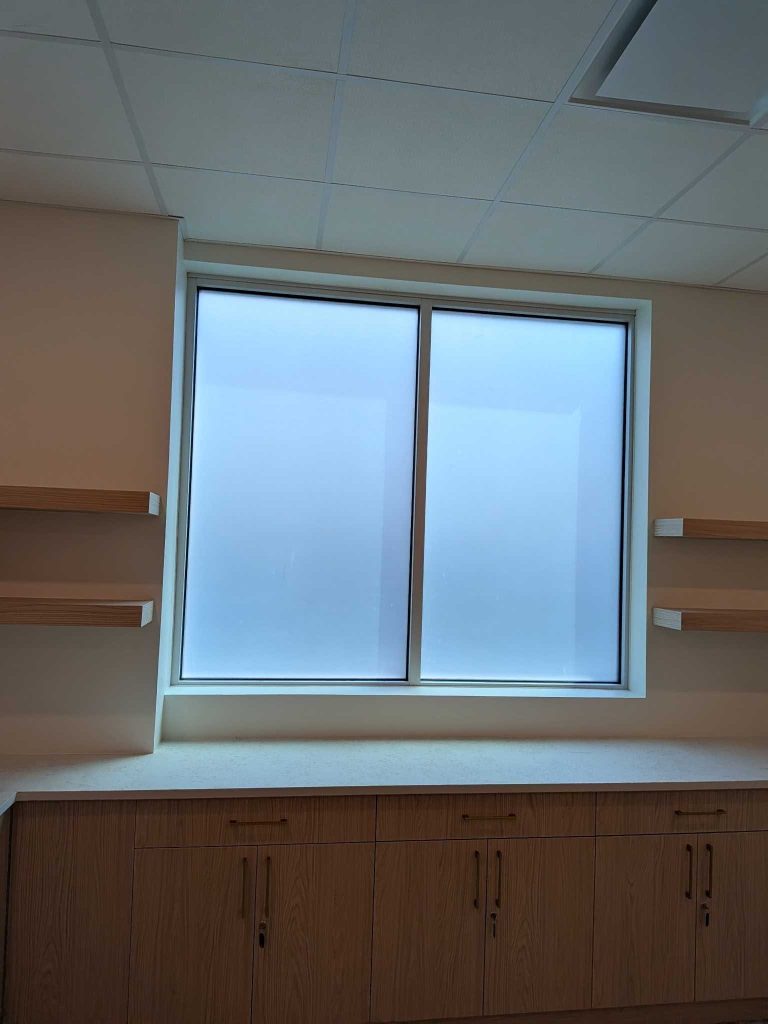
- Offices: boardrooms, phone rooms and partitions that need daylight with seated privacy.
- Healthcare and senior living: consultation rooms and glazing where visibility must be carefully controlled.
- Residential: bathroom windows, entry sidelights and neighbour-facing glass.
- Retail and hospitality: partial storefront coverage, branding and concealed back-of-house areas.
- Leased premises: reversible privacy and graphics without replacing the glass.
Frosted Film Cost: What Actually Changes the Price?
A reliable installed price requires measurements and a product selection. The total changes with film series, coverage, pattern or custom cutting, glass access, surface condition, edge finishing, removal of existing film and installation scheduling. For that reason, this guide does not promise one universal square-foot rate.
- Standard matte film is generally simpler than gradients or custom-cut graphics.
- Small panes may carry more edge-finishing labour per square foot.
- High or difficult-to-access glass can require additional equipment and coordination.
- Existing adhesive, film or surface contamination must be assessed before installation.
- Commercial work may require mockups, phased access and after-hours installation.
See the BC window film cost guide for the factors that apply across film families, then request a measured quote for the actual glass.
Film Versus Etched or Sandblasted Glass
| Consideration | Frosted film | Etched or sandblasted glass |
|---|---|---|
| Changeability | Can be removed and replaced | Permanent alteration or replacement |
| Branding | Supports custom-cut graphics and gradients | Possible, but generally more difficult to revise |
| Installation disruption | Usually installed on existing glass | May require fabrication or glass replacement |
| Surface care | Use film-safe cleaning methods | Cleaning depends on the finished glass surface |
Glass Compatibility and Installation
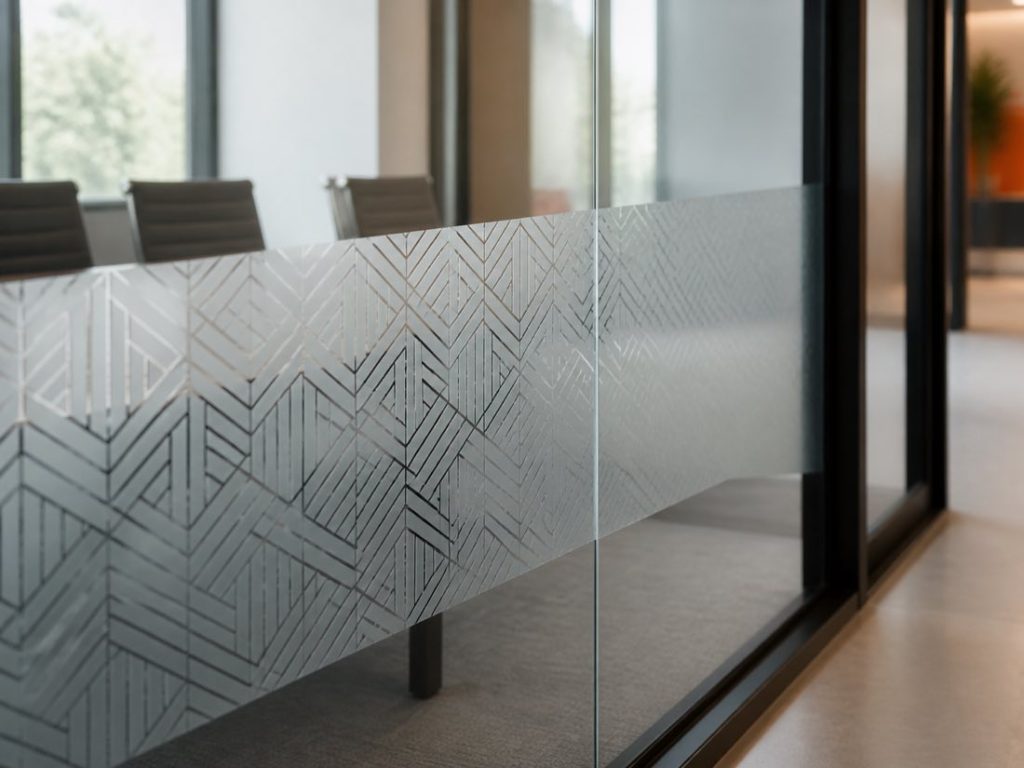
Decorative film is designed for smooth, compatible glass. An installer should confirm the glass condition, coatings, seals, edge clearance and whether the film belongs on an interior or exterior surface. Textured, damaged or contaminated glass may not be suitable. A sample or mockup is valuable when privacy level, colour or branding is important.
- Confirm the privacy and design requirement at the actual viewing distances.
- Select the coverage height, film style and any clear bands or graphics.
- Inspect and prepare the glass without damaging coatings or seals.
- Install, trim and squeegee the film, then allow the adhesive and remaining moisture to cure.
- Review cleaning instructions and inspect the finished edges.
Commercial Frosting and Branding
Commercial projects often need more than generic privacy. Coverage can be positioned at seated eye level, graduated from opaque to clear, or cut with logos and wayfinding. For office partitions and business-specific planning, see our commercial window frosting guide.
Frequently Asked Questions
Can you see through frosted window film?
Fine detail is obscured, but silhouettes or nearby movement may remain visible depending on the film, lighting and distance from the glass.
Does frosted window film work at night?
Yes, it continues to diffuse views from both directions. Strong interior lighting can still reveal silhouettes, so sensitive spaces may need a higher-privacy product or an additional window treatment.
Can frosted film be removed?
Most architectural decorative films can be removed from suitable glass. Removal difficulty depends on product age, adhesive, heat exposure and glass condition.
Can a logo or pattern be added?
Yes. Frosted film can be custom cut for logos, privacy bands, gradients and wayfinding, subject to artwork and installation requirements.
Sources: LLumar frosted film and LLumar commercial decorative film.
Guide prepared by Edward Zhang. Product availability and suitability must be confirmed for the actual glass and project.