One Cooling Compliance Plan for Your Whole Portfolio
The City requires owners to maintain at least one living space in each occupied rental unit at an average of 26°C or below overnight from April 1 to October 31. Ecovision evaluates window-film options as one part of a building-specific cooling plan.
What the New Westminster Cooling Bylaw Requires
What changed, and what it means for occupied rental units across your portfolio.
26°C
The cool-room rule
One living space per occupied rental unit must average 26°C or below between 8 p.m. and 8 a.m., from April 1 to October 31.
Owner
Owner’s responsibility
Owners must maintain it, and can’t block tenants’ own cooling devices.
CA$200 to CA$750
Daily fines are possible
The City says tickets may be issued daily when voluntary compliance has failed or stalled.
Plan
Documented plan
The city works with owners on a compliance plan. Have yours ready first.
The bylaw exists because 33 New Westminster residents died in the 2021 heat dome. This isn’t paperwork, it’s a life-safety standard.
The City Lists Window Film as One Cooling Option
, City of New Westminster, June 9, 2026
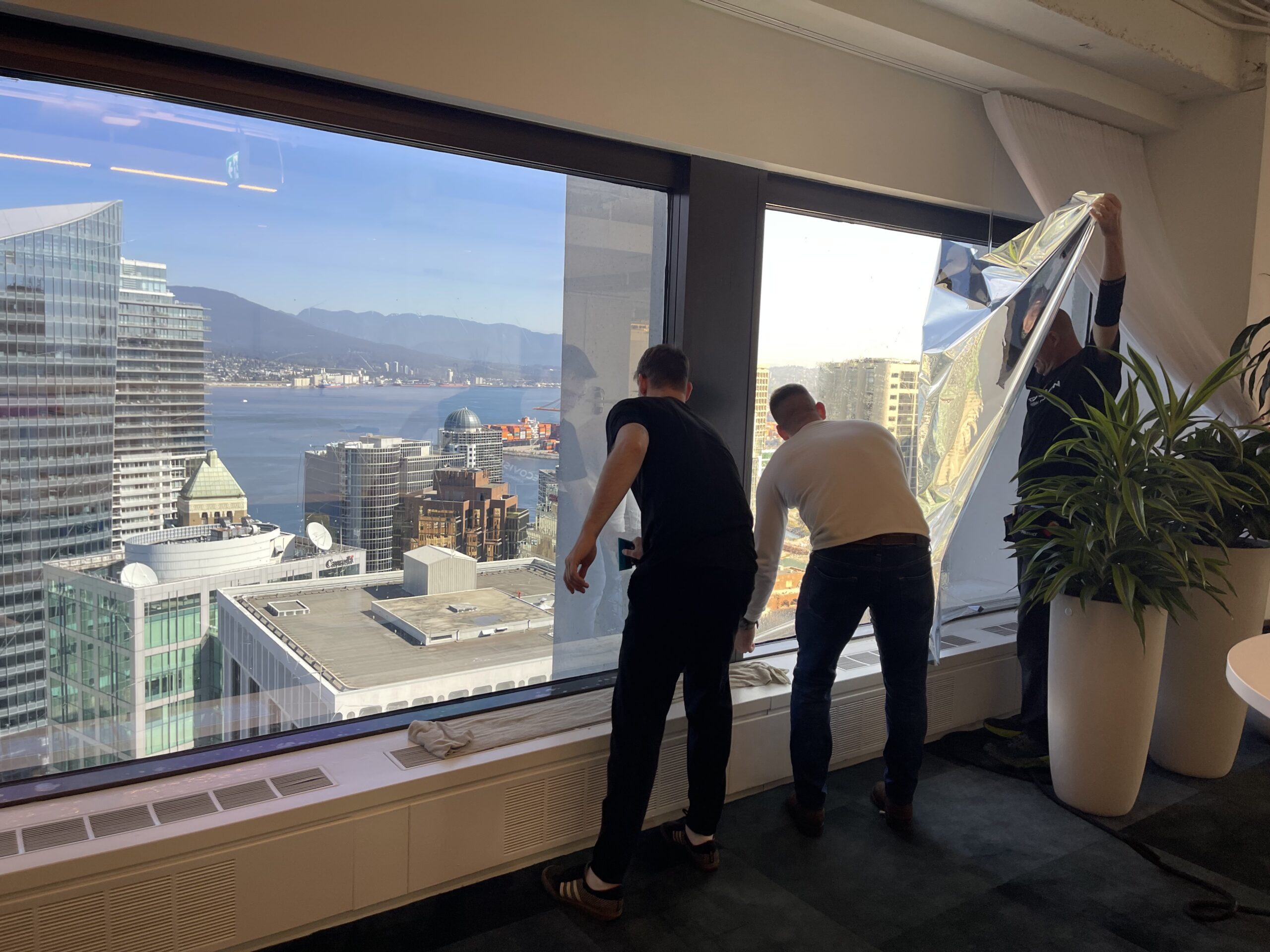
Window film is one City-listed option that reduces solar heat gain at the glass. The right plan may combine film with curtains, fans, air sealing, or mechanical cooling.
The Ecovision Cooling Assessment
The City encourages owners to conduct a cooling audit and choose measures that fit each building. Ours documents glazing exposure, risk areas, and practical options for owner review.
Facade survey
Worst-exposure walls and glazing documented.
Risk mapping
Hottest units flagged before complaints start.
Heat modeling
Peak temp, with film vs. bare glass.
Ranked plan
Interventions ordered by cost-effectiveness.
Compliance report
A one-pager you can show the city.
Compliance Tonight vs. Compliance Forever
Portable AC alone
- Works on mild nights
- Struggles in heat-dome, top-floor units
- Ongoing power cost, every unit, every summer
Window film + plan
- Reduces solar heat gain at the glass; performance depends on film and glazing
- Can reduce cooling load; verify results by unit and combine with active cooling where needed
- Passive after installation; performance depends on glass, exposure, and selected film
The smart move: film for the building, with AC as a bridge for the worst unit.
Every Measure the City Lists, How Each Performs
We install film, but we’ll tell you the truth about every option.
| Measure | How it works | Best for | Limits |
|---|---|---|---|
| Window film | Reduces solar heat gain at the glass; product-specific data determines heat and UV performance. | Passive solar-control option for suitable glazing. | Upfront cost; pair with AC for worst units. |
| Thermal curtains | Interior barrier after light hits the glass. | Cheap, tenant-controlled comfort. | Tenant-dependent; weak in extreme heat. |
| Portable AC | Active cooling, vented out a window. | Immediate relief for one room. | Ongoing power; struggles vs. solar load. |
| Ceiling fans | Air movement; +2, 3°C “feels-like”. | Cheap comfort when occupied. | No real temp drop; empty rooms unaffected. |
| Standing fans | Circulate air; night flushing. | Very low cost. | Comfort only; tenant-managed. |
| Air sealing | Weatherstrip to cut hot-air leaks. | Boosts other measures; helps winter. | Modest alone; ignores solar gain. |
| HVAC filter cleaning | Restores airflow where systems exist. | Quick win with central HVAC. | Only if the building has HVAC. |
We’ve Solved Heat Compliance in Care Facilities for Years
New Westminster extends to rentals a duty senior-living and healthcare operators have met since 2021, and we’ve done that work.
Highest-stakes buildings
Senior-living and extended-care facilities where heat resilience is a duty of care.
Compliance-driven cooling
Planned and installed to healthcare safety standards, with documentation and measurable results.
That standard, for you
The bylaw is new for rentals. The problem isn’t new to us.
Trusted Across Metro Vancouver
“It’s made my home more comfortable by reducing heat, blocking UV, and adding privacy without sacrificing light, with lower energy bills and a sleek look.”





Flexible Ways to Start
01
Complimentary Assessment
Free on-site cooling & solar-heat assessment with a compliance summary to keep.
02
Pilot Study
Film one high-exposure unit; measure before/after before you commit.
03
Sample Install
See and feel the difference on your own glass.
04
Phased Installation
Worst units first; roll out across budget cycles.
New Westminster Cooling Bylaw, FAQ
What does the New Westminster cooling bylaw require?
Under Business Regulations and Licensing (Rental Units) Bylaw No. 6926, at least one living space in every occupied rental unit must not exceed an average of 26°C between 8 p.m. and 8 a.m., annually from April 1 to October 31.
Does window film qualify as a compliance measure?
Yes. In its June 9, 2026 announcement the City of New Westminster names window film among the accepted ways to reduce indoor temperatures. Film cuts solar heat gain at the glass, building-wide and permanently, with no ongoing energy cost.
What happens if a building does not comply?
The City lists daily fines of CA$200 to CA$750. Bylaw Services says it will work with owners on a compliance plan with appropriate timelines when voluntary compliance is progressing.
Is a portable AC enough on its own?
A portable AC may be one solution, but the owner remains responsible for maintaining the required temperature. The right mix of passive and active measures depends on the unit and building.
How do we get started?
Book a free Ecovision Cooling Assessment. We map each building’s risk and give you a documented compliance plan. Flexible options include a pilot study, a sample install, and a phased rollout across your portfolio.
Book Your Free Portfolio Cooling Assessment
We’ll map each building’s glazing and heat risk, then provide a clear, costed options plan for owner review. This assessment is not a City certification or legal opinion.
Or call us directly:
(236) 862-0052
Request your free assessment
Tell us your building type and postal code, we’ll be in touch to schedule.

Ecovision Window Films Corp, BC’s certified LLumar & Vista installer. Solar control, privacy, security and bird-safe film.
© 2026 Ecovision Window Films Corp. All rights reserved.
This page summarizes the City of New Westminster’s cooling bylaw for general information and is not legal advice. Refer to the city’s official resources for the authoritative requirements.